StudyTexter · Academic AI
Best AI for writing essays in 2026: compare top tools, see pros and cons, and learn why StudyTexter is built for full academic papers with real sources.
Up to 95% cheaper than traditional ghostwriting · Better than ChatGPT for full academic papers · Plagiarism-free and AI-evasion optimized.





In this guide, I’ll compare the best AI tools for writing essays (features, pricing, and how “human” the output feels after light editing). We’ll also share how we approach essay drafts at StudyTexter — transparently: our output is meant as a draft / template, not something you should submit 1:1.
How to read this table
| Criteria | StudyTexter  |
ChatGPT | Grammarly | Paperpal | Yomu.ai | QuillBot | JotBot |
|---|---|---|---|---|---|---|---|
| Our rating |
4.9/5 ✓
|
4.6/5 | 4.5/5 | 4.4/5 | 4.3/5 | 4.1/5 | 4.0/5 |
| Best for |
Full draft +
structure fast ✓ |
Brainstorming, outlines, first drafts |
Editing, clarity, tone |
Academic writing support |
Academic drafting + citations |
Paraphrasing + rewording |
Writing with sources + drafting speed |
| Key strengths |
Fixed-price draft workflow
delivered in 2–4h delivered as PDF + Word positioned as draft/template ✓ |
Best “generalist” assistant strong for ideation + rewrites |
Best for polishing & reducing “AI-ish” stiffness |
Essay outline + academic checks says it won’t write full essays plagiarism checking options |
Built for academic writing citations tools + plagiarism checker |
Strong paraphrase/summarize workflow helps fix awkward phrasing |
Credit-based drafting with sources free plan + “unlimited” tier |
| Pricing (starting) |
€69
(fixed price model) ✓ |
Plus historically $20/mo |
Premium cited as $12/mo (annual) or $30/mo |
Prime starts at $25/mo, $139/yr |
Paid tiers around $11/mo (annual) |
$19.95/mo (cheaper annual equivalents) |
Free or $14/mo billed yearly |
| Authenticity score |
9
✓
|
8 | 8 | 7.5 | 7.5 | 7 | — |
If your biggest issue is:
We built StudyTexter to do exactly that.
Why students care:
We use a fixed-price approach (instead of "tokens" or "per word"), which can be easier to plan for.
Our terms explicitly say the draft must not be submitted/published 1:1 as your own academic work — it's meant for inspiration and development of your own text concept.
Students who want a complete structured starting point (then revise and personalize)
If you want a structured draft quickly and prefer fixed pricing, that's exactly what we built StudyTexter for.
Tailored to your requirements: topic, task description, outline, number of pages, sources, and additional requirements.
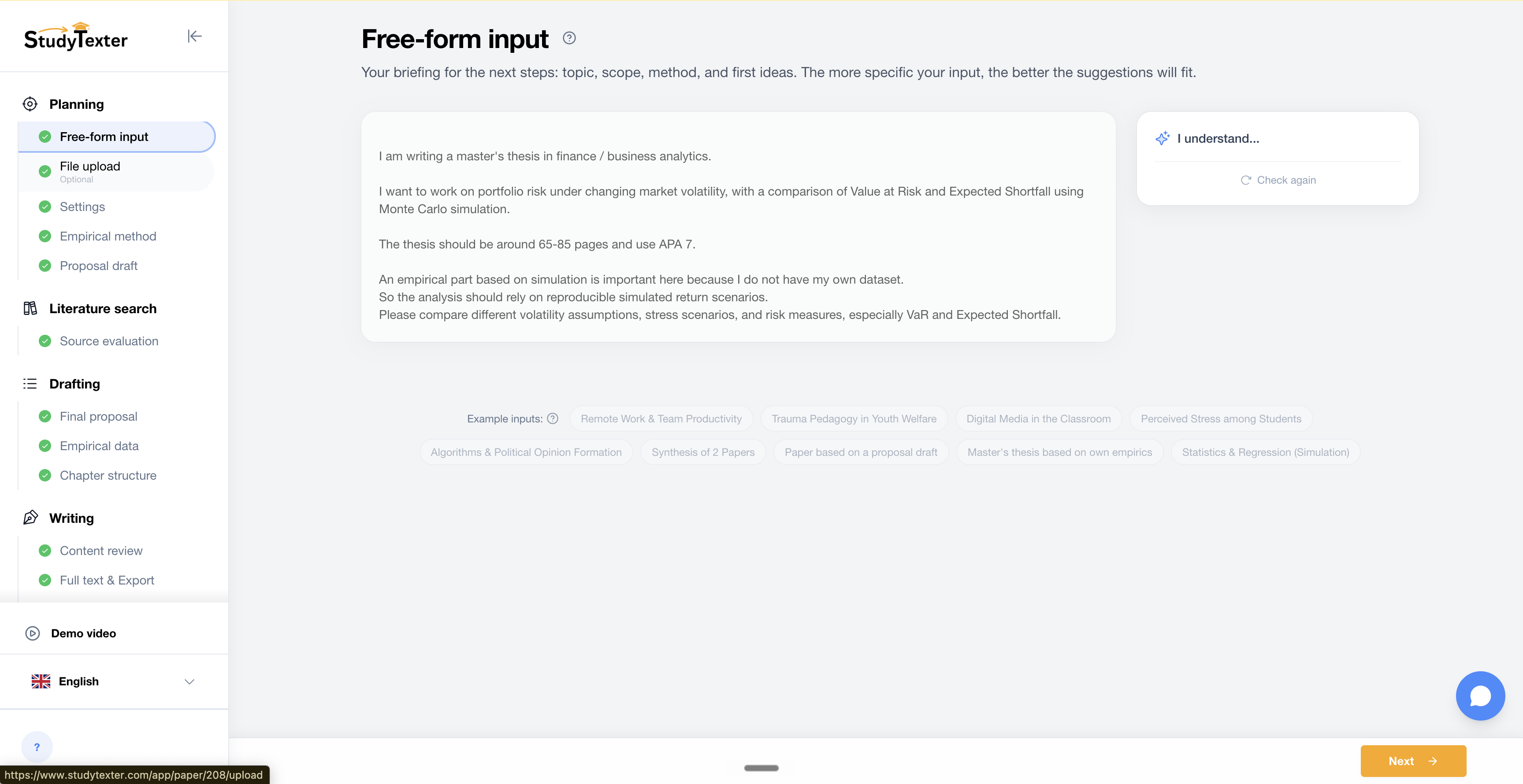
The AI automatically researches Real, verifiable academic sources, plans the paper logically, and creates a well-founded structure.
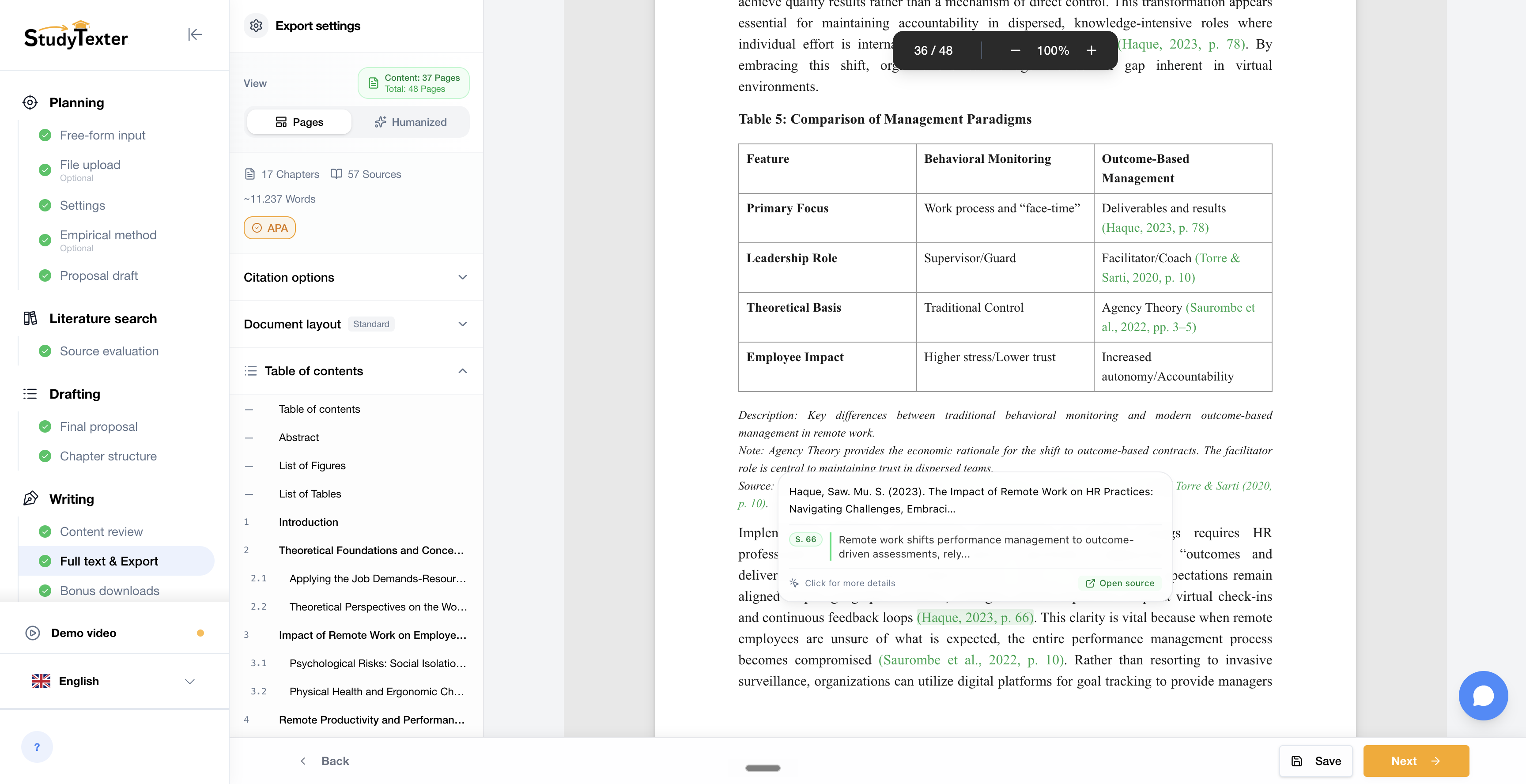
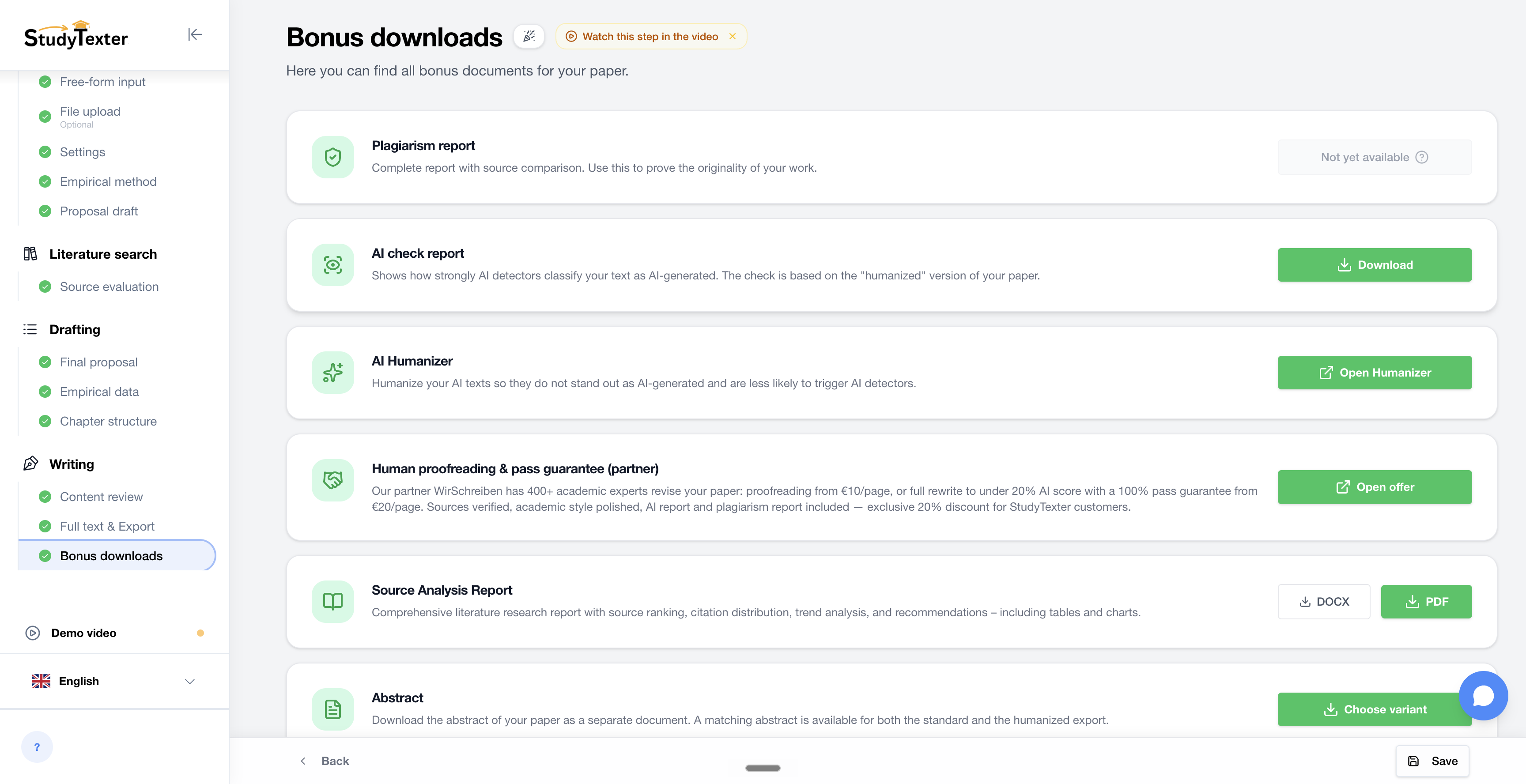
Opened in the StudyTexter editor for review and export, ready for your final edits. Writing (or having written) a paper has never been this easy or straightforward.
| Tool | Pricing | Best For | Strength | Risk / Limitation |
|---|---|---|---|---|
|
ChatGPT Best for brainstorming & flexible drafting |
$20/month (Plus) Free tier available |
|
Conversation: iterate quickly with follow-up prompts
|
⚠ Fake sources / confident inaccuracies without real sources
|
|
Grammarly Best for polishing & reducing "AI stiffness" |
$12/month (annual) $30/month (monthly) |
|
Taking rough paragraphs and making them read professionally
|
⚠ Not a research engine; won't build arguments for you
|
|
Paperpal Best "academic-first" writing companion |
$25/month $139/year |
|
Academic workflow tool that pushes responsible drafting
|
⚠ Will not write entire essays for you (by design)
|
|
Yomu.ai Strong for academic drafting + ethics stance |
$11/month (annual) |
|
More structured academic environment than general chatbots
|
⚠ Less flexible for non-academic use cases
|
|
QuillBot Best for paraphrasing & rewording |
$19.95/month Cheaper on annual plans |
|
Workhorse for making clunky text flow naturally
|
⚠ Over-paraphrasing can make writing feel unnatural
|
|
JotBot Good for drafting with sources (budget-friendly) |
$14/month (annual) Free plan available |
|
Budget-friendly with lightweight workflow
|
⚠ Less feature-rich than premium alternatives
|
Why this comparison often leads students to prefer us (StudyTexter):
Most of the tools above work best in combination (e.g., ChatGPT for structure + Grammarly for polish + a citations tool). That can mean juggling multiple subscriptions and still spending time stitching everything together.
That’s exactly why we built StudyTexter as a more straightforward option: fixed price and fast delivery of a structured draft—e.g., €69 for 5–40 pages, and we state delivery in within a guided workflow.
We still recommend using any AI output (including ours) as a draft/template: review it, personalize it, verify sources, and adapt it to your course rules—because that’s what keeps your work both high-quality and academically safe.
This matters because:
A practical “safe use” workflow
Important (our stance at StudyTexter)
StudyTexter already helps over 53,729+ students simplify their academic work?
Learn moreUse prompts that help you think and write, not prompts that try to outsource the whole assignment.
There isn’t one universal “best”—it depends on what you mean by essay writing: research + citations, planning/structure, drafting in a specific tone, or polishing. A practical approach is to use a research tool that shows sources (so you can verify claims) and a writing model that’s strong at structure and revision. Perplexity, for example, emphasizes answers with citations you can check.
If you want an essay workflow (topic → outline → paragraphs → revision) instead of a general chatbot, with Studytexter we focus on guiding you through the essay process step by step—so you keep your voice and logic consistent.
Both can be excellent, but they often “feel” different: one may sound more natural in long-form prose, the other may be stronger as an all‑purpose assistant with lots of tooling and plan options. The most reliable way to decide is to test the same prompt + rubric (tone, structure, citations, clarity) in both and compare outputs.
If you’re deciding based on plans and limits, both publish tiered pricing (free + paid options), so cost can be a deciding factor too.
Sometimes Claude or Gemini will be better for a specific writing style or workflow; other times ChatGPT will be better. One objective signal you can check is public leaderboards like LMArena (Text Arena), which ranks models via large-scale user preference voting (but it’s still not the same as “best for your essay”).
ChatGPT is one of the strongest all‑round options, but “best” depends on your use case:
It’s consistently near the top, but “best right now” changes fast. On LMArena’s Text Arena leaderboard, models’ ranks can shift and different models may lead depending on category and time.
For essays, “best” usually means best for your workflow: research accuracy + structure + your preferred writing voice.
“Smarter” isn’t a single thing. Some models may rank higher on certain leaderboards or excel at certain tasks (style control, reasoning, coding, long context). A credible way to compare is to look at independent leaderboards (like LMArena) and then run your own test prompts.
For most writing tasks, GPT‑4o is a strong default because OpenAI positioned it as faster and cheaper than GPT‑4 Turbo, and (per OpenAI) it matches GPT‑4 Turbo performance on English text/code while improving other language performance and speed/cost.
Also, OpenAI’s own model guidance recommends using newer models like GPT‑4o rather than older GPT‑4‑family options.
Older GPT‑4 models can still produce strong writing, but OpenAI generally recommends newer models (like GPT‑4o) for most use cases today.
In practice, essay quality comes more from your outline, sources, and revision than from picking one model generation over another.
If your essay workflow lives in Google Docs, Gemini’s integration can be a big advantage for drafting, refining, and summarizing directly where you write.
ChatGPT is typically chosen as a flexible general assistant across many tasks and formats (and can be paired with research tools). A good approach is: research with citations, then draft and revise in your preferred writing environment.
They’re “best” for different jobs:
If you want one tool built specifically for essays, with Studytexter we focus on the essay workflow (planning → structure → revision) so you don’t have to “invent the process” every time.
Yes-for brainstorming, outlining, restructuring arguments, improving clarity, and polishing style. The limitation is that it can still produce vague or overly confident text if your prompt and source material are weak.
A great pattern is: you provide a clear thesis + bullet outline + sources → the AI helps refine structure and wording → you verify and finalize.
Yes-many writers use AI for idea generation, rewrites, and editing. The best results usually happen when the writer already has a clear point of view and uses AI as a collaborative editor, not as the author.
It can generate original phrasing, but that doesn’t guarantee the result is “safe.” You still need to:
Sometimes it’s detectable in the sense that it can look “AI-ish,” and some institutions may use AI evasion and Humanizer tools. But detection is imperfect, and many schools focus more on authorship evidence (drafts, sources, and your ability to discuss the work) than on a single detector score.