Plagiarism check
Check your document for possible plagiarism before you submit. Review every match with its source and decide what to cite, rewrite or leave as it is.
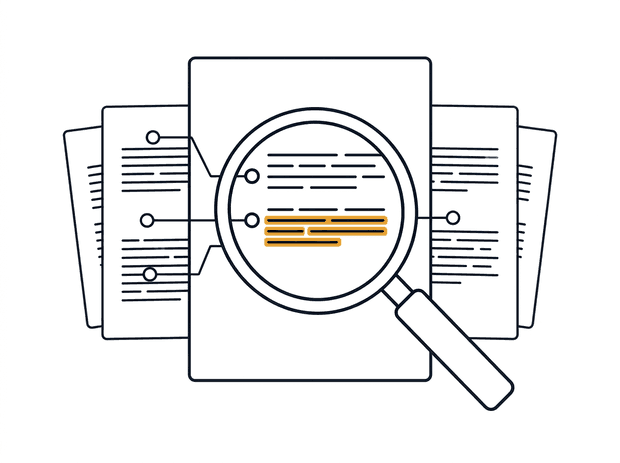
Start with your document
You upload your essay, paper or thesis in the StudyTexter app and get the full report back with every source.
Check for plagiarismYour file is transferred securely. It is removed from our upload storage after a completed plagiarism check, or if you do not start payment within 7 days.


 4.9 / 5over 103,974+ happy customers
 eKomi Gold Sealfor excellent customer reviews
Already trusted in Germany
StudyTexter comes from Germany. These are the certifications, associations and press from our home market.
Certified quality

TÜV certified

Dr. Jonathan Schulte is a certified EU AI Act officer
Member of

Recommended by

Independent report
Click the logo for the article from 23 January 2025
Reading the result
A match is not automatically plagiarism. A correctly referenced quotation, a bibliography entry and a standard academic phrase all show up as matches, which is why every passage is shown next to the source it came from.
A percentage describes overlap, not intent
The similarity figure says how much of your document matches sources that were found. What that means depends entirely on which passages are involved — ten percent of correctly cited quotations and ten percent of uncredited text are the same number and two different situations.
Every match is shown with its source
The report lists the sources it found with their links and their share of the document, and highlights each matching passage where it sits in your text. You can open the source and compare the wording before you change a single sentence.
Quotations and references are separated out
The report marks detected quotations and references as their own categories, and the academic filters keep them out of the similarity score. That is what stops a properly sourced literature review from reading as a problem.
No comparison sees everything: a clean report is evidence that nothing was found, not proof that nothing exists, and it does not replace the check your institution runs after you submit. The report gathers the facts about your document. The judgement stays with you and with the rules of your institution.
Where it fits
One check for academic work in English, whatever your department calls the document. The report is the same whether you are handing in a term paper in the United States or a dissertation in India.
Essays and term papers
Short work goes through the $14.99 package. Useful before a deadline where reused phrasing from lecture notes and readings is easy to miss.
Research papers
The comparison covers the web and document sources, so reused passages from your own earlier publications show up as well.
Master's thesis and dissertation
The longest and most closely reviewed format. Up to 100,000 words per check, with the complete list of sources that were found.
Assignments and lab reports
Method sections and standard definitions repeat across a cohort. The report shows you which of those overlaps carry a source and which do not.
PhD chapters
Check chapter by chapter or in one pass up to the 100,000-word limit per document.
Web content and articles
Passages taken from a company page, a documentation site or a competitor come back with the URL they match.
How it works
Three steps, in this order: you upload the document, you confirm the package that matches its length, and then you read the report. Nothing in your text is changed along the way.
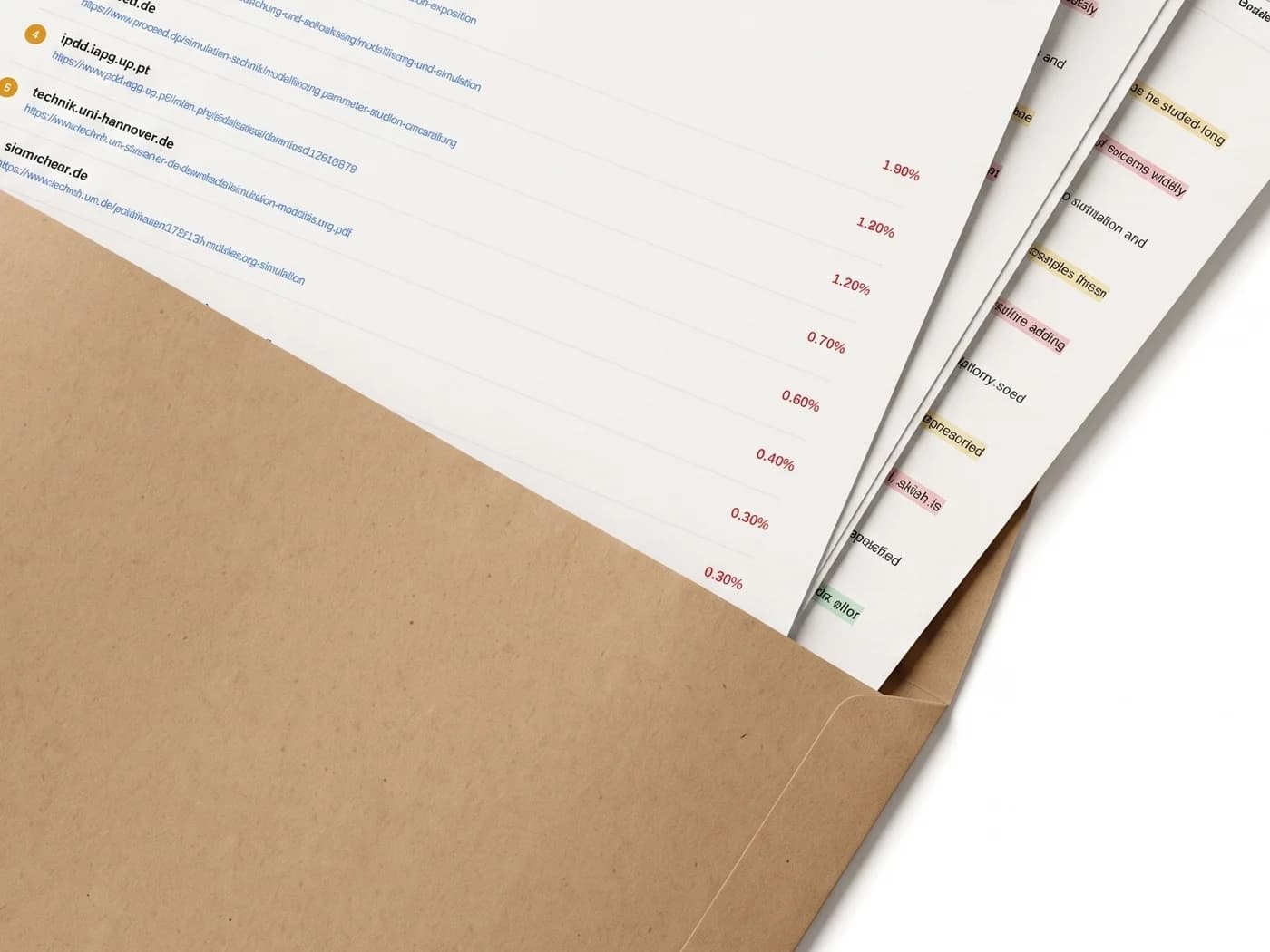
Upload document
Upload your essay, paper or thesis in the app. Up to 20 MB, 100,000 words and 18 supported formats, including PDF, DOCX and ODT.
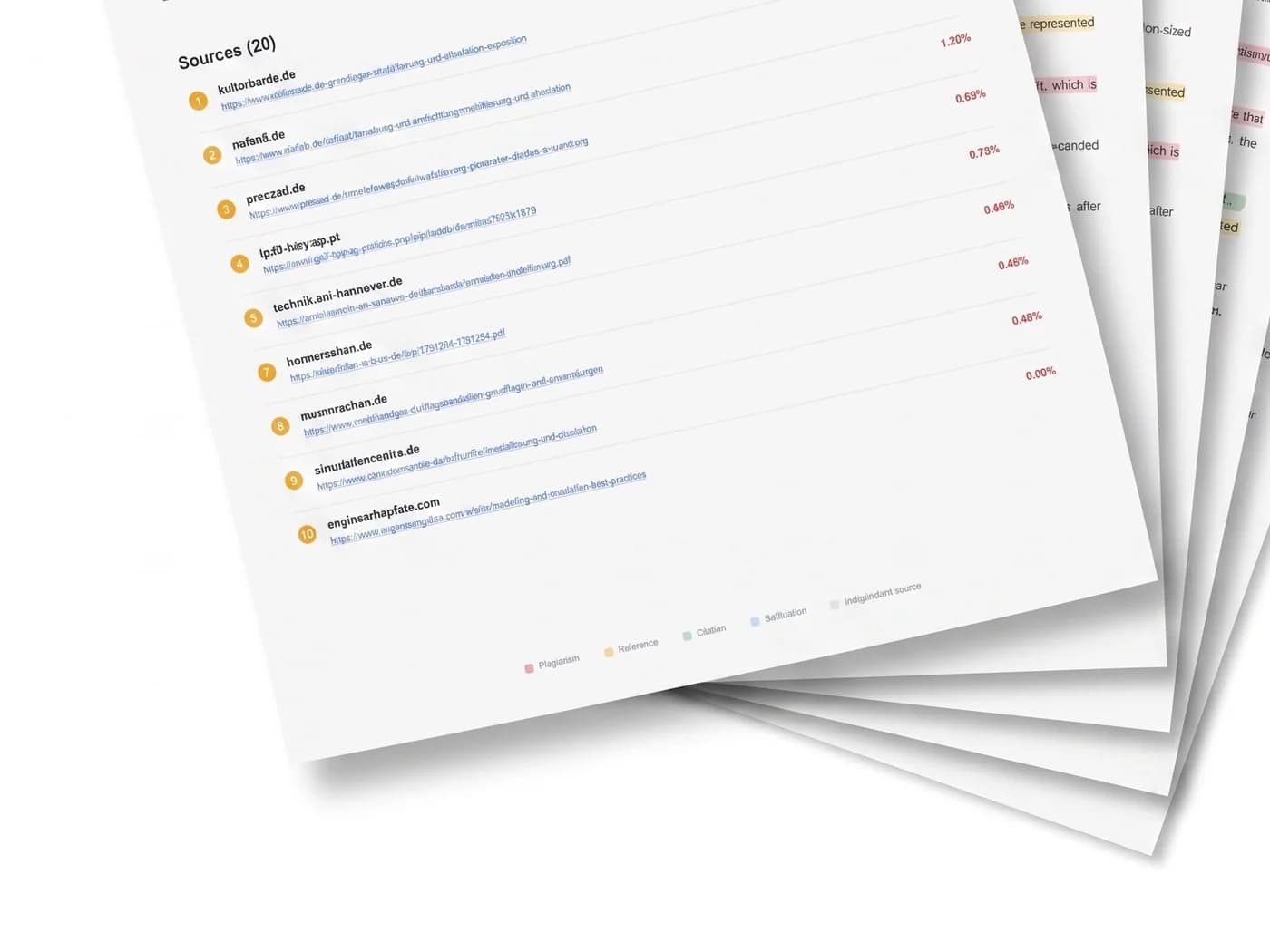
Confirm package
The words are counted after the upload and the matching package is selected automatically: $14.99 up to 7,499 words, $24.99 up to 49,999 words, $34.99 up to 100,000 words. One-time payment, no subscription.
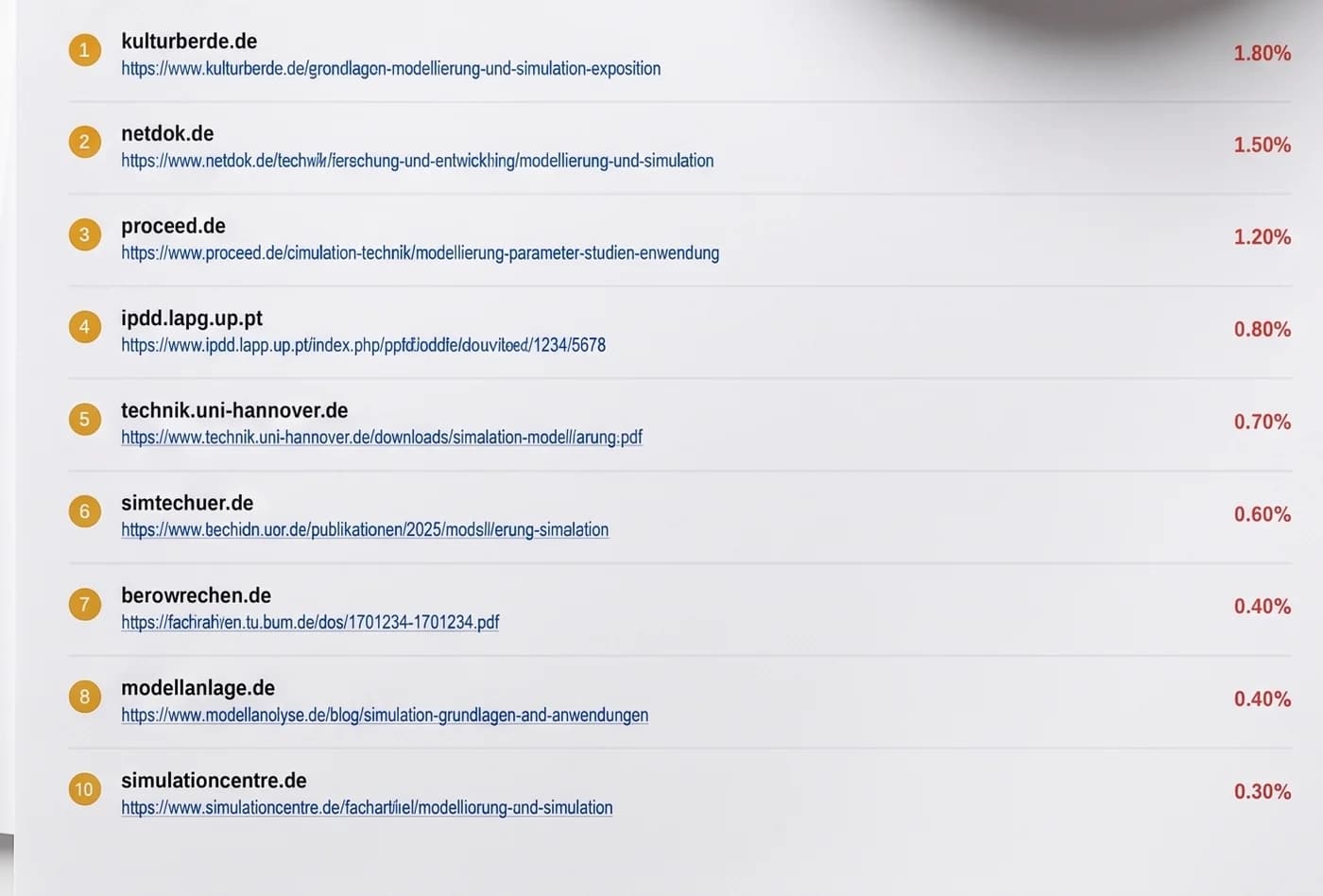
Receive plagiarism report
You get the complete report: originality, matches, the list of sources with their share, and every highlighted passage where it sits in your text. Then you decide what to cite, rewrite or leave alone.
Inside the report
The report is more than a percentage. It names what matches, where it came from and where it sits in your document, so that the decision stays yours.
One report, five levels of readingStart at the originality figure and work down to the individual passage. Each level answers a different question.
| Report element | What you see | The question it answers |
|---|---|---|
| Originality | The share of the document that matches none of the sources found. | How much of this text is my own? |
| Matches | The overall similarity figure, broken down by match category. | How large is the overlap, and how close is it? |
| Sources found | The list of sources with their URL and their share of the document. | Where does each match come from? |
| Highlighted passages | Every flagged passage in place in your text, with the source it belongs to. | Is this a quotation, a reference, or something I need to fix? |
| Search settings | The engines, databases and exclusions the comparison ran with. | What was this document actually compared against? |
None of these elements passes judgement for you. The report assembles the facts; the interpretation belongs to you and to your institution.
Price and protection
The package follows the length of the document, not a subscription. You see the price before you pay, and you pay once.
Compact analysis
Up to 7,499 words
Essay, term paper, short report.
$14.99per plagiarism check
Standard analysis
7,500 to 49,999 words
Master's thesis, research paper, long assignment.
$24.99per plagiarism checkFits most documents
Extended analysis
50,000 to 100,000 words
Dissertation and long-form research.
$34.99per plagiarism check
One-time payment. No subscription, no automatic renewal.
Protected upload
The document is transferred securely and is used for your plagiarism check only.
Automatic deletion
The file is removed from our upload storage after the check, or at the latest if no payment is started within 7 days.
Never published
Your work is not published, not resold and not added to a database that third parties can search.
Looking for a free plagiarism checker? Free tools usually limit the length of the text, the range of sources compared and the detail of the report. StudyTexter is paid, and it delivers the complete report with every source and highlighted passage from $14.99.
Academic integrity
Most flagged passages are not misconduct. They are the three ordinary ways a citation goes missing while you write, and each of them has a straightforward fix.
A quotation without quotation marks
Copying an author's exact wording is fine as long as it is marked as a quotation and attributed. Without the marks, the same sentence reads as your own. Put the wording back in quotation marks and add the reference.
A paraphrase that stayed too close
Swapping a few words for synonyms and keeping the sentence structure is still the original author's work. Either restate the idea in your own structure and cite it, or quote it directly. An idea taken from a reading needs the reference even when no wording was copied.
Reusing your own earlier work
Handing in a passage from your own previous paper without saying so counts as self-plagiarism at many institutions. Cite your earlier work the way you would cite anyone else's, and check your programme's rules.
Fixing a flagged passage means citing it correctly or rewriting it honestly. Rephrasing text purely to make a checker stop flagging it does not make the work yours, and it is not what this report is for.
Two different checks
Both examine your text and neither answers the other's question. A plagiarism check compares your text against existing sources; an AI detector guesses at how the text was produced.
| Plagiarism check | AI detection | |
|---|---|---|
| Question asked | Does this text come from existing sources? | Does this text look like it was produced by AI? |
| Method | Comparison against the web and document sources | Analysis of language patterns typical of AI |
| Result | Matches, each with the source it came from | A probability, offered as an indication |
| Where citations come in | Detected quotations and references are marked as their own categories | Not covered — attribution is a separate question |
| What it does not show | Not whether a text was written with AI | Not who actually wrote the text |
Attribution is the third thing in this list and the one you control directly: a source is either credited or it is not. StudyTexter keeps the plagiarism check separate from AI detection on purpose — mixing two scores into one number would make both unreadable.
Frequently asked questions
A plagiarism checker compares your document against sources it can reach — web pages and document databases — and reports the passages that match, together with the source each one came from. It does not decide whether something is plagiarism. It shows you where to look.
Free tools exist, but they almost always limit the length of the text, the range of the comparison and the detail of the report. StudyTexter is not free: the check is a one-time payment from $14.99, and it delivers the complete report with the list of sources and every flagged passage in place.
No checker can promise complete accuracy, and any tool claiming it should be treated with suspicion. A comparison finds what is reachable in the sources it searches. It can miss material behind a paywall or offline, and it can flag ordinary academic phrasing that nobody copied. That is why every match in the report is shown next to its source instead of as a bare number.
It is the share of your document that matches sources that were found. It is a signal, not a verdict. A report at eight percent made up of correctly cited quotations is in better shape than one at three percent where a single uncredited paragraph carries the overlap.
That depends on your institution, and the rules differ widely — some programmes allow AI assistance if you declare it, others prohibit it outright. It is also a separate question from this check: a plagiarism check compares your text against sources, it does not detect how the text was produced. Check your programme's policy, and declare what it asks you to declare.
Plagiarism is primarily an academic and professional integrity matter, handled by the rules of your institution or publisher, not by a court. It can overlap with copyright infringement when protected material is reproduced, but the two are not the same thing and the consequences differ. This is general information, not legal advice — for a specific situation, ask your institution.
Open the source next to the passage and decide which of three things it is: a quotation that needs quotation marks and a reference, a paraphrase that stayed too close to the original and needs restating plus a citation, or a passage that already carries its source and can stay as it is. Rewriting text only to make a checker stop flagging it hides the problem instead of fixing it.
18 formats are supported: PDF, DOC, DOCX, XLS, XLSX, PPT, PPTX, PPSX, ODT, ODS, ODP, TXT, RTF, XML, EPUB, HTML, HTM and ORG. The limit is 20 MB and 100,000 words per document.
No. The check reads your document and changes nothing in it. Your work is not published, not resold and not added to a database that third parties can search, and the file is removed from our upload storage after the check, or at the latest if no payment is started within 7 days.
No. Your institution runs its own check after you submit, against its own sources and its own rules, and often keeps the result on file. This check happens before that, on your initiative, and the report belongs to you. It does not predict or replace your institution's result.
Check your document before you submit
One-time from $14.99 · no subscription · file removed after the check


