StudyTexter · Academic AI
College essay AI can help you move from rough ideas to a stronger draft. See limits, risks and how StudyTexter keeps structure, sources and review in one workflow.
Up to 95% cheaper than traditional ghostwriting · Better than ChatGPT for full academic papers · Plagiarism-free and AI-evasion optimized.
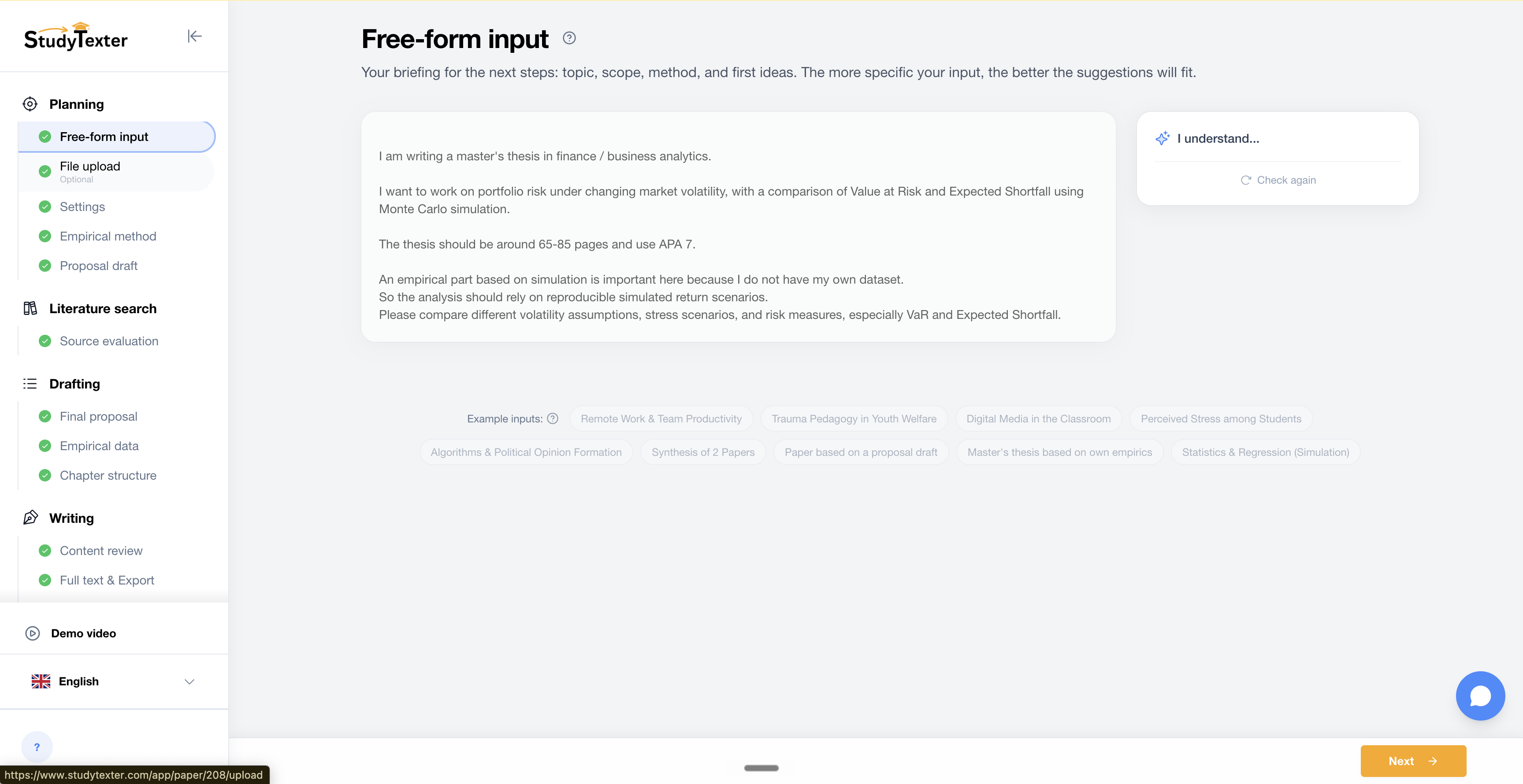





Important context before we get into tools: the Common App’s fraud guidance explicitly treats “misrepresenting as one’s own original work … the substantive content or output of an artificial intelligence platform” as fraud.
And some universities are even stricter (e.g., Brown says applicants may use AI for basic spelling/grammar review, but AI isn’t permitted for application content).
So the safest mindset is: use AI like a writing coach or editor-not a ghostwriter.
Used well, AI is strongest as a writing assistant and feedback coach—not as a full replacement for your work.
Great use cases (high value, low risk)
Brainstorming angles for a prompt (without writing the essay for you)
Building a clear outline
Improving clarity, grammar, and conciseness
Getting line-by-line feedback (“this part is vague—add a concrete detail”)
Checking if your essay sounds generic or “too broad”
Creating a revision plan: what to cut, what to expand, what to move
Weak / risky use cases
Copy/pasting a fully AI-written essay as your final submission
This often produces generic writing and raises integrity/policy risks. An admissions director quoted in Inside Higher Ed warned that simply using ChatGPT and copy-pasting tends to create a “horrible essay” because it lacks specificity—but AI feedback can be useful.
Most tools follow a similar loop:
Or outline/notes
Feedback, a score, and specific edits
Make sure everything that was output is correct
Until the essay reads clearly and authentically
Some tools focus on admissions coaching (story + authenticity). Others focus on academic writing (citations + structure).
Get a structured draft with citations, plagiarism checks, and an AI-evasion report, then revise it in your own voice.
For admissions essays
Policies vary. Inside Higher Ed notes that few universities have clear policies for admissions essays, and some institutions that address AI issue blanket bans in the admissions process.
Practical takeaway: treat AI like you’d treat a coach/editing tool—your story, your words, your final responsibility.
For college coursework essays
Your university typically expects your work to comply with academic integrity rules (and sometimes AI disclosure rules).
If you use a tool that generates drafts, the safest approach is:
StudyTexter’s Terms explicitly frame their output as drafts for inspiration and as a basis for your own work and state it’s prohibited to submit the content as your own work.
Below is an honest comparison of popular tools people use for “college essay AI”-including admissions-focused feedback tools and a fixed-price academic draft option (StudyTexter) for coursework-style essays.
Note: prices might change. This table reflects pricing/info published on the linked sources at the time of writing.
| Tool | StudyTexter | GradGPT | ESAI | Esslo | EssayGrader |
|---|---|---|---|---|---|
| Best for | Coursework essays / term papers (structured drafts w/ research + citations) ✓ | Admissions essay scoring + line-by-line feedback | Story + prompt coaching + supplemental tools | Admissions essay feedback (not writing essays) | Rubric grading + plagiarism/AI evasion and Humanizer (teacher/feedback angle) |
| Free option? | Not positioned as free (but sample papers available) ✓ | Yes ("Free plan" with limited trials) | Yes ("Starter" free forever) | Yes (one round of line-by-line edits for one draft) | Yes (free tier) |
| Paid pricing (published) | Fixed packages: €69 (up to 20 pages), €89 (up to 40), €119 (up to 80), €159 (up to 120) ✓ | $24/month (monthly) or $12/month billed yearly ($144) | $49.99 monthly or $20.99/month billed yearly ($249.99) | Student plan shown in search snippets as $39/mo; Student Plus $79/mo; Counselor $99/mo | Plans include $6.99/mo (Lite) and $14.99/mo (Pro) per pricing page |
| What makes it useful | editor review workflow + draft in Word/PDF + literature review + AI-evasion report + plagiarism report ✓ | Essay score + categories (writing/theme/detail/authenticity/structure) and "line by line feedback" approach | Strong "toolkit" (hook helper, outline assistant, supplemental assistant, etc.) + "Join over 750,000 students" claim | Scores writing/detail/voice/character + suggestions like removing clichés; positioned as fine-tuning, not writing | Built-in AI writing detection + plagiarism checks (flags for review) |
Most admissions essay AI tools are subscription-based (monthly/yearly). That’s great if you’re iterating across many drafts and supplements.
But if your situation is more like “I need a structured academic essay draft fast, with citations and formatting elements”, a fixed-price model can be simpler to budget.
Example: 2-month admissions season (subscriptions)
| Tool | StudyTexter | GradGPT (monthly) | ESAI (monthly) | Esslo (Student plan) |
|---|---|---|---|---|
| Typical 2-month cost (subscriptions) |
From 69–119 € (one-time purchase, no subscription) ✓ | $48 (2 × $24/month) | $99.98 (2 × $49.99) | $78 (2 × $39/month) |
Example: one academic essay draft (fixed price)
StudyTexter packages start at €69 for up to 20 pages and scale to €159 for up to 120 pages.
After payment, you continue in the StudyTexter workflow, review the draft, and export the files yourself.
How to interpret this fairly:
If you want your essay to sound like you (and not like “AI wrote this”), use AI for questions and critique, not for full writing.
A practical workflow (fast and safe)
Write a messy first draft yourself (don’t overthink)
Ask an AI tool to:
identify what’s unclear
mark generic lines
suggest where a concrete example is missing
Revise by adding:
specific moments (“what happened, where, what did you do”)
sensory detail (what you saw/heard)
reflection (what changed in you)
Re-run feedback and repeat
Tools like Esslo explicitly position themselves as fine-tuning feedback (not writing or brainstorming).
Course essays are a different beast: structure + evidence matter.
If you’re using a draft generator, your must-do checklist is:
Verify every factual claim
Verify every citation (title, author, year, page number, DOI/URL if relevant)
Rewrite sections so your professor can see your reasoning
Make sure the output matches your course rubric and formatting rules
StudyTexter service is producing drafts and explicitly requires you to review.
“Volunteering taught me a lot about leadership and teamwork. I learned to communicate better and help others.”
“On my third week at the food pantry, the line doubled and our check-in system broke. I stopped trying to ‘manage everyone’ and instead asked one volunteer to direct arrivals while I rebuilt the list. It wasn’t flashy leadership—it was listening, delegating, and keeping calm when the plan failed.”
Notice what changed:
concrete moment
observable actions
reflection without buzzwords
That’s the kind of improvement AI feedback tools are good at prompting you to write.
Before you paste your essay into any AI tool, check:
For example, GradGPT states saved essays are “encrypted and visible only to you.”
StudyTexter highlights “100% discretion” and describes editor-and-export workflow plus included reports.
Sometimes. Some schools and platforms may run submissions through plagiarism tools, and some also experiment with AI‑detection tools. But “AI detectors” are not definitive—many have false positives and false negatives—so most institutions (when they take the issue seriously) look for contextual evidence too: sudden shifts in writing style, lack of drafts, inability to explain the essay, or inconsistencies with earlier work. The safest approach is to follow your school’s policy and keep proof of your writing process (notes, outlines, drafts, revision history).
Not with certainty just from the final text. A university typically can’t “see” that you used ChatGPT unless you:
If your institution requires disclosure, the most reliable way to stay safe is to disclose appropriately and use AI only in allowed ways (e.g., brainstorming, outlining, proofreading).
Not reliably. Humans can often suspect AI when writing is unusually generic, overly polished, repetitive, or lacks personal specificity—but skilled human writing can look similar, and AI can be edited to look human. Automated AI detectors are probabilistic and can be wrong. A fair evaluation usually considers additional evidence (drafts, sources, your ability to discuss the essay, and consistency with your past writing).
You can’t prove it from the text alone, but these are common red flags:
Use these as signals—not as proof.
Some do, many don’t, and practices vary widely by country, institution, and department. In coursework contexts, institutions are more likely to check submissions using plagiarism systems (and sometimes AI‑detection add-ons) or to investigate if a tutor flags concerns. In admissions contexts, policies and enforcement are less standardized—some schools may treat the personal statement as an integrity matter, others focus on authenticity via review and interviews. Assume your essay could be scrutinized and write accordingly.
It depends on the rules you’re under. In many schools, using AI for support (brainstorming, outlining, feedback, grammar, clarity) may be allowed, while submitting AI‑generated text as your own is often treated as academic misconduct. For admissions essays, “okay” often comes down to authenticity expectations: the essay is meant to reflect your voice and experiences. If you use AI, keep it in a supporting role and ensure the final essay is genuinely yours.
Common examples (depending on policy) include:
If the AI is doing the substantive thinking and writing and you present it as your own, that’s typically considered cheating.
It varies by institution and by how the AI was used. Possible outcomes range from:
If AI use violates an application statement of authenticity, the risk is higher. If you used AI only for light editing consistent with policy (like proofreading), the risk may be lower—especially if you can show drafts and authorship.
The “best” tool is the one that helps you improve your own writing without replacing it. Look for AI that supports:
Avoid using any tool as a “one-click essay generator.” Also consider privacy: don’t paste sensitive personal info into tools you don’t trust, and check whether your text may be stored or used for training.
It can be helpful as a writing assistant for:
It’s not a substitute for your voice and experiences, and it can produce inaccuracies or generic phrasing. The best use is iterative: you write, it gives feedback, you revise, and you verify facts and details yourself.
You can use it in many contexts, but whether you should depends on policy and purpose. A safe, commonly acceptable approach is to use it like a coach:
Avoid copying large AI-generated sections into your final essay—especially if rules forbid it or if it compromises authenticity.
It can generate text that isn’t a direct copy, but that doesn’t guarantee it’s “safe”:
To stay safe: write in your own words, cite all real sources you used, don’t use AI to “hide” sources, and verify every factual claim.
Requirements vary by instructor and style guide, but common options include:
If your institution has a specific format, follow that first.
Often yes (if permitted), especially for grammar, concision, and readability. To keep it ethical and authentic:
Also keep earlier drafts/version history so you can show you authored the content and used AI only as an editor.
Often yes (if permitted), especially for grammar, concision, and readability. To keep it ethical and authentic:
Also keep earlier drafts/version history so you can show you authored the content and used AI only as an editor.
Not at all—650 is the Common App maximum, and many strong essays use the full limit. What matters is that every sentence earns its place. If you’re exactly at 650, make sure the ending isn’t rushed and the essay isn’t padded with filler. Being slightly under (e.g., 620–650) is also perfectly fine if it improves clarity and impact.
Same answer: it’s totally acceptable. Admissions readers won’t penalize you for using the full word count. They will notice if it feels bloated, repetitive, or generic—so prioritize specificity, personal voice, and strong narrative structure over hitting a number.