
Best AI Detector 2026: What Independent Studies Show
Many of the top Google results for “best AI detector” on Oct 12, 2026 come from companies that sell a detector or from sites that earn a commission. We did it differently: we read eight independent studies in full and matched them to ten detectors. For each one you see who tested it, on which human texts, who paid, and how often human writing was wrongly flagged as AI. Prices and free limits come from dated screenshots.

 Janosch & Dr. Jonathan SchulteStudyTexter editorial team
Updated
23 min read
Janosch & Dr. Jonathan SchulteStudyTexter editorial team
Updated
23 min readDisclosure: This comparison is published by StudyTexter, a company in the same market. We only state verifiable facts with source and date. Method
Contents
The best AI detector depends on what you need, and none is proof: in independent studies, Turnitin (schools only) and Pangram (account needed) had the fewest false flags; for a quick free check, Scribbr and Copyleaks work without an account. Turnitin also missed every fully AI-written paper in a 2026 study. GPTZero’s false flags ranged from 9 of 18 texts in 2023 to 0.00% on a 2024 benchmark and 0.71% in a 2025 working paper that is not peer-reviewed. In a 2023 study, essays by non-native English writers were flagged 61% of the time on average. Treat any score as a hint. If you still have to write the paper, StudyTexter guides you to a draft with real sources and a plagiarism and AI check included, one-time from $79.
Which AI detector is best? The evidence matrix
We ranked the detectors by the mistake that can hurt students most: how often independent researchers saw the tool flag human writing as AI. Tools with more studies, newer studies and fewer false flags rank higher. We also weighed how well the tool caught AI text in the 2026 study, and whether the vendor also sells a rewriting tool. Vendor numbers are shown, but they don’t change the order.
- StudyTexter: for writing the paper itself (not a detector)
- Turnitin: what many schools use
- Pangram, Originality.ai, Copyleaks, GPTZero: tested in several studies
- ZeroGPT, Winston AI, Scribbr, QuillBot, Grammarly: fewer or no independent tests
| Detector | Human texts wrongly flagged as AI, by study |
|---|---|
| Turnitin | 0 of 18 (2023)[1] · 0 of 42 (2023)[2] · 0 of 10 (2023)[4] · 0 of 40 (2026)[5] Vendor claim: under 1% for documents with over 20% AI[9] |
| Pangram | 0.00% of 1,992 (2025, not peer-reviewed)[6] · 0 of 40 (2026)[5] Vendor claim: 1 in 10,000[21] |
| Originality.ai | 0 of 42, 2 uncertain (2023)[2] · 0.25% (2024 benchmark)[7] · 0.11% (2025, not peer-reviewed)[6] Vendor claim: “99%+” accurate, new model[19] |
| Copyleaks | 0 of 42 (2023)[2] · 5 of 10 (2023)[4] · 0 of 40 (2026)[5] Vendor claim: .03%[16] |
| GPTZero | 9 of 18 (2023)[1] · 1 of 42 (2023)[2] · 1 of 10 (2023)[4] · 0.00% (2024 benchmark)[7] · 0.71% (2025, not peer-reviewed)[6] · 0 of 40 (2026; text also mentions “a small false positive rate”)[5] Vendor claim: no more than 1%[12] |
| ZeroGPT | 0 of 18 (2023)[1] · 1 of 42 (2023)[2] · 0 of 10 (2023)[4] · 1.42% (2024 benchmark)[7] Vendor claim: under 1%[25] |
| Winston AI | 0 of 18 (2023)[1] · 0.55% (2024 benchmark)[7] Vendor claim: 0 of 27,743 human documents[23] |
| Scribbr | 1 of 42 (2023)[2] Vendor claim: no false positive rate stated |
| QuillBot | no independent study found Vendor claim: “99% detection rate”[28] |
| Grammarly | no independent study found Vendor claim: “99% detection accuracy”[30] |
Two warnings. Most evidence is from 2023, and vendors have changed their models since, for example Turnitin in July 2026 and Originality.ai in September 2026[9][19]. And samples are small: with 0 false flags on 42 texts, the true rate could still be about 7%.
| Study | Human texts, language, who paid |
|---|---|
| International Journal for Educational Integrity (IJEI), Dec 2023; peer-reviewed; tested Mar to May 2023[1] | 18: 9 written in English, 9 written in seven other languages and machine-translated into English; counts full and partial AI flags. No funding beyond the authors’ universities; two authors help run a conference that Turnitin sponsors. |
| Open Information Science, Oct 2023; peer-reviewed; tested Jun/Jul 2023[2] | 42 first-year student essays from 2014/15, English. No funding, no conflict of interest. The author notes Turnitin may have seen such papers before, but thinks this had no major effect. |
| Patterns, 2023; peer-reviewed; tested Mar 2023[3] | 91 TOEFL essays by non-native writers and 88 US 8th-grade essays. No conflicts; one author funded by the US National Science Foundation. Reports the average over 7 tools; per-tool values only in a chart. |
| Journal of Educational Technology in Higher Education, Sep 2024; peer-reviewed; tested Sep/Oct 2023[4] | 10 control texts in English, by staff and by Vietnamese students. Funding and competing interests: “not applicable”. |
| RAID benchmark, ACL 2024; peer-reviewed; queried Jan 2024[7] | Human texts from 8 domains such as news, Wikipedia, Reddit and abstracts; English. Funded by a US government research agency (IARPA). |
| NBER working paper, Sep 2025; not peer-reviewed[6] | 1,992 texts written before 2020 (reviews, blogs, news, novels, résumés), English, no student papers. No conflicts stated; funding includes Chicago Booth and the Google Cloud Research Program. |
| Preprint, Feb 2026; not peer-reviewed[8] | The same 91 TOEFL essays and US essays as the 2023 study, plus essays in Czech. Charles University and University of Oslo. |
| IJEI, Jun 2026; peer-reviewed and preregistered; AI texts from May 2025[5] | 40 papers of 4,000+ words by non-native graduate students, written before 2019, English. Supported by the author’s faculty; no financial or institutional link to any detector. |
The best AI detectors in 2026, tool by tool
Each card shows the price and free limit as displayed on Oct 12, 2026, what the tool is good for and its limits. The study results are in the matrix above.
1. StudyTexter for writing the paper itself, not a detector
A detector only judges a text that already exists. If you still have to write your paper, the better question is how to build it so you can show where every claim comes from. That is what StudyTexter is for. It is not an AI detector, and we don’t rank it as one.
Why it comes first for the paper
- a guided path in 12 steps from your topic to a full draft, which you revise as the author
- you accept or reject each source it suggests from 479M+ sources
- every citation shows its source and page number in the Evidence View
- a plagiarism and AI check is included; 2,800+ citation styles, chosen in step 3 (free)
Honest limits
- it does not check a text you already wrote: for that, use a detector below
- free only for steps 1 to 5, up to your proposal draft; from the literature search (step 6) on you need a package
- packages by page count: $79 (20), $99 (40), $139 (80), $179 (120 pages), one-time
- draft in up to 2 hours, but you still have to read, revise and own it
2. Turnitin what many schools use
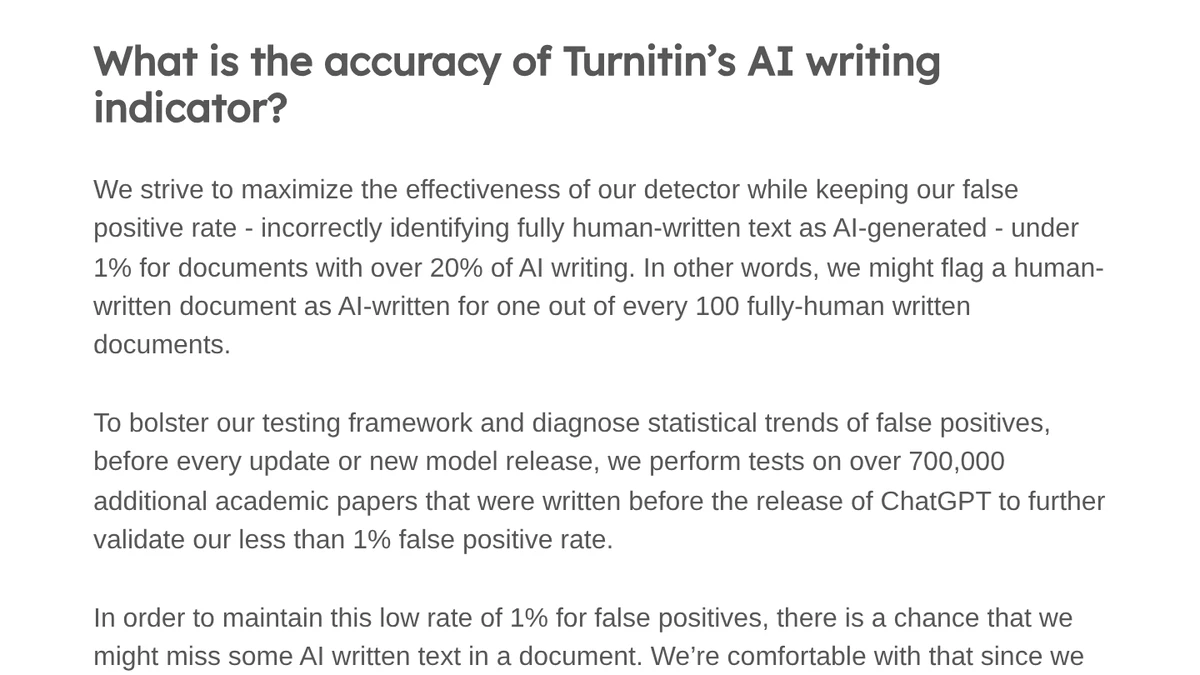
- 1Under 1%: Turnitin’s target false positive rate applies to documents “with over 20% of AI writing”.
- 21 in 100: Turnitin “might flag a human-written document as AI-written for one out of every 100 fully-human written documents”.
- 3Turnitin’s own test: “over 700,000 additional academic papers” before each update; not an independent test.
Screenshot of guides.turnitin.com, Oct 12, 2026, 11:39 UTC, taken by StudyTexter, cropped. Taken at a narrower window width so the text stays readable.
Good for: knowing what your instructor may see. Limits: you can’t run it yourself. In four independent studies, Turnitin wrongly flagged none of the human texts[1][2][4][5]. But in the 2026 study, Turnitin also scored all 40 fully AI-written papers below 20%, so it missed every one of them[5]. For a similar plagiarism check before you submit, see our Turnitin alternative guide.
3. Pangram strongest recent results, account needed
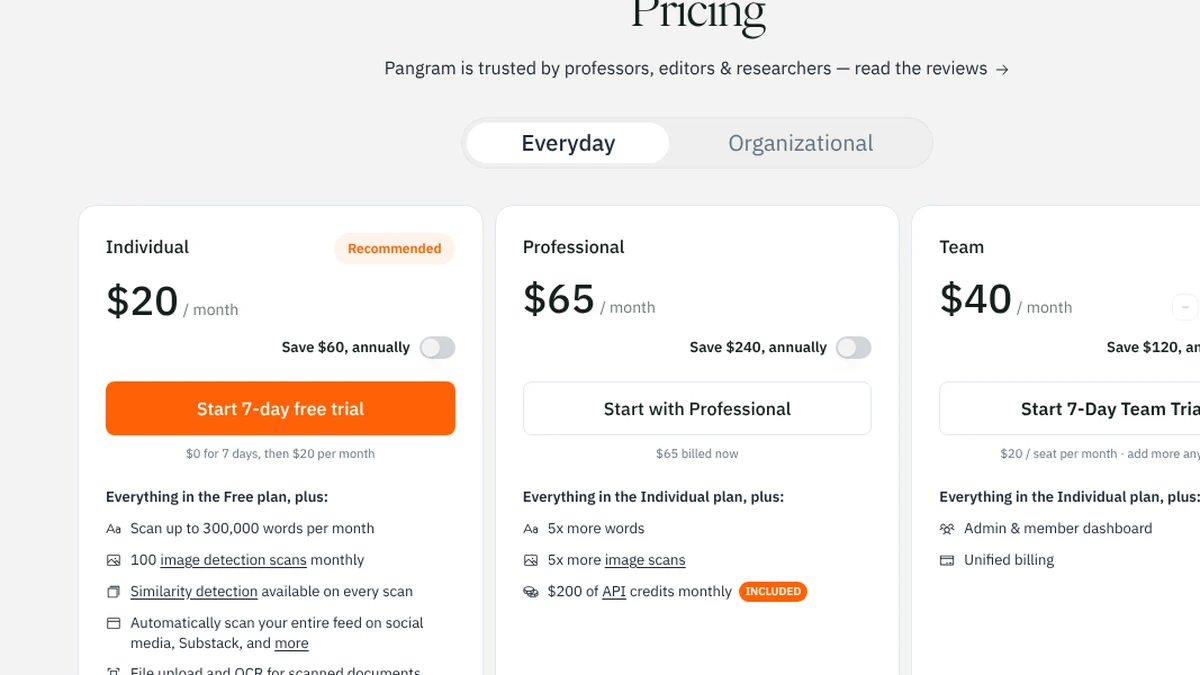
- 1$20 per month for the Individual plan when billed monthly.
- 2Annual billing saves $60 a year, according to the toggle.
- 3Trial: “$0 for 7 days, then $20 per month”.
Screenshot of pangram.com/pricing, Oct 12, 2026, 11:28 UTC, taken by StudyTexter, cropped.
Good for: a second opinion when a score really matters. Limits: you need an account even for free checks, and it costs more than most here. In the two newest studies we found, it had no false flags, and in 2026 it caught far more AI-written papers than the other three tools[5][6]. GPTZero, which sells a competing detector, reran the 2025 dataset and reports its own tool ahead[13]; we list that as a vendor result, not as independent evidence.
4. Originality.ai low false flags in three studies
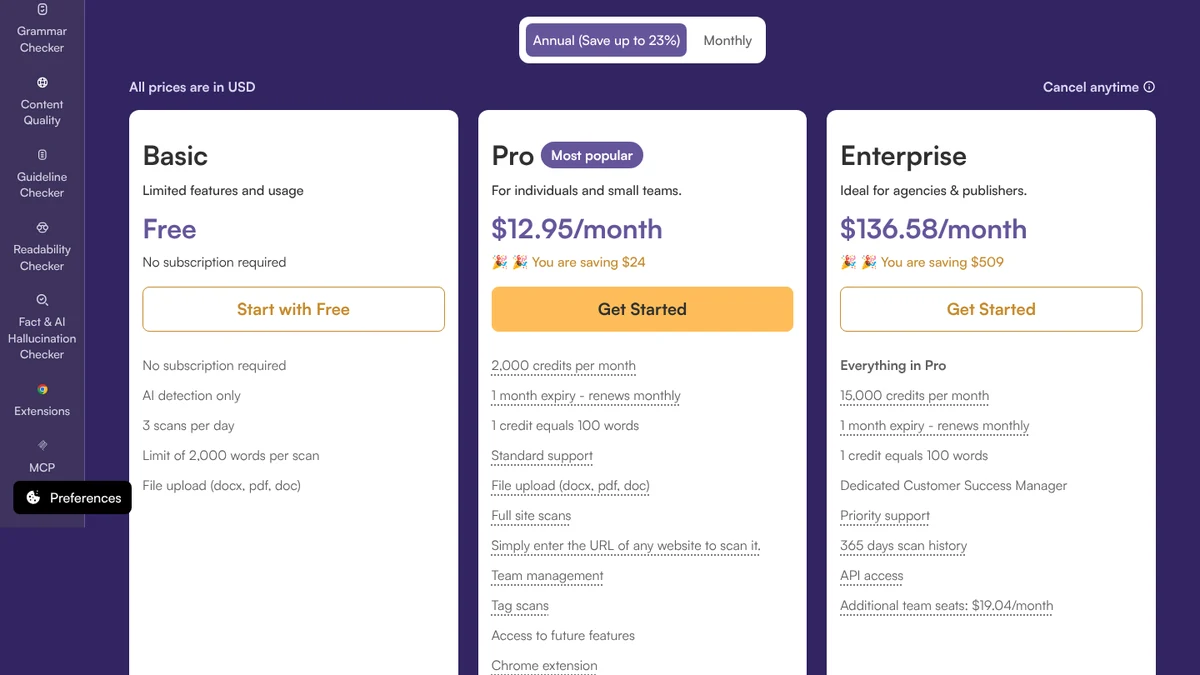
- 1Annual view is selected; monthly billing shows Pro at $14.95.
- 2Pro: $12.95 per month, billed annually.
- 3Free tier: 3 scans a day, up to 2,000 words per scan.
Screenshot of originality.ai/pricing, Oct 12, 2026, 11:30 UTC, taken by StudyTexter, cropped.
Good for: a few free checks a day with file upload. Limits: its plans are aimed mainly at teams, agencies and publishers, and the studies tested models it has since retired[19]. In the three studies that report its own rate, it wrongly flagged at most 0.25% of human texts[2][7][6].
5. Copyleaks biggest free scan, mixed results
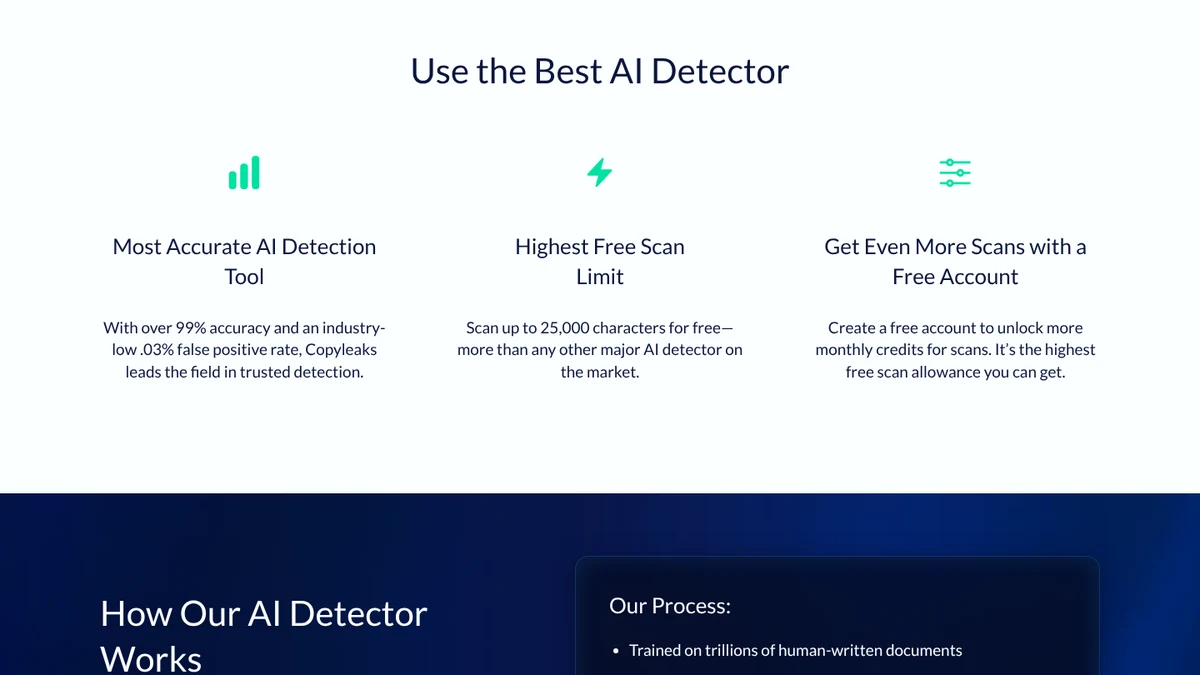
- 1Vendor claim: “over 99% accuracy and an industry-low .03% false positive rate”; no study named here.
- 2Free limit: “Scan up to 25,000 characters for free”.
- 3Free account: more monthly scan credits once you sign up.
Screenshot of copyleaks.com/ai-content-detector, Oct 12, 2026, 11:32 UTC, taken by StudyTexter, cropped. We declined optional cookies first.
Good for: a free check of a full chapter at once. Limits: studies disagree: no false flags on 42 student essays and on 40 papers by non-native graduate students[2][5], but 5 of 10 human texts flagged in another 2023 study[4]. Ten texts is a small sample, yet far from the vendor’s “.03%”.
6. GPTZero popular; far fewer false flags since early 2023
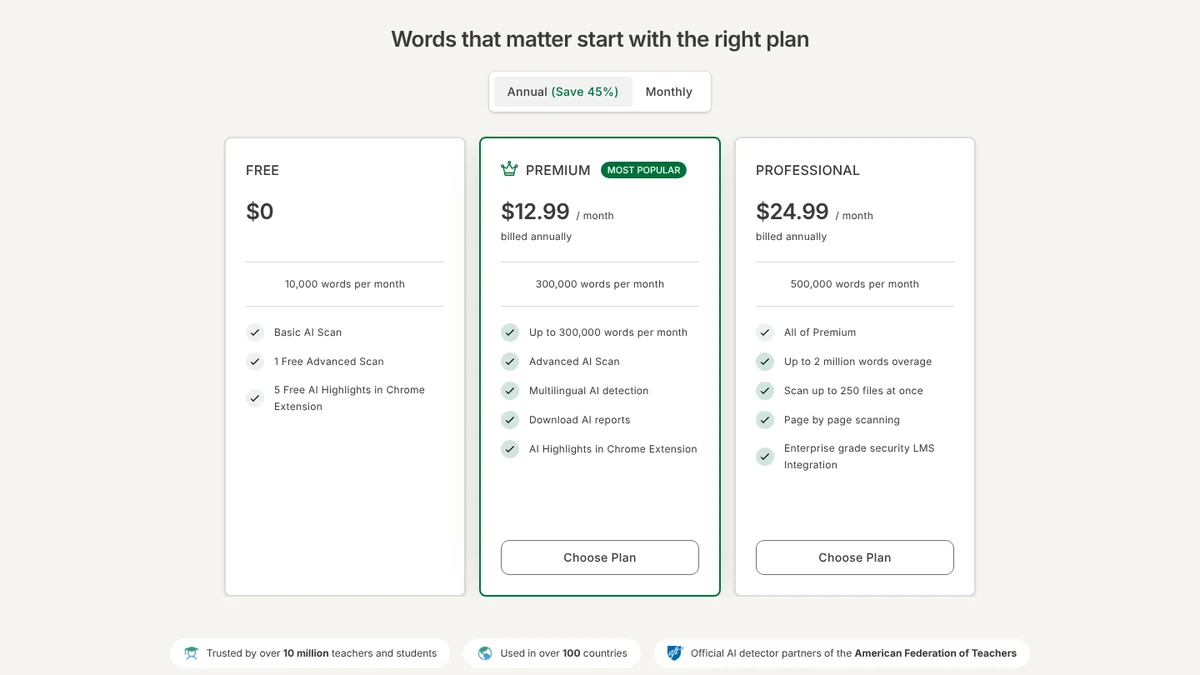
- 1Free: $0 with 10,000 words per month.
- 2Premium: $12.99 per month, billed annually.
- 3Monthly billing: Premium then shows $23.99 per month.
Screenshot of gptzero.me/pricing, Oct 12, 2026, 11:30 UTC, taken by StudyTexter, cropped.
Good for: a free check with a monthly word budget. Limits: results changed a lot over time. In a test from March 2023, GPTZero wrongly flagged 9 of 18 human texts, 6 of them machine-translated; the authors called it “unsuitable for the academic environment”[1]. Later results: 1 of 42 and 1 of 10 (2023), 0.00% on a 2024 benchmark and 0.71% in a 2025 working paper that is not peer-reviewed[2][4][7][6]. The 2026 study classed all 40 human papers as human for every tool, GPTZero included, but its text also mentions “a small false positive rate” for GPTZero without giving a number[5].
7. ZeroGPT free, large limit; also sells a rewriting tool
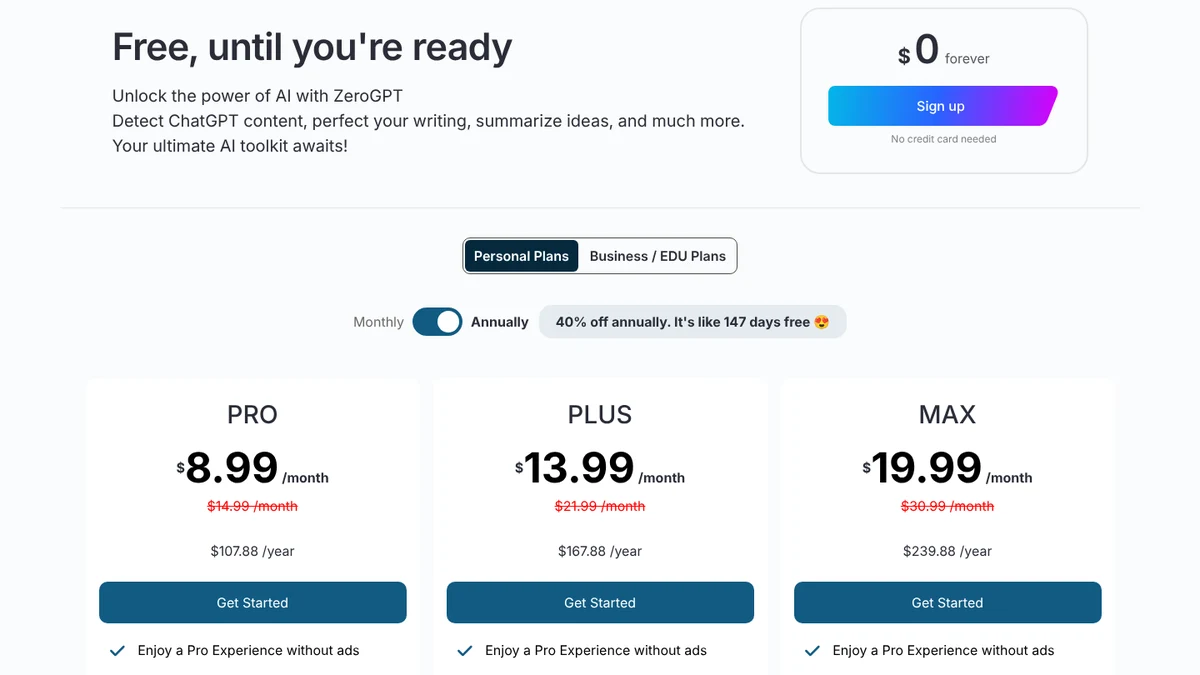
- 1Free plan: “$0 forever”, “No credit card needed”.
- 2Annual billing is selected.
- 3Pro: $8.99 per month, $107.88 a year; $14.99 per month on monthly billing.
Screenshot of zerogpt.com/pricing, Oct 12, 2026, 11:31 UTC, taken by StudyTexter, cropped.
Good for: a quick free check without an account. Limits: its plans also include a rewriting tool[24]. In studies, it flagged none of 18 and none of 10 human texts and 1 of 42 student essays[1][4][2]; in that last study it judged only 79% of the human essays correctly and called the rest “uncertain”[2]. On the 2024 benchmark it flagged 1.42%, and the rate varied widely by type of text[7].
8. Winston AI few independent tests
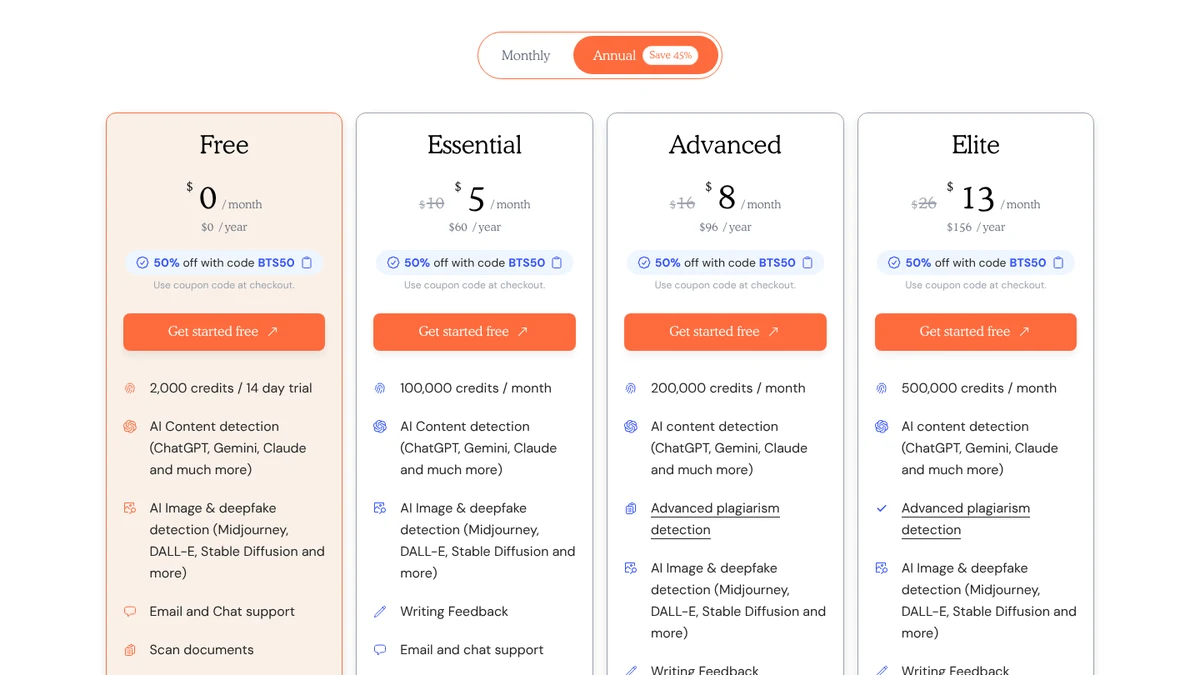
- 1Coupon: the lower prices need this code at checkout.
- 2Free: 2,000 credits for a 14-day trial.
- 3Essential: 100,000 credits a month.
Screenshot of gowinston.ai/pricing, Oct 12, 2026, 11:30 UTC, taken by StudyTexter, cropped.
Good for: trying a second detector for two weeks. Limits: only two independent results: no false flags on 18 human texts in 2023 (then called GoWinston) and 0.55% on the 2024 benchmark[1][7]. The home page numbers are Winston’s own summary; the page names no single study for the 27,743 figure[23].
9. Scribbr free, no account
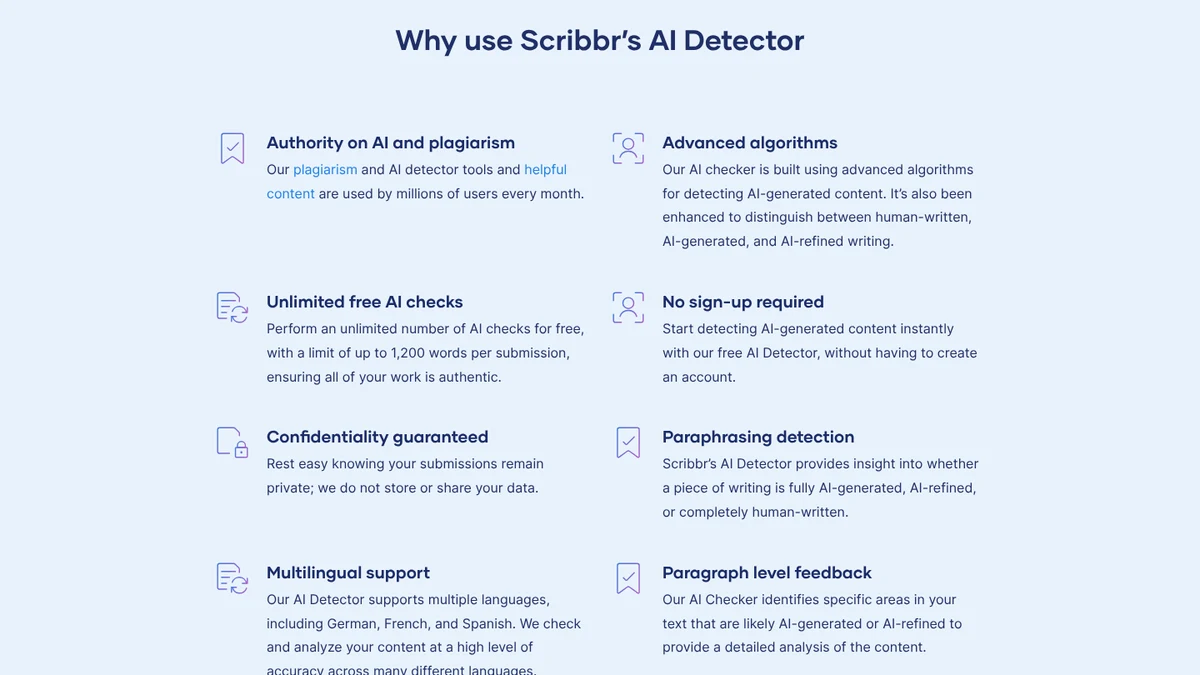
- 1Unlimited free checks, according to Scribbr.
- 2Limit: “up to 1,200 words per submission”.
- 3No account: “without having to create an account”.
Screenshot of scribbr.com/ai-detector, Oct 12, 2026, 11:29 UTC, taken by StudyTexter, cropped.
Good for: a free first look without signing up. Limits: long papers must be checked in parts; one study result (1 of 42)[2]. Every test of Scribbr is in our Scribbr AI detector review.
10. QuillBot free, no independent study found
Good for: a quick check if you already use QuillBot. Limits: we found no peer-reviewed study of its detector. QuillBot says that when results are unclear, its model “tends to classify texts as human written”[28]. On Oct 12, 2026, quillbot.com blocked our screenshot tool with a security check, so there is no screenshot.
11. Grammarly free, vendor numbers only
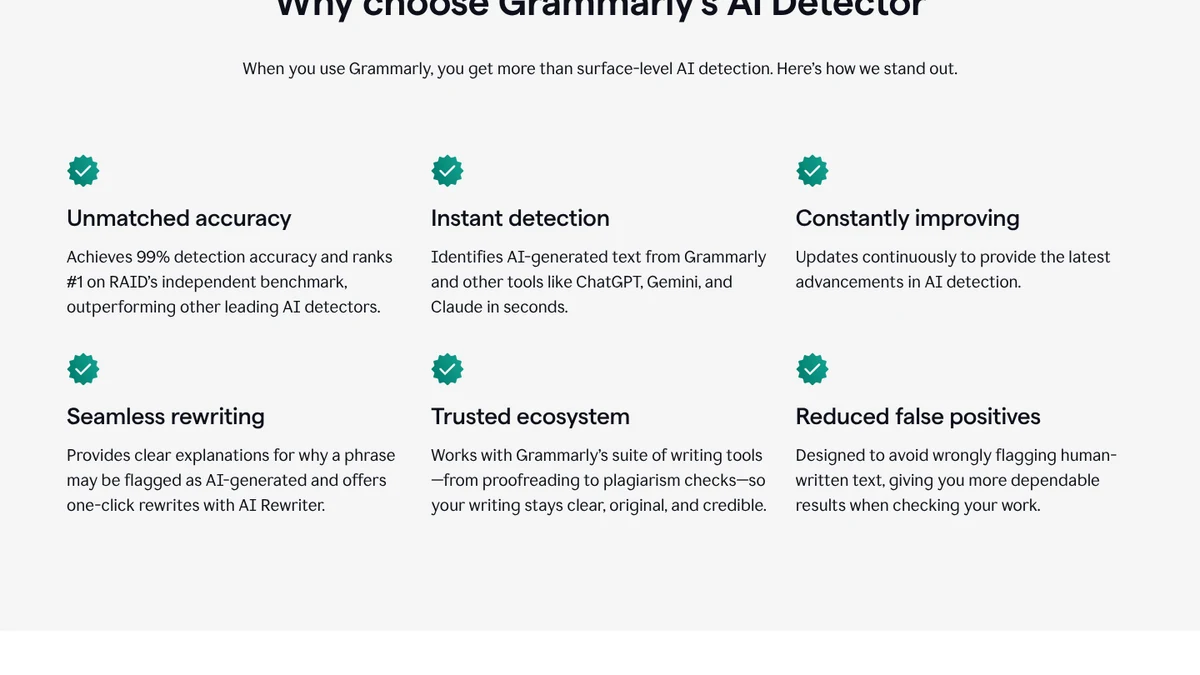
- 1Vendor claim: 99% detection accuracy and first place on the RAID benchmark, in Grammarly’s words.
- 2False positives: “Designed to avoid wrongly flagging human-written text”; no rate given.
Screenshot of grammarly.com/ai-detector, Oct 12, 2026, 11:29 UTC, taken by StudyTexter, cropped.
Good for: a check inside a tool you may already use. Limits: we found no independent study with its false-flag rate. Grammarly itself says you should never rely on a detector alone[30].
Do AI detectors flag non-native English writers more often?
Many of our readers write in English as a second language. The evidence points in both directions, depending on the year and the tool:
| Study | What it found |
|---|---|
| Patterns, 2023; tested Mar 2023[3] | Seven detectors (Originality.AI, Quill.org, Sapling, OpenAI, Crossplag, GPTZero, ZeroGPT) flagged 61.22% of 91 TOEFL essays by non-native writers on average; all seven flagged 18 of them, at least one flagged 89. US 8th-grade essays were judged almost perfectly. |
| IJEI, Dec 2023[1] | Human texts written in seven other languages and machine-translated into English were flagged in 11.1% of cases on average (2.4% for texts written in English). Machine translation is not the same as writing in a second language. |
| Preprint, Feb 2026[8] | A commercial detector flagged 23.1% of the same 91 TOEFL essays and none of the US essays. For essays in Czech, the researchers found no systematic bias. |
| IJEI, Jun 2026[5] | All four tools, including GPTZero, classed none of 40 papers by non-native graduate students as AI (score under 20%). |
| Vendor claims[10][12] | Turnitin: 1.4% for English learners vs 1.3% for native writers. GPTZero: 1.1% on TOEFL essays. |
Our reading: newer tools seem to do better than in 2023, but the bias has not been shown to be gone. Turnitin itself names text “without a lot of structural variation” or text “that literally repeats itself” among the causes of false positives[9]. The authors of the 2026 study write that detection tools “should not be used as sole evidence in high-stakes decision-making”[5].
What does a flag mean? The calculator
A false positive rate of 1% sounds tiny. What matters to you is a different number: of all papers a detector flags, how many were written by a person? That depends on the false positive rate, on how much AI text the tool catches, and on how many papers were written with AI at all:
of all flags would be on a paper written by a person.
With 1% false flags, a 90% catch rate and 10% AI-written papers, about 1 in 11 flags is on a paper a person wrote. That is why one score is not proof. For a different view, the number of students hit as more papers are checked, see the calculator in our Scribbr review.
Before and after a flag: a plan that helps you show your own work
This plan is built from what universities and Turnitin say about detector results. It is not legal advice; your school’s procedure comes first.
Before you submit
- Read the AI rules for your courseweek 1Find out what AI use is allowed and whether you must disclose it. If the rules are unclear, ask in writing.
- Turn on version history and keep notesweek 1 to submissionWrite in Google Docs, or in Word with files saved to OneDrive. Keep the sources you read and where each quote comes from.
- Optional: one free checkbefore you submitA score is a hint. If your own text is flagged, keep your evidence ready rather than rewriting good sentences.
If a detector flags your own writing
- Ask what exactly was flaggedday 1Ask which tool, which score and which passages. Turnitin’s AI report is not visible to students, but instructors can download it as a PDF and share it; scores from 1% to 19% show only as “*%”[9].
- Collect your writing processday 1 to 2Gather drafts, version history, notes and sources. One US university tells its faculty to use detectors only “as part of a broader investigation, ideally supported by drafts, revision history, or a student interview”[32].
- Check your course rulesday 2The same guidance warns faculty that if their AI policy was unclear, “a formal charge may be difficult to uphold”[32].
- Point to the limitsin the meetingTurnitin says its score “should not be used as the sole basis for action”[9]. At Washington State University, 33% of AI hearing cases from 2023 to 2025 ended “not responsible” because only a detector result was submitted; the university accepts no detector as the only support for a case[31].
- Offer to explain your workin the meetingThe same faculty guidance says instructors may ask students to “explain how they completed the work” and “demonstrate their drafting process”[32].
| University | What changed |
|---|---|
| Washington State University, US, Feb 2026[31] | Cancelled Turnitin’s AI detection; no AI detector as the sole support for a case |
| Curtin University, Australia, from Jan 2026[33] | Switched off AI detection in Turnitin; plagiarism checks stay |
| Saginaw Valley State University, US, Jul 2025[32] | Faculty told not to use detectors as “standalone evidence” |
Best free AI detector: free limits and prices compared
Many detectors are free and ready right away, a real advantage over any paid tool:
| Detector | Free limit |
|---|---|
| Scribbr | unlimited checks, 1,200 words each; no account |
| Copyleaks | 25,000 characters per scan; no login |
| ZeroGPT | 15,000 characters per check; no account |
| QuillBot | 1,200 words, 6 scans a day |
| GPTZero | 10,000 words a month |
| Originality.ai | 3 scans a day, 2,000 words each |
| Pangram | 20 checks a day; account needed |
| Winston AI | 2,000 credits for 14 days; account needed |
| Grammarly | limit not stated |
| Detector | Billed monthly | Billed annually |
|---|---|---|
| ZeroGPT Pro | $14.99 | $8.99 / mo |
| QuillBot Premium | not shown | $8.33 / mo |
| Originality.ai Pro | $14.95 | $12.95 / mo |
| GPTZero Premium | $23.99 | $12.99 / mo |
| Copyleaks Personal | $16.99 | $13.99 / mo |
| Winston AI Essential | $18 | $10 / mo |
| Pangram Individual | $20 | saves $60 / yr |
For a single paper, a free tier may be enough. Check the whole text in as few parts as possible: Turnitin explains that on documents of only a few hundred words, its prediction will be mostly “all or nothing”[9].
AI detectors vs StudyTexter: different jobs
A detector looks at a finished text and estimates how it was written. StudyTexter starts earlier and guides you to a draft you can back up, source by source.
| Feature | AI detectors |  |
|---|---|---|
| What it does | estimates whether a finished text was written with AI | guided 12 steps from topic to full draft |
| Free | many free tiers, some without an account | steps 1 to 5, up to your proposal draft |
| AI and plagiarism check | AI check; plagiarism often extra or paid | plagiarism and AI check included |
| Sources and citations | not part of a detector | 479M+ sources; source and page number per citation in the Evidence View |
| Payment | free or monthly/annual plans | one-time from $79, no subscription |
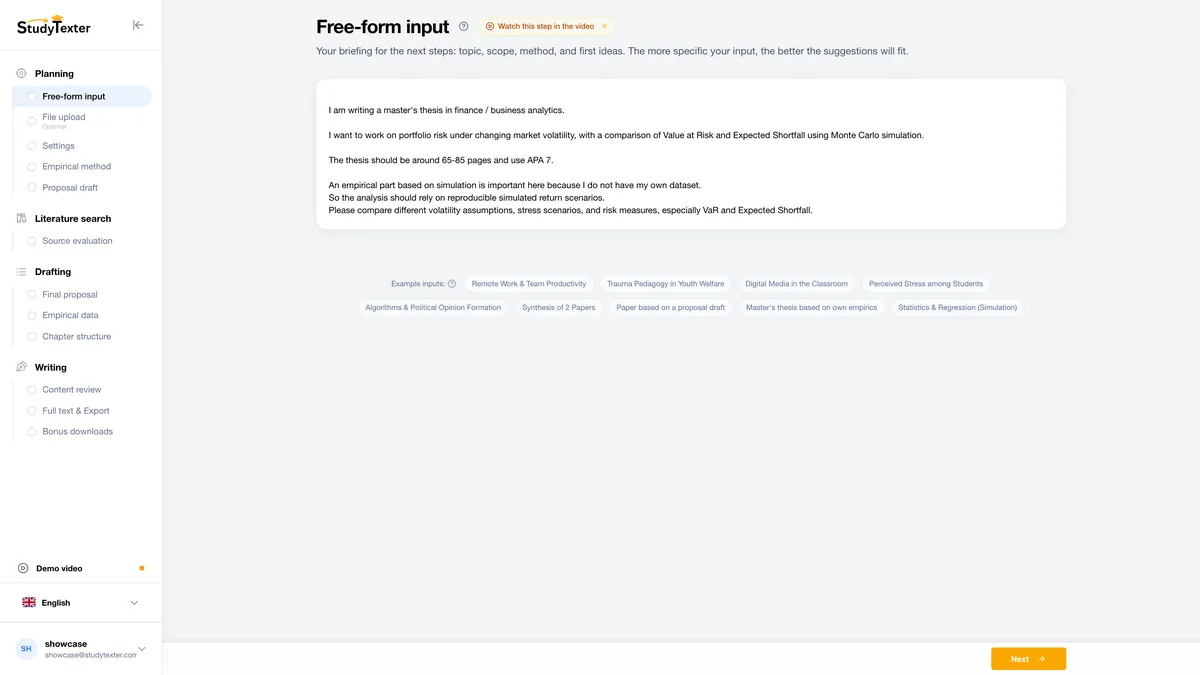
Topic in your words
Describe your topic in your own words. One sentence is enough to start.
- Texts 3 human-written texts (one by a non-native writer, with permission), 3 AI-written texts, each 600 to 1,000 words.pending
- Tools the free tiers of Scribbr, Copyleaks, ZeroGPT, GPTZero, Originality.ai, QuillBot and Grammarly, by hand, without automation.pending
- Record score, label, date and a screenshot for every run.pending
We have not run this test yet, so this page makes no accuracy claim of its own.
Best AI detector: frequently asked questions
What is the best AI detector?
None is right every time. In the independent studies we found, Turnitin and Pangram had the fewest false flags, but Turnitin is only for schools; see the evidence matrix above.
What is the best free AI detector?
For a quick check without an account, Scribbr (1,200 words) and Copyleaks (25,000 characters) are easy to start with. Compare all free limits in the table above.
Is there a 100% accurate AI detector?
No. Several vendors say so themselves: Turnitin says its score “should not be used as the sole basis for action”, and Grammarly and GPTZero say “No AI detector is 100% accurate”.
Which AI detector do professors and universities use?
Many schools use Turnitin inside their plagiarism check; students can’t see its AI report. Some have switched it off, such as Washington State University (2026) and Curtin University (from January 2026).
GPTZero vs ZeroGPT: which is better?
The evidence is mixed: in one 2023 study GPTZero wrongly flagged 9 of 18 human texts and ZeroGPT none; on a 2024 benchmark GPTZero flagged 0.00% and ZeroGPT 1.42%. ZeroGPT’s plans also include a rewriting tool.
GPTZero vs Turnitin: which is more accurate?
On human texts, Turnitin had no false flags in four studies; GPTZero ranged from 9 of 18 texts (2023) to 0.00% on a 2024 benchmark. But Turnitin missed all 40 fully AI-written papers in a 2026 study.
What should I do if a detector flags my own writing?
Ask which tool and score were used, and collect your drafts, version history, notes and sources. See the step plan above; several universities say a detector result alone is not enough evidence.
Method and disclosure
We read websites, terms and reviews ourselves, back every number with a source and access date, and only add test results once we have them. Found a mistake? We correct it with a date.
On Oct 12, 2026 we read the eight studies in the table above in full. We counted only results on human-written texts that the authors report per tool. We visited each detector’s public pages without an account, took dated screenshots and declined optional cookies. We did not paste any text into a detector, did not sign up and did not run any tool. Vendor numbers are labeled as vendor claims.
StudyTexter sells a guided draft with a plagiarism and AI check included, so we have an interest in this topic. Every statement has a source and date. All product names are trademarks of their owners; we use them only to describe the products. If you find a mistake, we’ll correct it and date the change.
Changes: Oct 12, 2026 first version; the same day, revised after an independent fact check (2026 study results, GPTZero ranges, study table with funding, shorter page).
Sources
- Testing of detection tools for AI-generated text, International Journal for Educational Integrity 19, article 26 (Dec 25, 2023; peer-reviewed)14 tools, 18 human texts (9 English, 9 machine-translated), tests March to May 2023 · accessed Oct 12, 2026
- The Effectiveness of Software Designed to Detect AI-Generated Writing: A Comparison of 16 AI Text Detectors, Open Information Science 7(1) (Oct 6, 2023; peer-reviewed)16 tools, 42 first-year student essays, tests June/July 2023 · accessed Oct 12, 2026
- GPT detectors are biased against non-native English writers, Patterns (2023; peer-reviewed; arXiv version)7 detectors, 91 TOEFL essays, average false positive rate 61.22% · accessed Oct 12, 2026
- GenAI Detection Tools, Adversarial Techniques and Implications for Inclusivity in Higher Education (arXiv preprint, Mar 2024; published under a different title in the International Journal of Educational Technology in Higher Education 21, article 53, Sep 9, 2024; peer-reviewed)7 detectors, 10 human control texts, tests Sept/Oct 2023; same numbers in both versions · accessed Oct 12, 2026
- Who wrote this? Evaluating the reliability of AI detection tools in higher education, International Journal for Educational Integrity 22, article 16 (online Jun 29, 2026; peer-reviewed)GPTZero, Pangram, Copyleaks, Turnitin; 40 papers by non-native graduate students · accessed Oct 12, 2026
- Artificial Writing and Automated Detection, NBER Working Paper 34223 (Sep 2025; not peer-reviewed)1,992 human texts; false positive rates of GPTZero, Originality, Pangram · accessed Oct 12, 2026
- RAID: A Shared Benchmark for Robust Evaluation of Machine-Generated Text Detectors, ACL 2024 (peer-reviewed; arXiv version)false positive rates of GPTZero, Originality, Winston, ZeroGPT at a threshold of 0.5 · accessed Oct 12, 2026
- Different Time, Different Language: Revisiting the Bias Against Non-Native Speakers in GPT Detectors (arXiv preprint, Feb 5, 2026; not peer-reviewed)a commercial detector flagged 23.1% of the same 91 TOEFL essays · accessed Oct 12, 2026
- Turnitin Guides: Turnitin’s AI writing detection capabilities FAQsunder 1% false positives, 300 words minimum, *% for 1 to 19%, not visible to students · accessed Oct 12, 2026
- Turnitin: AI writing solutions pageEnglish Language Learners: 0.014 vs 0.013 false positive rate (Turnitin’s own test) · accessed Oct 12, 2026
- GPTZero: Pricing (annual and monthly view)free 10,000 words per month; Premium $12.99 or $23.99 per month · accessed Oct 12, 2026
- GPTZero: Technologyfalse positive rate “no more than 1%”, TOEFL 1.1%, “No AI detector is 100% accurate” · accessed Oct 12, 2026
- GPTZero: Chicago Booth benchmark (vendor post)GPTZero reports its own tool ahead of Pangram on the same dataset · accessed Oct 12, 2026
- GPTZero: home page banner“GPTZero is now a part of Superhuman” · accessed Oct 12, 2026
- SiliconANGLE: Grammarly parent Superhuman buys AI detector GPTZero (Jun 24, 2026)Superhuman “has agreed to acquire GPTZero” · accessed Oct 12, 2026
- Copyleaks: Free AI Detector25,000 characters without login; “.03% false positive rate” · accessed Oct 12, 2026
- Copyleaks: Pricing (yearly and monthly view)Personal $13.99 per month yearly, $16.99 monthly · accessed Oct 12, 2026
- Originality.ai: Pricing (annual and monthly view)free 3 scans per day, 2,000 words; Pro $12.95 or $14.95 per month · accessed Oct 12, 2026
- Originality.ai: AI detection accuracy (updated Sep 21, 2026; vendor)AI Allowance “99%+”; Lite, Turbo and Academic models retired in September 2026 · accessed Oct 12, 2026
- Pangram: PricingIndividual $20 per month, 7-day trial · accessed Oct 12, 2026
- Pangram: AI Detector (FAQ)false positive rate “1 in 10,000”, 20 free checks a day after signing up · accessed Oct 12, 2026
- Winston AI: Pricing (annual and monthly view)2,000 credits 14-day trial; Essential with coupon code · accessed Oct 12, 2026
- Winston AI: home page (vendor claims)99.87% accuracy, “zero false positives across 27,743 human documents” · accessed Oct 12, 2026
- ZeroGPT: Pricingfree 15,000 characters per check; Pro $8.99 or $14.99 per month · accessed Oct 12, 2026
- ZeroGPT: home page (vendor claims)98.4% detection accuracy, “<1%” false positive rate · accessed Oct 12, 2026
- Scribbr: Free AI Detectorunlimited checks, 1,200 words each, no account · accessed Oct 12, 2026
- Scribbr: Plagiarism Checker (accessed Oct 11, 2026)premium AI check only with a plagiarism check, from $19.95 · accessed Oct 12, 2026
- QuillBot: AI Content Detector1,200 words per scan, 6 scans per day; “99% detection rate” citing RAID · accessed Oct 12, 2026
- QuillBot: Premium$8.33 per month, billed annually · accessed Oct 12, 2026
- Grammarly: Free AI Detector“99% detection accuracy”, “#1 on RAID” · accessed Oct 12, 2026
- Washington State University, Office of the Provost: Cancellation of Turnitin AI Detection software (memo, Feb 11, 2026)33% of AI hearing cases “not responsible”; no detector as sole evidence · accessed Oct 12, 2026
- Saginaw Valley State University, Office of Student Conduct: FAQ for faculty (PDF, Jul 2025)detectors not “standalone evidence”; drafts, revision history, interview · accessed Oct 12, 2026
- Curtin University: Update on Turnitin AI-Detection Tool (Sep 4, 2025)AI detection in Turnitin off from Jan 1, 2026 · accessed Oct 12, 2026
Read next
Brands and logos mentioned belong to their owners and are used for identification only. They are not affiliated with StudyTexter.