Research proposal generator · 30 min
Most “research proposal generator” tools (ChatGPT's Research Proposal Maker, LowTech.ai, Template.net) output a topic or a template. StudyTexter drafts the full proposal: research question with scope, literature review with the gap, methodology with justification, timeline with milestones, full bibliography with real DOIs. 10–20 pages, in 30 minutes, in your supervisor's reference style. Cross-link to the full <a href="/dissertation-proposal">dissertation proposal</a> guide for context.
 From $69Drafted in 30 minutes
The top of the “research proposal generator” SERP offers four very different things — none of which is a submission-ready proposal:
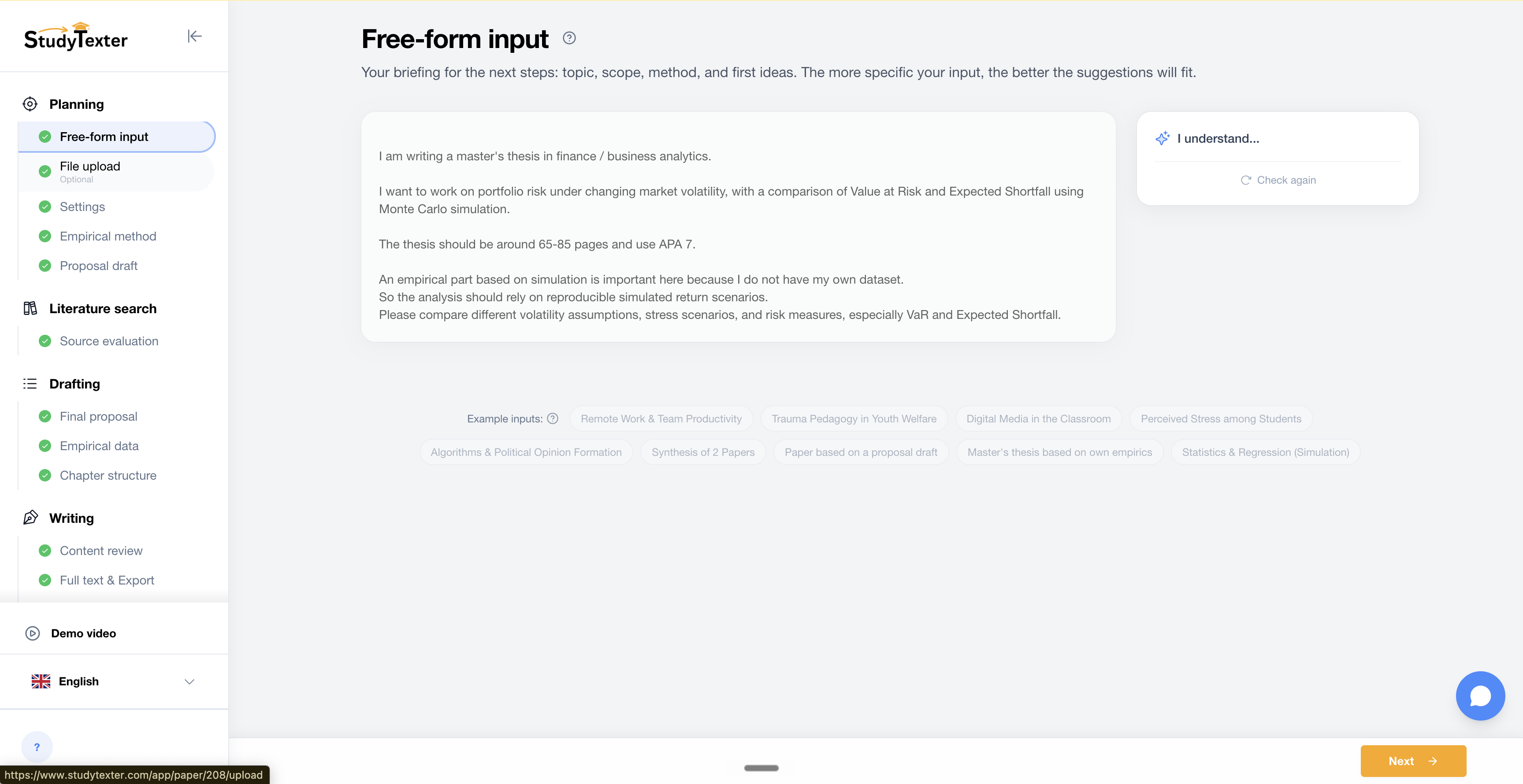
Four steps from brief to a 10–20 page submission-ready proposal.
Research question (or topic you want refined), discipline, target length (US PhD 10–20 pages, UK Master's 5–10 pages, UK PhD application 8–12 pages), reference style, supervisor's specific requirements.
The AI proposes an 8-section outline (title + abstract, intro + research question, lit review, methodology, timeline + chapter outline, references, ethics plan). You approve, swap sections, or refine the research question.
Each section drafts against the outline. Literature review pulls 30–60 real DOI sources organised thematically, ending with the explicit research gap. Methodology is justified for the research question. Timeline includes realistic monthly milestones.
Before export, the editor checks for the five proposal-failure modes (vague question, missing gap, methodology mismatch, unrealistic timeline, missing ethics plan). Originality + AI-detection report. Export DOCX, PDF, or LaTeX with bibliography.
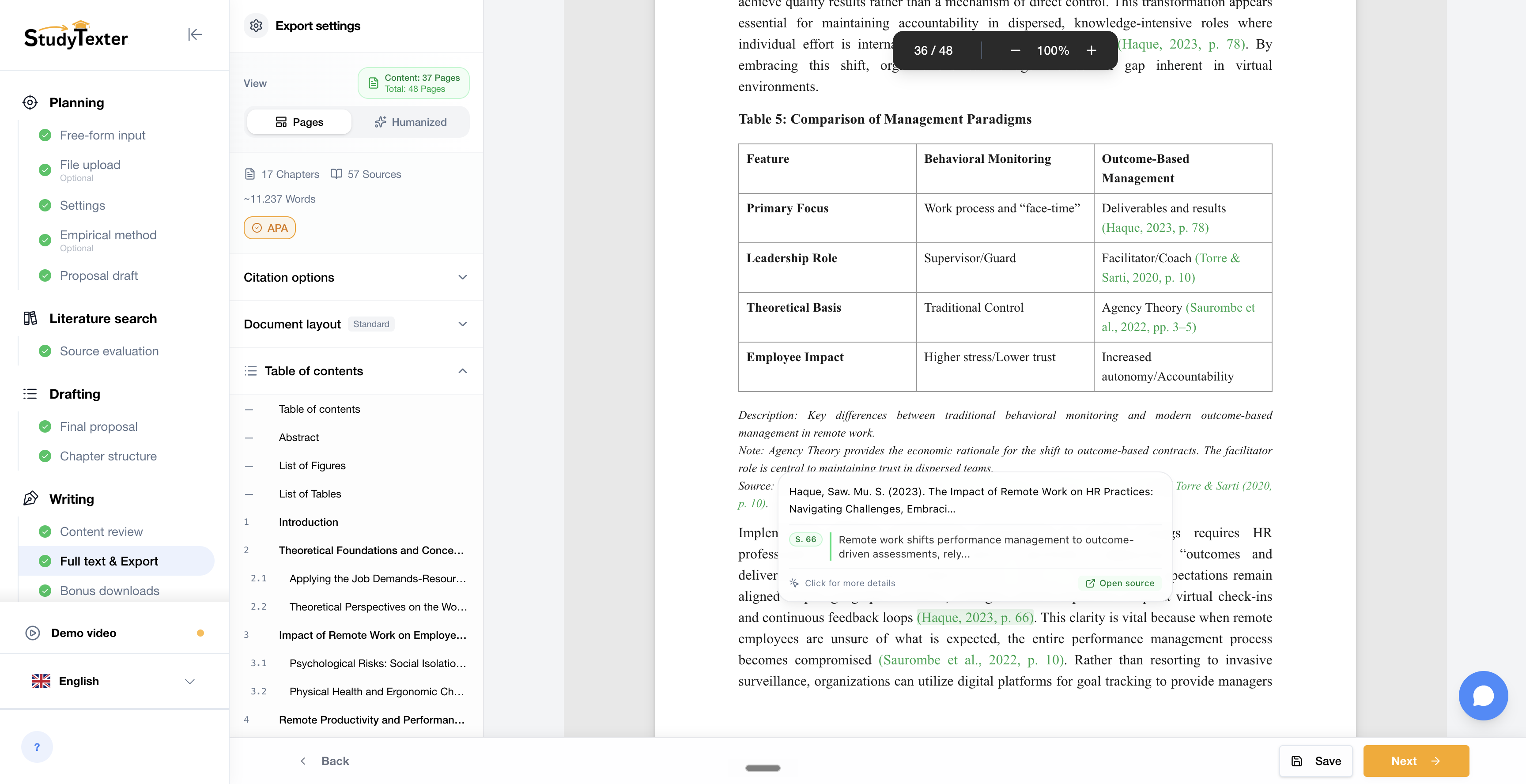
What the leading research proposal generators actually deliver.
| Capability | StudyTexter | Topic / template generators | ChatGPT-based generators |
|---|---|---|---|
| Full 10–20 page proposal | Yes (all 8 sections) | No (topic / template only) | Partial (loses coherence) |
| Real DOI bibliography | Live lookup, 30–60 sources | No | Hallucinated |
| Research question with scope | Population + time period + mechanism specified | Generic | Generic |
| Literature review with gap statement | Explicit gap at the end of each theme | No | Often missing gap |
| Methodology justified for question | Discipline-specific justification | Template only | Inconsistent |
| Realistic timeline with milestones | Month-by-month + Gantt-style | Template only | Generic |
| Ethics plan (when relevant) | Auto-included for human / animal / sensitive data research | Template only | Sometimes missing |
| Reference style (APA / Harvard / Vancouver / IEEE) | All major styles, first-class | Inconsistent | Inconsistent |
| Originality + AI-detection at export | Both reports ship with export | No | No |
| Cost | $69 per proposal | Free → $20/mo | Free → $20/mo |
The single biggest reason proposals fail review: vague research question. StudyTexter forces explicit scope (population, time period, mechanism, method) before drafting begins. The proposal you export has a question committees can evaluate.
A literature review without an explicit research gap is the second-biggest failure mode. StudyTexter organises the literature thematically and ends each theme with what the literature has and has not addressed — culminating in the gap your research fills.
The methodology must match the research question (qualitative method for qualitative question, etc.). The timeline must be realistic (12 months minimum for PhD fieldwork). The ethics plan must address human / animal / sensitive data research. StudyTexter flags misalignment before export.
Free preview: brief, 8-section outline, first section. Pay $69 only when you export the finished proposal with real DOI bibliography, methodology justified, timeline, and reviewer's-eye check.
Proposal length and reviewer expectations vary by country and stage.
Brief, outline, and the first section are free. You only pay when you export the finished proposal.
Compared to 1–2 weeks of your own time or $500–$1,500 from a human proposal-writing service, $69 for a 10–20 page proposal in 30 minutes is the rational trade. Once the proposal is approved, the dissertation itself is the next step — see <a href="/dissertation-writing-service">dissertation writing service</a>.
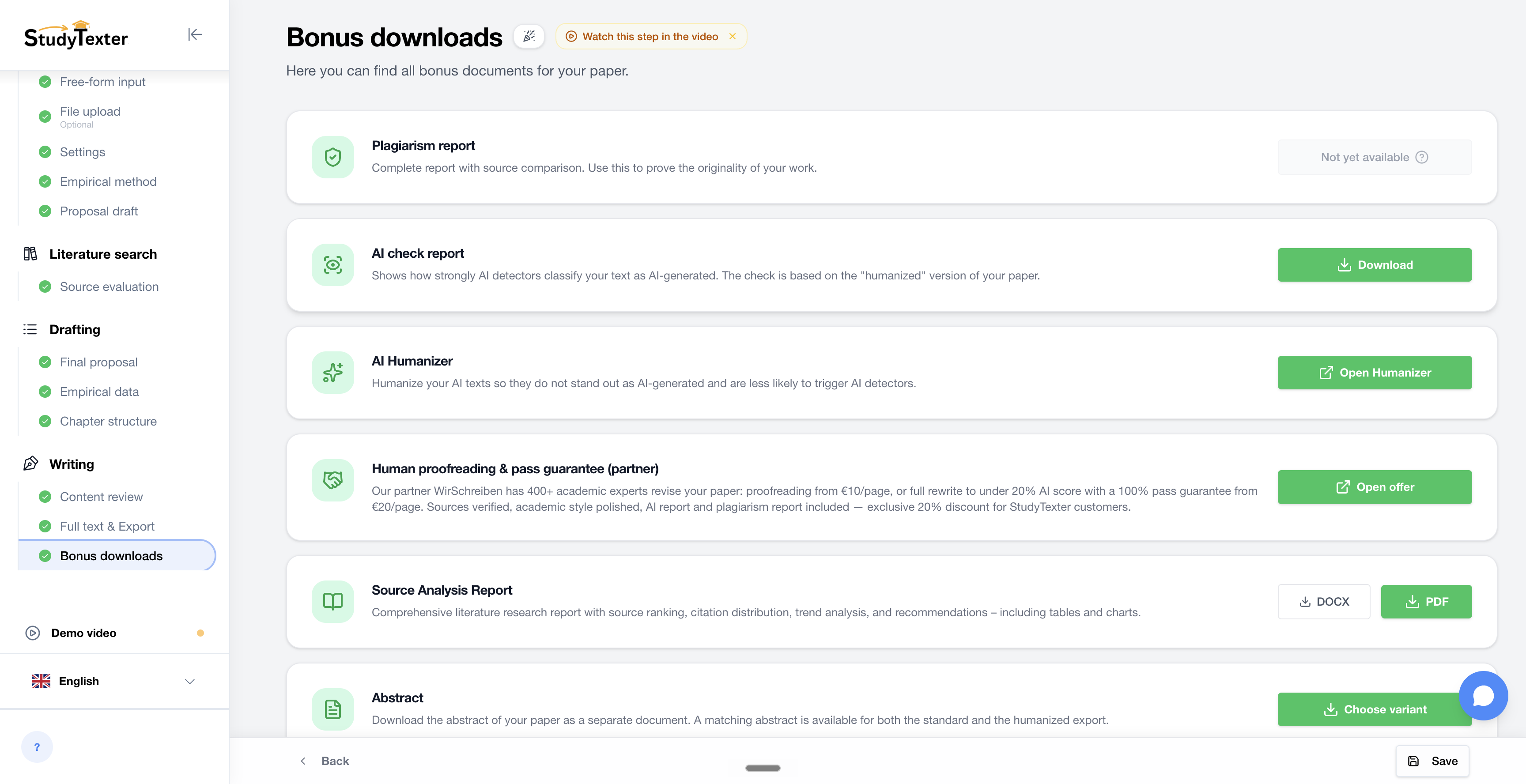
An AI tool that drafts a research proposal end-to-end — title + abstract, research question, literature review, methodology, timeline, references, ethics plan. The good ones (StudyTexter) use real DOI citations and check for the common failure modes. The free ones (LowTech.ai, Template.net, ChatGPT) output topics or templates or hallucinated drafts.
Free preview: brief, outline, and the first section. You only pay when you export the finished proposal ($49–$69 depending on length). See pricing section above for the full breakdown.
5 minutes to brief, 10 minutes to approve the outline, 15 minutes for the AI to draft each section. Total: 30 minutes for a 10–20 page proposal. Add another 30–60 minutes if you want to revise the draft before export.
Yes — the literature review section pulls 30–60 real, verifiable DOI sources from Crossref, PubMed, and IEEE Xplore. Click any citation to open the source. No hallucinated DOIs like ChatGPT produces.
The editor checks for the five proposal-failure modes before export (vague question, missing gap, methodology mismatch, unrealistic timeline, missing ethics plan). Most proposals that pass these five checks pass committee review on the first submission. Always have your supervisor review before submission.
Yes — thesis proposal and research proposal use the same 8-section structure. Pick “thesis proposal” at brief-time and the editor uses the right length and reference conventions (Master's thesis proposal: 5–10 pages; PhD thesis proposal: 10–20 pages).
Yes — PhD application proposals are 8–12 pages submitted with the application. The editor emphasises novelty (the research is new) and feasibility (the research is doable in the timeframe), which is what admissions committees evaluate. $59.
Both work. You can brief with a fully-formed research question, or with a broad topic (“I'm interested in [area]”) and the AI proposes 5–10 candidate research questions for you to pick. The thesis-topic-generator workflow is built in.
If the research question is testable (quantitative or mixed-methods design), yes — the proposal includes a hypothesis section with H0 and H1 statements. Qualitative or exploratory research questions get a propositions section instead, which is the convention in qualitative methods.
Yes. Upload PDFs, paste DOIs, or paste BibTeX entries. The editor adds them to the source pool and includes them in the literature review. You can also mark them as “must cite” so they appear in specific sections.
If your research involves humans, animals, or sensitive data, yes — the proposal auto-includes an ethics section covering ethics-board approval, informed consent procedures, data protection (GDPR / HIPAA), and risk mitigation. This is required by most institutions before fieldwork can begin.
Yes — see dissertation writing service for the post-approval workflow. The proposal you wrote becomes the spine of the full dissertation. Cross-link to AI dissertation writer for the AI-drafted dissertation workflow.
