
Grammarly Humanizer Review: Free and Fast, but What Happens to Your Citations?
Grammarly’s free humanizer is one click away in any browser. Most reviews ranking for it in October 2026 come from companies selling a rival humanizer or detector, and so does this one. So we kept it checkable: on Oct 11, 2026 we read Grammarly’s page and its public HTML, plans, terms and help docs, plus the AI rules of three universities and colleges, and prepared a citation test you can repeat yourself.

 Janosch & Dr. Jonathan SchulteStudyTexter editorial team
Updated
16 min read
Janosch & Dr. Jonathan SchulteStudyTexter editorial team
Updated
16 min readDisclosure: This comparison is published by StudyTexter, a company in the same market. We only state verifiable facts with source and date. Method
Contents
Grammarly’s AI humanizer is free on grammarly.com, works without an account, and with a free account adds four preset voices, a custom voice and six languages. Its page says nothing about keeping quotes, page numbers or references, and the rewrite prompt in the page’s public HTML (as of Oct 11, 2026) asks the model to replace every en dash and swap formal words, with no exception for direct quotations. Grammarly itself says the tool is not intended to evade AI detectors, so for cited text check every quote, page number and reference afterwards; you stay the author either way.
Our verdict on Grammarly’s AI humanizer
Grammarly’s humanizer is free, quick to reach and made by a company that says over 40 million people use its tools[5]. Grammarly is also unusually direct about the risks: its own page says the tool is not intended to evade AI detectors and that disguising AI use can count as cheating[1]. For emails, cover letters or blog posts, where nobody checks a quote against its source, it can be a sensible free option.
Academic text is a different job. Grammarly’s humanizer page makes no promise about keeping citations intact, and the rewrite rules we found in the page’s public HTML on Oct 11, 2026 point to two concrete weak spots: page ranges and direct quotations[2]. Until our side-by-side test is published, treat every quote, page number and reference in the output as unchecked.
 Grammarly AI Humanizer at a glanceAs of Oct 11, 2026
- Made by
- Superhuman Platform Inc., formerly Grammarly, Inc., San Francisco[6]
- Free tool
- paste text or upload a file on grammarly.com, no account; no word limit named[1]
- Free account adds
- Humanizer agent in Grammarly’s docs and Superhuman Go: 4 preset voices, a custom voice from a 200-word sample, 6 languages[1][3]
- Pro
- “the full Humanizer experience”, not described further; $12 a month billed yearly or $30 billed monthly[4]
- Citations and quotes
- not mentioned on the humanizer page
- AI detectors
- Grammarly: the tool is not intended to evade them[1]
- Your text and training
- used for training by default on individual accounts, opt-out in settings[7]
| Task | Grammarly |
|---|---|
| Smooth an email, cover letter or post | fits: free, four voices, custom voice |
| Polish an essay without sources | fits, with disclosure; check your course’s AI rules first |
| Rework a paper with quotes and references | check every citation: no stated protection, dash and wording rules (see below) |
| Hide AI use from your instructor | no: Grammarly itself warns this may count as cheating |
What Grammarly’s page says under the hood: 8 rewrite rules
Grammarly’s humanizer page doesn’t say how the free tool handles citations. On October 11, 2026, the public HTML that grammarly.com/ai-humanizer delivers to every visitor contained the humanizer’s LLM prompt, last updated April 17, 2026[2]: make the text read like human writing, keep its meaning, follow eight rules. Paraphrased, with the four that touch citations highlighted:
- Replace every em dash and every en dash (–) with a comma, period or semicolon, so that
no dash characters may remain
. - Remove emojis.
- Use everyday words and active voice, prefer short sentences and split long ones.
- Swap formal words for plain ones, for example
utilize → use
. - Avoid a list of formal words, among them accurate, analyze and comprehensive.
- Keep technical terms, names, dates, statistics and existing formatting such as lists and headings.
- Don’t add or remove ideas or sentences.
- Return only the rewritten text.
We can’t see Grammarly’s servers, so we don’t know whether every request runs exactly this text, or whether the Humanizer agent in a free account works differently. What is missing matters as much: none of the eight rules mentions quotation marks, page numbers, “et al.” or reference lists.
Citation risk map
| Citation part | Risk |
|---|---|
| Page ranges: pp. 112–118 | Rule 1 replaces every en dash. The range could turn into “pp. 112, 118”; APA uses an en dash here. |
| Direct quotations | Rules 3 to 5 swap formal words, with no exception for quoted text. One changed word inside quotation marks makes a misquote. |
| Author and year | Rule 6 keeps names, dates and statistics. Probably safe. |
| Claim and citation together | Rule 3 prefers short sentences, rule 7 forbids adding or removing sentences. After a split, a citation can end up behind the wrong half. |
| Reference list | Rule 1 against rule 6: page ranges like 105–124 could lose their dash. |
| Hedges, “et al.”, “p.”, “as cited in” | Not covered by any rule. |
Our citation test: paragraph and scorecard
Here is the paragraph we will run through Grammarly’s free tool and, for comparison, through StudyTexter on the same day. It reads like a typical AI-assisted literature review and contains every part of a citation the rules above could touch. The sources are invented for the test, so nobody is misquoted. Copy it and run your own check if you like.
Formative feedback is widely regarded as one of the most effective levers for improving student writing. Moreno and Hale (2021) analyzed 37 first-year composition courses and reported that students who received comments on a draft improved their final grades by an average of 0.42 standard deviations (n = 1,284). Earlier studies had pointed in the same direction, although most of them relied on small samples from a single institution (Okafor, 2019, pp. 33–35). Importantly, the effect was strongest when feedback was delivered within one week of submission (Moreno & Hale, 2021, pp. 112–118). In a follow-up survey, 68% of participants stated that they read every comment, while only 41% revised their drafts accordingly (Moreno & Hale, 2021, p. 120).
Okafor (2019) argues that “a comprehensive feedback cycle was found to be more accurate than any single grade in predicting later performance” (p. 47). This finding suggests that the timing and structure of feedback may matter as much as its content. However, not all studies support this conclusion. Lindqvist et al. (2022) found no significant difference between written and audio feedback and observed that “students rarely utilize feedback that arrives after the grade” (p. 9). Furthermore, as Brennan (2018, as cited in Okafor, 2019) notes, feedback that students do not act upon is unlikely to produce lasting change.
Consequently, many institutions have begun to utilize peer review to enhance the scalability of feedback (Lindqvist et al., 2022). Taken together, these findings indicate that instructors should prioritize timely, actionable feedback over lengthy commentary. Future research should examine whether these effects persist across disciplines and in large online courses, where personalized comments are more difficult to deliver at scale.
Lindqvist, A., Berg, M., & Sato, K. (2022). Written versus audio feedback in first-year writing. Journal of Writing Pedagogy, 14(2), 1–19.
Moreno, L., & Hale, J. (2021). Timing matters: Formative feedback and final grades in composition courses. Assessment in Higher Learning, 9(3), 105–124.
Okafor, C. (2019). Feedback cycles and student performance. Teaching Studies Press.
| Check | Pass if |
|---|---|
| Author–year citations | all authors and years unchanged |
| Page ranges pp. 112–118, pp. 33–35 | en dash and both numbers kept |
| Quote with “comprehensive”, “accurate” | word for word, quotation marks kept |
| Quote with “utilize” | word for word |
| Statistics 0.42, n = 1,284, 68%, 41% | unchanged |
| “as cited in” and “et al.” | unchanged |
| Hedges: suggests, may, indicate | none turned into “proves” or “shows” |
| Reference list | unchanged, page ranges with dash |
| Meaning drift | changed claims, counted sentence by sentence |
| AI score before and after | GPTZero plus a second detector |
- Same day, same text. The paragraph above, pasted unchanged by hand into Grammarly’s free tool on grammarly.com and into StudyTexter.pending
- Default settings. No voice, no extra instructions, first result kept. Screenshots with date and time.pending
- Two readers. Two editors compare input and output sentence by sentence against the scorecard, separately.pending
- Two detectors. GPTZero has belonged to Grammarly’s parent company since 2026, so we add a second detector owned by neither company.pending
Until the results are here, this page contains no quality verdict on Grammarly’s output.
One company, both sides: humanizer, detector and GPTZero
Grammarly offers the tool that makes AI text sound human and an AI detector that checks for it. Since 2026 its parent Superhuman also owns GPTZero, a widely used AI detector: the deal was announced in June 2026, and gptzero.me now says GPTZero is now a part of Superhuman
[10][11][12]. According to the announcement, GPTZero stays a standalone product[11].
- Grammarly’s own detector: it claims 99% accuracy, yet the same page says no AI detector is 100% accurate and that lightly edited AI text
may evade detection
[8]. In a test published on Carleton College’s AI blog, it caught AI text “somewhat reliably”,including text ‘humanized’ by Grammarly!
[13] - Turnitin: in August 2025 Turnitin added detection for text edited with humanizer tools. At launch, Plagiarism Today noted that outside testing would be needed to judge how well it works[14].
- Authorship: Grammarly’s free Authorship report marks which text came from AI, the web or you; your school sees it only if you share it[9].
- For any before-and-after check: a GPTZero score now comes from Grammarly’s sister company. That doesn’t make it wrong, but keep it in mind when you compare Grammarly with anyone, including us.
Integrity note: what Grammarly and schools say
Grammarly’s own FAQ is clear: where AI use is restricted or must be disclosed, using a humanizer to disguise AI use may be considered unethical and could constitute cheating or plagiarism
. It recommends citing AI use when in doubt[1].
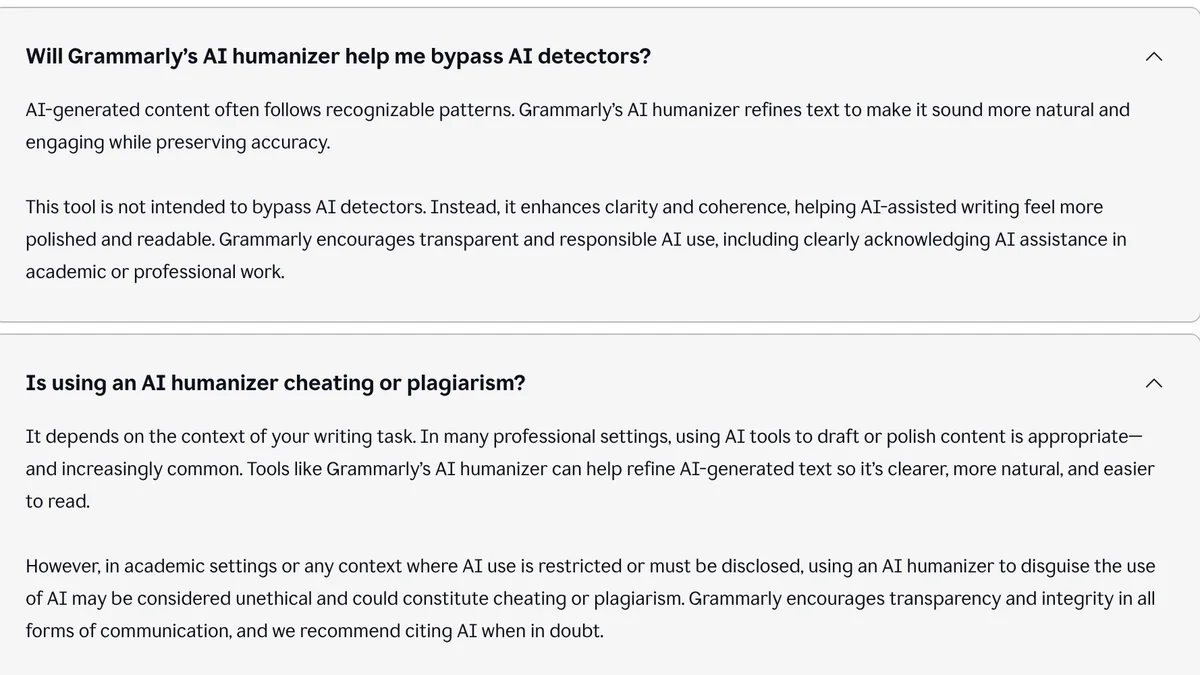
- 1Detectors: Grammarly says the tool is not intended to get past AI detectors and encourages clearly acknowledging AI help in academic work.
- 2Academic settings: where AI use is restricted or must be disclosed, disguising it
may be considered unethical and could constitute cheating or plagiarism
. - 3When in doubt: Grammarly recommends citing AI.
Screenshot of grammarly.com/ai-humanizer (FAQ, two answers opened), Oct 12, 2026, 04:00 UTC, taken by StudyTexter in a browser set to US English, window 1024 px wide[1].
College and university rules point the same way:
| Institution | Rule |
|---|---|
| University of Notre Dame, US, fall 2024[15] | Suggestions from editing tools like Grammarly are AI-generated text. If generative AI is banned in a class, that includes editing tools unless stated otherwise. |
| Academy of Contemporary Music (ACM), Policy 075, UK, Sep 2026[16] | Names Grammarly. Text that is generated and then rewritten may count as misconduct. Keep drafts from before any AI help. |
| University of the Sunshine Coast, Australia, Oct 2024[17] | Spelling and grammar checks can be allowed, but the generative AI functions of editing tools are prohibited. |
A faculty resource at the University at Buffalo describes students running AI text through the humanizer to “disguise its origins”[18]. The takeaway is the same for every tool, ours included: know your course rules, disclose AI help and keep your drafts.
What Grammarly does well
Pick Grammarly’s humanizer if …
- you want a free rewrite right now, without an account
- you already use Grammarly’s docs or Superhuman Go
- you want preset voices or a custom voice trained on your own sample
- you write in one of its six languages and need tone, not citations
- you want Authorship to document your writing process for free
Pick StudyTexter if …
- you still have to write the paper and need sources for it
- you want to accept or reject each source yourself
- you need a citation style you can pick in step 3 for free
- you want plagiarism and AI checks included before you submit
- you would rather pay once than manage a subscription
Grammarly also deserves credit for its integrity guidance: its humanizer page warns its own users about cheating in plain words[1].
Grammarly humanizer vs StudyTexter
The two tools start at different points. Grammarly’s humanizer reworks text you already have. StudyTexter takes you from your topic to a full draft with sources, in up to 2 hours, which you then revise.
| Feature | |  |
|---|---|---|
| What it does | rewrites existing text in a new tone | guided 12 steps from topic to full draft |
| Free | basic tool free to try, no account; no limit stated | steps 1 to 5, up to your proposal draft |
| Sources | keeps what you paste; no source search in the humanizer | 479M+ sources, you accept or reject each |
| Citation style | not mentioned on the humanizer page | over 2,800 styles, chosen in step 3 |
| Plagiarism and AI check | AI detector free; plagiarism check in Pro | both included |
| Price | Pro subscription, $12 to $30 a month | one-time from $79, no subscription |
| Where you use it | grammarly.com, Grammarly docs, Superhuman Go | web app; export to Word, PDF, LaTeX, Google Docs |
Price, terms and reviews
The humanizer itself costs nothing. For the full Humanizer experience and Pro’s in-editor AI and plagiarism checks, Grammarly Pro costs $30 a month, $60 a quarter or $144 a year[4], after a 7-day free trial[5]. Prices are in US dollars by default; UK students see pounds at checkout, and Grammarly names no Canadian or Australian prices[4].
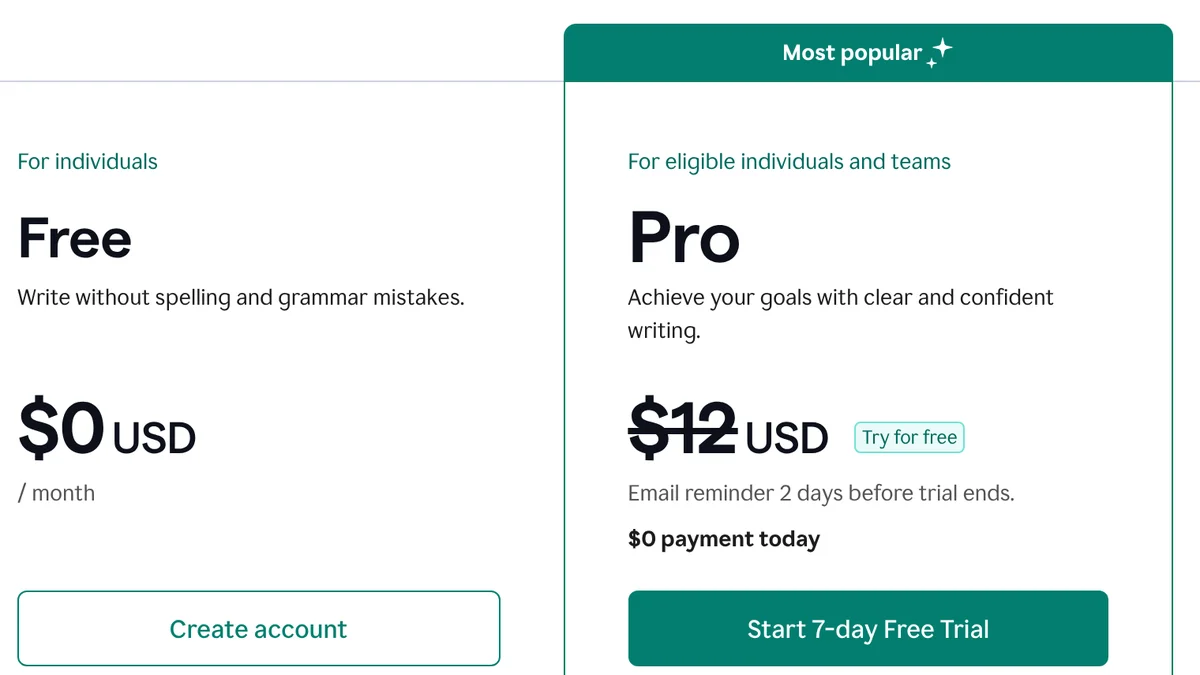
- 1Free: $0 USD a month, with an account.
- 2Pro: the card shows $12 USD, struck through, with no billing period. Grammarly’s help center explains it: $144 a year, on average $12 a month; billed monthly, Pro is $30[4].
- 3Trial: 7 days,
$0 payment today
, an email reminder 2 days before the trial ends. After that, paid plans renew automatically until you cancel[6].
Screenshot of grammarly.com/plans, Oct 12, 2026, 03:58 UTC, taken by StudyTexter in a browser set to US English; the page shows US dollars[5].
- Renewal and refunds: paid plans renew automatically until you cancel, and the terms call all payments non-refundable to the extent the law allows[6].
- Disputes: unless you are in the EEA or local law forbids it, the terms require binding arbitration; new users can opt out by email within 30 days. In Canada, non-arbitrable claims go to courts in Quebec or Ontario[6].
- Training: on individual accounts, “Product Improvement and Training” is on by default and can be switched off[7]. For the free tool without an account, Grammarly doesn’t say.
On Trustpilot, Grammarly has 3.1 out of 5 from 10,473 reviews: 68% give five stars, 9% one star. Trustpilot’s AI summary says most reviewers were somewhat happy and value the time saved, but notes frustration with unexpected charges and annual subscriptions. The ratings cover all of Grammarly, not the humanizer alone[19].
We summarize what the documents say as of Oct 11, 2026. This is not legal advice.
Grammarly humanizer FAQ
Is Grammarly’s AI humanizer free?
Yes. The basic tool on grammarly.com works without an account. A free account adds four preset voices, a custom voice and six languages: English, Spanish, French, German, Portuguese and Italian. Pro unlocks “the full Humanizer experience”, which Grammarly does not describe further (as of Oct 11, 2026).
Does Grammarly’s humanizer have a word limit?
Its page names no word limit for the free tool, but points you to a free account to “continue humanizing”. With a long paper, work section by section and check each part.
Does Grammarly’s humanizer keep citations and quotes intact?
Its page doesn’t say. The rewrite rules in the page’s public HTML keep names, dates and statistics, but say nothing about quotation marks, page numbers or reference lists, and they replace every en dash, which APA uses in page ranges. Check every quote and reference afterwards. Our test is pending.
Can Turnitin or GPTZero detect text from Grammarly’s humanizer?
We found no reliable public test for this tool. Grammarly says it is not intended to evade AI detectors, and in a test on Carleton College’s AI blog, Grammarly’s own detector flagged Grammarly-humanized text “somewhat reliably”. Turnitin added humanizer detection in August 2025; GPTZero now belongs to Grammarly’s parent Superhuman.
Is using Grammarly’s humanizer cheating?
That depends on your course rules. Grammarly itself warns that disguising AI use may count as cheating or plagiarism where AI use is restricted or must be disclosed. If AI help is allowed, disclose it.
Grammarly humanizer or QuillBot humanizer: which is better for essays?
Both say they are not tools for avoiding AI detection, and neither page promises to keep citations intact. Grammarly’s basic tool is free with no stated limit; QuillBot’s free plan has word limits that Premium removes. With cited text, check the output line by line either way.
What if I still have to write the paper with sources?
Then start earlier. StudyTexter guides you from topic to a full draft in 12 steps, with sources from over 479 million that you accept or reject, over 2,800 citation styles to pick in step 3 and plagiarism and AI checks included. Steps 1 to 5 are free; packages start at $79, one-time. You stay the author.
Method and disclosure

We read websites, terms and reviews ourselves, back every number with a source and access date, and only add test results once we have them. Found a mistake? We correct it with a date.
On Oct 11, 2026 we read Grammarly’s humanizer page and its public HTML (archived with a checksum and on archive.org), the plans page in a browser, the terms, three help articles, the AI Detector and Authorship pages, Trustpilot, QuillBot’s humanizer page, news on the GPTZero deal, a published test, a faculty resource and the AI rules of three universities and colleges. We did not create a Grammarly account, did not run its humanizer and used nothing from the page’s scripts.
Most reviews ranking for this search in October 2026 come from companies selling a competing humanizer or detector[21][22]. StudyTexter offers its own humanizer too. So every statement has a source and date, the test material is public, and there is no quality verdict before the test.
Changes: Oct 11, 2026 first version; the same day, term aligned with the app (proposal draft); Oct 12, 2026: added dated screenshots of Grammarly’s humanizer FAQ and plans page, facts unchanged.
Sources
- grammarly.com/ai-humanizerfree tool, Humanizer agent, languages, FAQ on detectors and integrity · accessed Oct 11, 2026
- grammarly.com/ai-humanizer, public HTML (archived copy)rewrite prompt in the HTML delivered on Oct 11, 2026, last updated Apr 17, 2026 · accessed Oct 11, 2026
- Grammarly Support: Humanizer user guidewhere the Humanizer agent runs, custom voice from a 200-word sample · accessed Oct 11, 2026
- Grammarly Support: How much does Grammarly Pro cost?$30 monthly, $60 quarterly, $144 yearly; currencies · accessed Oct 11, 2026
- grammarly.com/plans (rendered in a browser)Free and Pro features, 7-day trial · accessed Oct 11, 2026
- Superhuman Terms of Service (effective Oct 29, 2025)company, auto-renewal, no refunds, arbitration · accessed Oct 11, 2026
- Grammarly Support: Product Improvement and Training Controltraining on by default for individual accounts · accessed Oct 11, 2026
- grammarly.com/ai-detectoraccuracy claims and limits · accessed Oct 11, 2026
- grammarly.com/authorshipAuthorship report, Free and Pro · accessed Oct 11, 2026
- gptzero.me“GPTZero is now a part of Superhuman” · accessed Oct 11, 2026
- Pulse 2.0, Superhuman to acquire GPTZero (Jun 23, 2026)deal announcement, GPTZero stays a standalone product · accessed Oct 11, 2026
- SiliconANGLE, Grammarly parent Superhuman buys AI detector GPTZero (Jun 24, 2026)deal details, rebrand of Grammarly, Inc. in October 2025 · accessed Oct 11, 2026
- Carleton College AI blog, Grammarly Revisited (Oct 29, 2025)hands-on look at Grammarly’s AI features · accessed Oct 11, 2026
- Plagiarism Today, Turnitin launches anti-AI humanizer feature (Aug 27, 2025)Turnitin flags text edited with humanizers · accessed Oct 11, 2026
- University of Notre Dame, Policy Update: AI Editing Tools (Fall 2024)Grammarly suggestions count as AI-generated text · accessed Oct 11, 2026
- Academy of Contemporary Music, Policy 075: Student Use of Artificial Intelligence (v2.0, approved Sep 1, 2026)UK policy naming Grammarly · accessed Oct 11, 2026
- University of the Sunshine Coast, AI guidelines (last amended Oct 23, 2024)genAI functions of editing tools · accessed Oct 11, 2026
- University at Buffalo CATT, Grammarly’s new AI tools: what faculty should knowfaculty view of the humanizer · accessed Oct 11, 2026
- Trustpilot, grammarly.com3.1 / 5 from 10,473 reviews · accessed Oct 11, 2026
- quillbot.com/ai-humanizerfree and Premium limits, languages · accessed Oct 11, 2026
- Undetectable AI blog, Grammarly AI Humanizer review (modified Sep 14, 2026; sells a humanizer)top-ranking review · accessed Oct 11, 2026
- Quetext blog, Grammarly AI Humanizer review (Mar 2026; sells an AI detector)ranking review without a test · accessed Oct 11, 2026
Read next
Brands and logos mentioned belong to their owners and are used for identification only. They are not affiliated with StudyTexter.