
Is GPTZero Accurate? What the Numbers Really Measure
GPTZero states its accuracy in many ways: 99.9%, “no more than 1%” false positives, 1 in 10,402. Each number measures something different. We read GPTZero’s pages and every independent test we could find, from March 2023 to July 2026. For each one you see the sample, the date and who ran it. We did not enter any text into GPTZero.

 Janosch & Dr. Jonathan SchulteStudyTexter editorial team
Updated
18 min read
Disclosure: This comparison is published by StudyTexter, a company in the same market. We only state verifiable facts with source and date. Method
Contents
In the newest large tests, mostly yes on English prose, but no score is proof. GPTZero’s own newest test reports 1 false flag in 10,402 student essays (GPTZero 4o, October 2026). The large independent tests from 2024 to 2026 found 0% to 1.36% false flags on human texts. Older or small tests found much more: 9 of 18 texts in March 2023 and 8 of 50 short essays in a 2025 preprint. We found no independent test that names the 4o model yet. GPTZero itself says results should not be used to punish students.
Is GPTZero accurate? First, what its numbers measure
Many pages that answer this question quote one number. GPTZero itself gives at least seven, and they measure different things. A high accuracy rate can still hide false flags on human writing, which is the error that matters most to students. Here is what each number means:
| GPTZero says | What the number measures |
|---|---|
| “99.9% accuracy rate”[2] | Correct results on human and AI texts together. The data set is not named on the page. It does not tell you how often human writing is flagged. |
| “no more than 1%” and “under 1%”[1] | A ceiling for false positives “when evaluating AI versus human text”. No data set, text type or date is given. |
| “1% of human texts” on RAID[2][4] | The RAID metric “TPR@FPR=1%”: the threshold is set so that exactly 1% of human texts count as AI, then the share of AI texts caught is measured (95.7%). |
| 1.1% on TOEFL essays[1] | GPTZero’s own test on essays by English learners. Sample size not stated. |
| 99.1% of human articles classed as human[6] | Only results with the label “high” confidence. Lower confidence levels are not covered by this number. |
| 0.05% (1 error)[5] | GPTZero’s re-run of a 2025 university data set of 1,992 human texts. Here “Mixed” and “Lightly edited by AI” count as AI. |
| 1 in 10,402[3] | GPTZero 4o on the test part of the PERSUADE student essays, GPTZero’s own test, published Oct 18, 2026. |
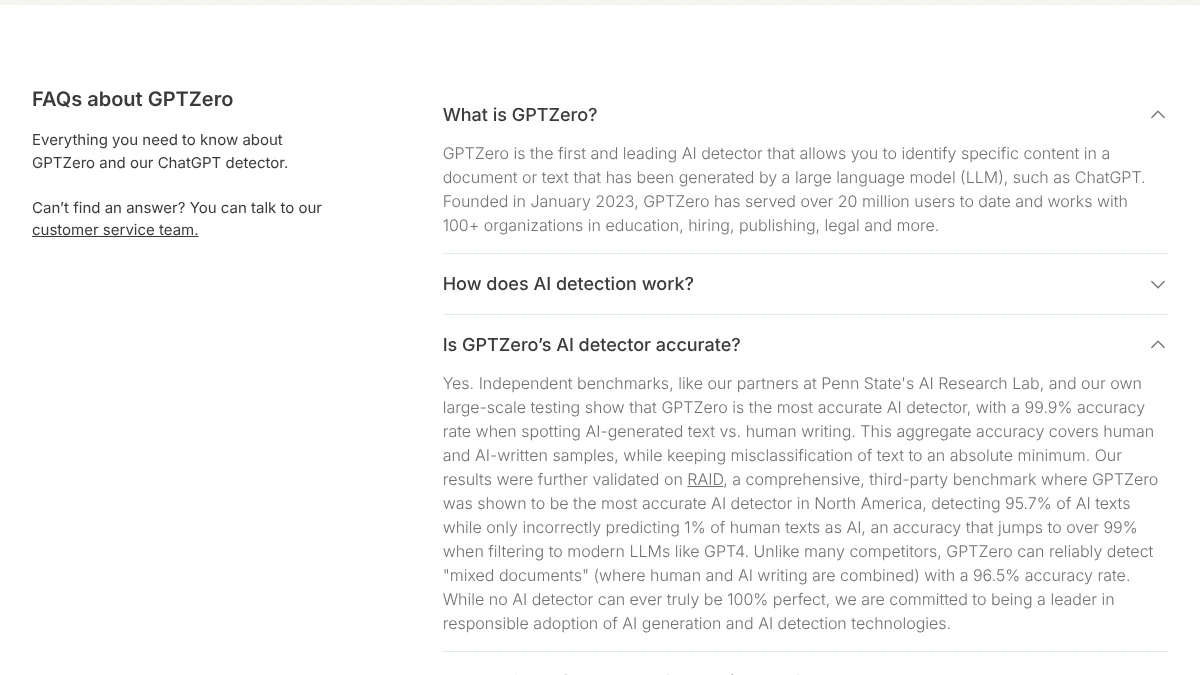
- 199.9% accuracy: GPTZero says this “aggregate accuracy covers human and AI-written samples”. It is not a false positive rate.
- 2“1% of human texts” on RAID: in GPTZero’s own RAID post, this is the error rate the benchmark fixes in advance, not a measured result.
- 3Limit: “no AI detector can ever truly be 100% perfect”, in GPTZero’s words.
Screenshot of gptzero.me, Nov 3, 2026, 19:01 UTC, taken by StudyTexter, cropped. We opened one FAQ answer; no text was entered.
So when someone says “GPTZero is 99% accurate”, ask: accurate on what texts, at which threshold, and which version? The rest of this page answers those questions with dates.
How accurate is GPTZero in independent tests? A timeline
We list every independent test we found that reports GPTZero’s errors on human-written text, ordered by test date, or by publication date where no test date is given. The date matters: GPTZero has released several model versions, such as 2025-12-18-base and 4o[5][3], so a 2023 result says little about the 2026 tool.
- 9 of 18 human texts flaggedtested Mar 2023Peer-reviewed study of 14 tools. Of the 18 texts, 9 were written in English and 9 machine-translated into English; GPTZero flagged 3 and 6 of them. Two authors help run a conference that Turnitin sponsors, which they disclose[9].
- 1 of 42 student essaystested Jun to Jul 2023Peer-reviewed. First-year essays from 2014/15, tested with GPTZero’s paid version. No funding[10].
- 1 of 10 control textstested Sep to Oct 2023Peer-reviewed. Texts by university staff and by Vietnamese students[11].
- 0.00% at the default thresholdtested Jan 2024RAID benchmark, peer-reviewed, nearly 15,000 human texts from 8 types such as news, Reddit and abstracts. Funded by a US government research agency[8].
- 8 of 50 student essays (16%)preprint Jun 2025Not peer-reviewed, small sample, essays of only 40 to 800 words, no test date. Most false flags were on very short and on longer essays[12].
- 0.71% of 1,992 human textsworking paper Sep 2025Not peer-reviewed; reviews, blogs, news and novels, no student papers[13][5]. GPTZero says the authors used the wrong field of its API; its own re-run shows 0.05%[5].
- 1.36% of 15,700 web articlespublished May 2026By Graphite, a growth agency, not peer-reviewed. Articles written before ChatGPT existed. GPTZero cites this result on its own blog[14][3].
- 0 of 40 graduate paperspublished Jun 2026Peer-reviewed and preregistered. Papers of 4,000+ words by non-native graduate students. The text also mentions “a small false positive rate” for GPTZero, without a number[15].
- 0 of 495 human passagespublished Jul 2026Epoch AI, a research institute. The GPTZero version is not named. When AI text imitated a real author’s style, the three detectors missed 10% to 18% of it[16].
The pattern in our list: large tests from 2024 on found few or no false flags, while the early and the small tests found many more. Two warnings. First, small samples are weak evidence in both directions: 0 of 40 does not prove a rate of zero. Second, none of these tests names GPTZero 4o, the model GPTZero has used by default since September 20, 2026[3]. GPTZero’s own 4o post shows a 0% result for 4o on Epoch AI’s benchmark, but it does not say who ran it[3]. We found no independent test that names 4o as of Nov 3, 2026.
Why GPTZero’s accuracy depends on your text
Six things explain most of the gap between 1 in 10,402 and 9 of 18:
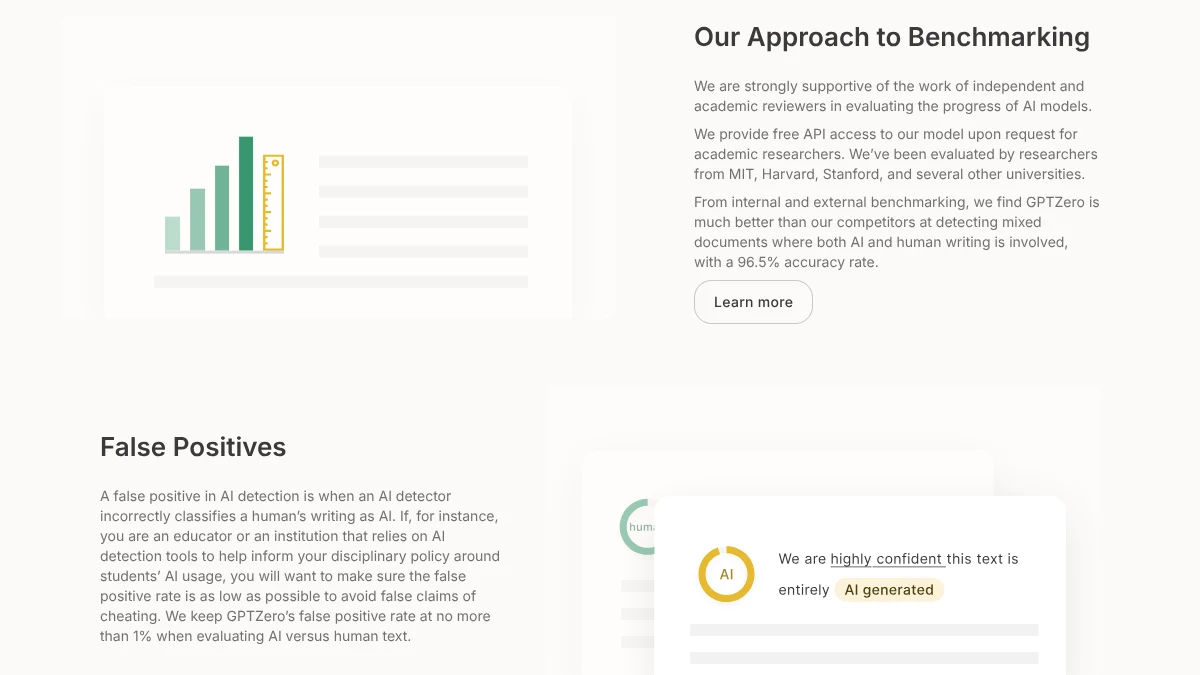
- 196.5% is GPTZero’s accuracy on mixed documents (part human, part AI), from “internal and external benchmarking”.
- 2False positive, as GPTZero defines it: a human’s writing classified as AI.
- 3The claim: a false positive rate of “no more than 1% when evaluating AI versus human text”.
- 4Confidence label in the sample result: “highly confident”. GPTZero tunes this level to an average error rate under 1%.
Screenshot of gptzero.me/technology, Nov 3, 2026, 19:00 UTC, taken by StudyTexter, cropped.
GPTZero is open about several of these limits. It says its model is tuned to prefer “less-harmful false-negative errors over false-positive errors”[1], and that “it is more important that a student is not wrongly flagged than that every AI text is caught”[7]. It also says the majority of its training data is “English prose, written by adults”[6].
GPTZero false positives: what do they mean for a whole degree?
A small rate for one paper becomes a bigger number over many papers. This calculator uses GPTZero’s own rates and lets you compare them with independent results. Set how many of your papers might be checked:
That is papers in total. The bars show the chance that at least one of them gets a false AI flag.
With 4 papers a term over 8 terms, GPTZero’s newest claim gives a chance of about 0.3% that even one of 32 papers gets a false flag. At its stated ceiling of 1%, the chance is 27.5%. Which number is closer to your case depends on your text type and on the model version your school uses. Here is the source of the lowest rate:
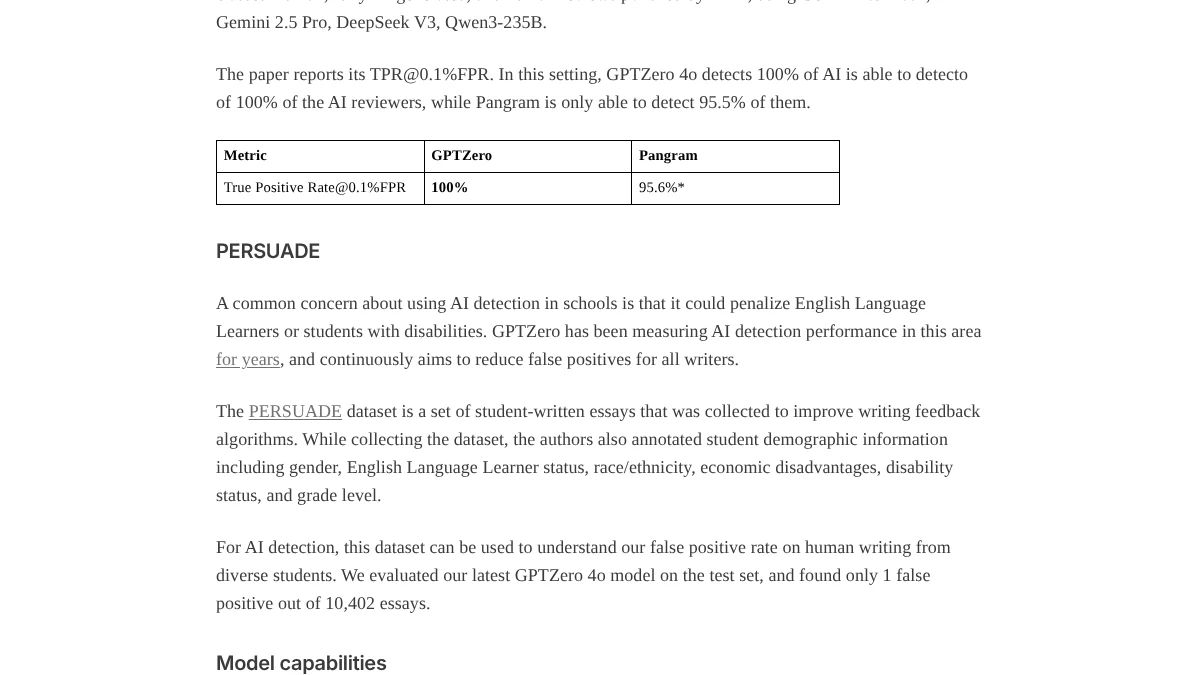
- 1PERSUADE: a set of student-written essays, collected to improve writing feedback; GPTZero used its test part.
- 2Who wrote them: the data set records English Language Learner status, disability and other details.
- 3The result: “only 1 false positive out of 10,402 essays”, in GPTZero’s own test of its 4o model.
Screenshot of gptzero.me/news/introducing-gptzero-4o, Nov 3, 2026, 19:01 UTC, taken by StudyTexter, cropped. Post dated Oct 18, 2026.
For two other views on the same question, see the calculators in our best AI detector guide (how many flags hit human writers) and our Scribbr review (how many students are hit in a large group).
Is GPTZero fair to non-native English writers?
Many of our readers write English as a second language, so this question matters. The evidence is mixed and mostly older:
| Source | What it found |
|---|---|
| Patterns, peer-reviewed; tested Mar 2023[17] | Seven detectors, GPTZero among them, flagged 61.22% of 91 TOEFL essays by non-native writers on average. Values per tool are shown only in a chart. |
| IJEI, Dec 2023; tested Mar 2023[9] | GPTZero flagged 6 of 9 human texts that were machine-translated into English. Translation is not the same as writing in a second language. |
| IJEI, Jun 2026[15] | 0 of 40 papers by non-native graduate students flagged as AI, by any of the four tools, GPTZero included. |
| GPTZero’s own claims[1][3] | 1.1% on TOEFL essays; 1 in 10,402 on the PERSUADE set, which includes English learners. |
Our reading: newer results look much better than 2023, but the best results come from GPTZero’s own tests. If English is your second language, keep your drafts and notes from day one.
Is GPTZero free? Prices and user reviews
GPTZero has a real free plan, which is a strong point. Without an account, one scan can be up to 10,000 characters; for longer scans you need a free account[2].
| Plan | Price per month |
|---|---|
| Free | $0 |
| Premium | $12.99 annual / $23.99 monthly |
| Professional | $24.99 annual / $45.99 monthly |
What users say on Trustpilot
| Trustpilot, GPTZero | Result |
|---|---|
| TrustScore | 2.2 out of 5 (“Poor”) |
| Reviews | 140, of which 40 in the last 12 months |
| Stars | 5★ 41%, 4★ 2%, 3★ 3%, 2★ 5%, 1★ 49% |
| The 20 newest reviews (Feb 12 to Sep 22, 2026), our reading | 5 say the writer’s own text was flagged as AI; 8 mention billing or cancelling (one of them praises the support) |
Low review scores do not measure accuracy. They do show that some people feel wrongly flagged, which matches what GPTZero itself says about edge cases: “There always exist edge cases with both instances where AI is classified as human, and human is classified as AI”[6]. In June 2026, Superhuman, the company behind Grammarly, agreed to buy GPTZero; gptzero.me now links to both in its footer[21][2].
Where GPTZero is better, and where StudyTexter fits
GPTZero and StudyTexter do different jobs. GPTZero judges a text that already exists. StudyTexter helps you build your paper so you can show where each claim comes from.
Where GPTZero is better
- it checks any finished text; StudyTexter is not a detector for other people’s texts
- free plan with 10,000 words a month[18]
- confidence levels, sentence highlights and a “Mixed” label explain the result[1]
- few or no false flags in the large independent tests from 2024 to 2026[8][15][16]
- publishes many benchmarks and offers free API access to researchers, in its own words[1]
Where StudyTexter fits
- you still have to write the paper: a guided path in 12 steps from your topic to a full draft, which you revise as the author
- you accept or reject each source it suggests from 479M+ sources
- every citation shows its source and page number in the Evidence View
- plagiarism and AI check included; free for steps 1 to 5, up to your proposal draft; packages one-time from $79, no subscription
What to do if GPTZero flags your own writing
GPTZero says its results should not be used as the final verdict[6][19]. These steps help you show your own work:
- Ask for the detailsday 1Ask which tool, which model and which label were used: “AI”, “Mixed” or “Lightly edited by AI”, and the confidence level. Ask which passages were highlighted.
- Quote GPTZero itselfday 1GPTZero writes that its results “should not be used to punish students” and that it is “designed to be a guide as opposed to a final verdict”[6][19].
- Show how you workedday 1 to 2Collect drafts, version history, notes and the sources you read. Your writing process is better evidence than any score.
- Check the text typeday 2GPTZero says it can flag “highly procedural text”, and that it works best on longer English prose[6][2]. Methods sections, lists and short answers are harder cases.
- Follow your school’s procedurein the meetingYour course rules and your school’s academic integrity process come first. This is not legal advice.
GPTZero vs StudyTexter: detector or writing guide?
| Feature | GPTZero |  |
|---|---|---|
| What it does | estimates whether a finished text was written with AI | guided 12 steps from topic to full draft, with 479M+ sources |
| AI and plagiarism check | AI detection is its core product; plagiarism check offered separately | plagiarism and AI check included |
| Payment | free plan, or monthly or annual plans | one-time from $79, no subscription |
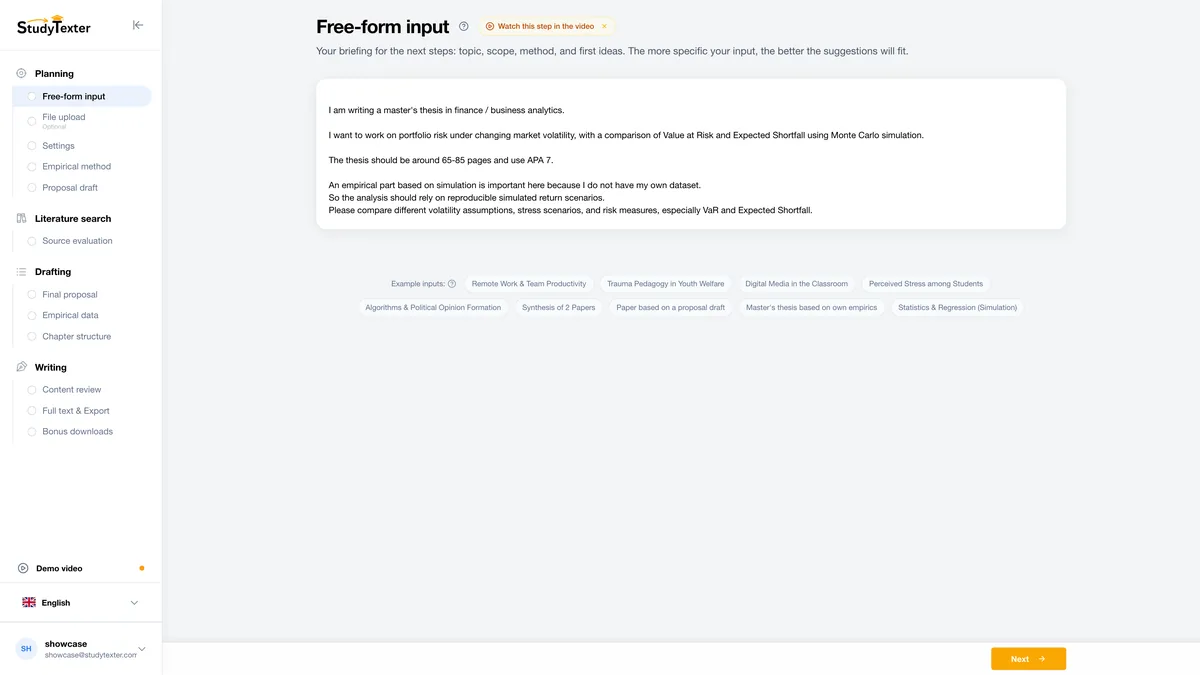
Topic in your words
Describe your topic in your own words. One sentence is enough to start.
- Texts human-written texts of different types and lengths (with the writers’ permission) and AI-written texts, each with a known origin.pending
- Tool GPTZero’s free plan, by hand, without automation, current default model.pending
- Record label, confidence level, highlighted passages, date and a screenshot for every run.pending
We have not run this test, so this page makes no accuracy claim of its own. All numbers above come from GPTZero or from published tests.
Is GPTZero accurate? Frequently asked questions
How accurate is GPTZero?
On human writing, the large independent tests from 2024 to 2026 found 0% to 1.36% false flags. Small or older tests found more: 16% of 50 short essays (2025 preprint) and 9 of 18 texts (March 2023). GPTZero’s own newest test reports 1 in 10,402.
Is GPTZero reliable enough to prove AI use?
No, and GPTZero says so itself: results “should not be used to punish students”, and the tool is “designed to be a guide as opposed to a final verdict”.
Can GPTZero give a false positive on my own writing?
Yes. Several independent tests found false flags, for example 9 of 18 texts in 2023 and 8 of 50 short essays in a 2025 preprint, and GPTZero states a false positive rate of up to 1%. GPTZero says accuracy is lower on short texts.
Is GPTZero free?
Yes, with limits: the Free plan has 10,000 words a month. Without an account, one scan can be up to 10,000 characters. Premium costs $12.99 a month billed annually or $23.99 billed monthly (Nov 3, 2026).
Is GPTZero better than other AI detectors?
In the newest tests it did as well as the best tools on human texts: 0 of 495 (Epoch AI, July 2026) and 0 of 40 (IJEI, June 2026). Our guide to the best AI detector compares all major tools.
Is GPTZero biased against non-native English writers?
The evidence is mixed: a 2023 study found high false flag rates for non-native writers across 7 detectors, while newer results look much better. See the table in the section on non-native writers above.
What is a good GPTZero alternative?
For another detector, see our best AI detector guide. If you still have to write your paper, StudyTexter guides you to your own draft with sources, page numbers and a plagiarism and AI check included.
Method and disclosure

We read websites, terms and reviews ourselves, back every number with a source and access date, and only add test results once we have them. Found a mistake? We correct it with a date.
On Nov 3, 2026 we read GPTZero’s home page, Technology page, FAQ, student page, pricing page (annual and monthly view) and three blog posts, and took dated screenshots of public pages. We read the RAID paper and the 2025 preprint in full and used our earlier reading of the other studies for our best AI detector guide; we checked their links again on Nov 3, 2026. We did not enter any text into GPTZero, did not create an account and did not submit anything.
We counted only results on human-written texts that a source reports for GPTZero. Vendor numbers are labeled as GPTZero’s own claims. StudyTexter sells a guided draft with a plagiarism and AI check included, so we have an interest in this topic. All product names are trademarks of their owners; we use them only to describe the products. If you find a mistake, we will correct it and date the change.
Changes: Nov 3, 2026 first version; the same day, revised after an independent fact check (wording on GPTZero 4o, comparison table, calculator option, review count).
Sources
- GPTZero: Technology (sections False Positives, De-biasing, Confidence Scores, FAQ)“no more than 1%”, “under 1%”, TOEFL 1.1%, “No AI detector is 100% accurate” · accessed Nov 3, 2026
- GPTZero: home page and FAQ“99.9% accuracy rate”, RAID “1% of human texts”, 10,000 characters without an account, footer links to Superhuman and Grammarly · accessed Nov 3, 2026
- GPTZero: Introducing GPTZero 4o (vendor post, Oct 18, 2026)1 false positive in 10,402 PERSUADE essays; default model since Sep 20, 2026 · accessed Nov 3, 2026
- GPTZero: GPTZero is Officially The Most Accurate Commercial AI Detector (vendor post, Oct 15, 2025)explains the RAID metric TPR@FPR=1% · accessed Nov 3, 2026
- GPTZero: GPTZero Tops Accuracy on Chicago Booth Benchmark in 2026 (vendor post, Jan 13, 2026)re-run: 0.05% false positives; “Mixed” counted as AI · accessed Nov 3, 2026
- GPTZero: Frequently asked questionshigh confidence: 99.1% of human articles classified as human; limits of the classifier · accessed Nov 3, 2026
- GPTZero: How AI detection works“more important that a student is not wrongly flagged” · accessed Nov 3, 2026
- RAID: A Shared Benchmark for Robust Evaluation of Machine-Generated Text Detectors, ACL 2024 (peer-reviewed; arXiv version, tables 4 and 8)GPTZero 0.00% false positives at a threshold of 0.5; 0.0% to 13.0% by type of text at a 5% target · accessed Nov 3, 2026
- Testing of detection tools for AI-generated text, International Journal for Educational Integrity 19, article 26 (Dec 25, 2023; peer-reviewed)18 human texts, tests in March 2023 · accessed Nov 3, 2026
- The Effectiveness of Software Designed to Detect AI-Generated Writing: A Comparison of 16 AI Text Detectors, Open Information Science 7(1) (Oct 6, 2023; peer-reviewed)42 first-year student essays, tests June/July 2023 · accessed Nov 3, 2026
- GenAI Detection Tools, Adversarial Techniques and Implications for Inclusivity in Higher Education (arXiv preprint, Mar 2024; journal version in the International Journal of Educational Technology in Higher Education 21, article 53, Sep 9, 2024; peer-reviewed)10 human control texts, tests Sept/Oct 2023 · accessed Nov 3, 2026
- Assessing GPTZero’s Accuracy in Identifying AI vs. Human-Written Essays (arXiv preprint, Jun 30, 2025; not peer-reviewed)50 human essays of 40 to 800 words, 8 flagged as AI · accessed Nov 3, 2026
- Artificial Writing and Automated Detection, NBER Working Paper 34223 (Sep 2025; not peer-reviewed)1,992 human texts; GPTZero 0.71% at a threshold of 0.5 · accessed Nov 3, 2026
- Graphite: AI now writes as many online articles as humans do (May 15, 2026; not peer-reviewed)15,700 articles from before ChatGPT; GPTZero false positive rate 1.355% · accessed Nov 3, 2026
- Who wrote this? Evaluating the reliability of AI detection tools in higher education, International Journal for Educational Integrity 22, article 16 (online Jun 29, 2026; peer-reviewed)40 papers by non-native graduate students · accessed Nov 3, 2026
- Epoch AI: AI detectors and false negatives (data insight, Jul 15, 2026)495 human passages, GPTZero 0 flagged · accessed Nov 3, 2026
- GPT detectors are biased against non-native English writers, Patterns (2023; peer-reviewed; arXiv version)7 detectors including GPTZero, 91 TOEFL essays, average false positive rate 61.22% · accessed Nov 3, 2026
- GPTZero: Pricing (annual and monthly view)Free 10,000 words a month; Premium $12.99 or $23.99; Professional $24.99 or $45.99 per month · accessed Nov 3, 2026
- GPTZero: For Students“designed to be a guide as opposed to a final verdict” · accessed Nov 3, 2026
- Trustpilot: GPTZero reviews2.2 out of 5 from 140 reviews · accessed Nov 3, 2026
- SiliconANGLE: Grammarly parent Superhuman buys AI detector GPTZero (Jun 24, 2026)Superhuman “has agreed to acquire GPTZero” · accessed Nov 3, 2026
Read next
Brands and logos mentioned belong to their owners and are used for identification only. They are not affiliated with StudyTexter.