
Turnitin AI Detection: How the Score Works and What It Can’t Prove
You submit a paper, and Turnitin may give your instructor an AI score you never see. On Nov 3, 2026, we read Turnitin’s current help pages, its release notes since 2023, four independent studies and the policies of nine universities. Here is how the score is made, what each display means, how often it is wrong, and what schools may do with it.

 Janosch & Dr. Jonathan SchulteStudyTexter editorial team
Updated
19 min read
Disclosure: This comparison is published by StudyTexter, a company in the same market. We only state verifiable facts with source and date. Method
Contents
Yes, if your school licenses it: Turnitin scores each prose sentence, labels those above a threshold as AI and shows your instructor the share, as a number only from 20% (1 to 19% shows as “*%”, and under 300 words of prose gets no score). Turnitin targets under 1% false positives on documents with over 20% AI writing and says the score “should not be used as the sole basis for action”. Students don’t see it by default, and at least eight universities have switched it off since 2023.
Does Turnitin detect AI?
Yes, if your school pays for it and has it switched on. Turnitin’s AI writing detection is part of the Similarity Report and needs a Turnitin Originality license; admins can turn it off[1]. It reads your prose sentence by sentence and tells your instructor how much of it looks AI-written. It does not decide whether you cheated. Turnitin says so itself: the score “should not be used as the sole basis for action or a definitive grading measure”[1].
- Who sees it
- instructors and admins; not students by default, but instructors can share the report as a PDF[1]
- What it scores
- prose sentences in long-form writing; lists, headers, references, tables and code are removed[1]
- Minimum / maximum
- 300 to 30,000 words of prose, file under 100 MB[3][1]
- File types
- .docx, .pdf, .txt, .rtf[3]
- Languages
- English, Spanish, Japanese, Arabic, German, Dutch, Turkish; humanizer and paraphrasing detection in English only[1]
- Shown as a number
- from 20%; 1 to 19% shows as *%[1]
- Latest model change
- Oct 14, 2026 (English)[4]
- Access
- no student license; only through your school’s Turnitin Originality license[1]
This page explains Turnitin’s AI score. If you want to check your paper for plagiarism before you submit, see our Turnitin alternative for students. If you want to compare AI detectors, see our guide to AI detectors and the studies behind them.
How Turnitin detects AI: from your file to a percentage
Turnitin explains the process in its FAQ, last updated on Nov 3, 2026[1]. In short: it removes everything that is not a full sentence, scores each sentence, counts the sentences above a threshold, and shows that share as a percentage.
- File check.docx, .pdf, .txt or .rtf, under 100 MB, 300 to 30,000 words of prose, a supported language.Fails? Gray “- -”, no score.
- Prose onlyLists, headers, references, data tables, formulas and code are removed.Removed text doesn’t count either way.
- Sentence scoresEach sentence gets a score from 0 to 1, read in context with the text around it.The model is a transformer, not a rule list.
- ThresholdSentences above a threshold are labeled AI, the rest Human.Turnitin does not state its value.
- Share of sentencesThe score is the share of AI-labeled sentences in the prose that was checked.Not the share of your whole file.
Two details matter for you. First, the percentage is a share of the prose that was checked, “not necessarily the percentage of the entire submission”[1]. A paper with long lists or tables can show highlights that don’t match the number. Second, Turnitin says its model “is not explicitly programmed” to measure signals such as “perplexity” or “burstiness” and learns patterns from training data instead (an older passage of the same FAQ still speaks of “differences in word probability”). Turnitin adds that “individual predictions may not always be explainable”[1]. So even Turnitin may not be able to say why one sentence was labeled AI.
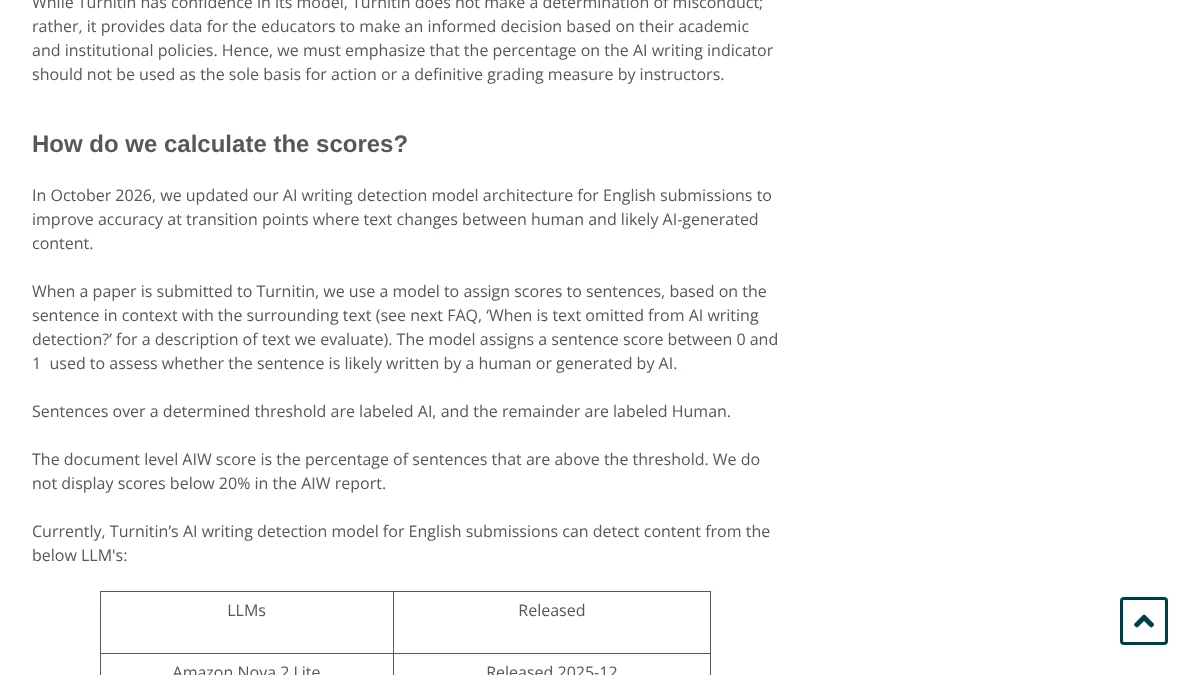
- 1October 2026: Turnitin changed the model for English papers “to improve accuracy at transition points” between human and AI text.
- 2Sentence score: every sentence gets a value “between 0 and 1”, read “in context with the surrounding text”.
- 3Threshold: sentences above it are labeled AI, the rest Human.
- 4The score: “the percentage of sentences that are above the threshold”; nothing below 20% is shown as a number.
Screenshot of guides.turnitin.com, Nov 3, 2026, 19:08 UTC, taken by StudyTexter. Cropped only; the numbered marks are ours. Window 1200 px wide so the text stays readable[1].
The model also changes. Turnitin lists 12 dated entries in its release notes from May 2023 to October 2026[4]. A report keeps its old score; only a new submission gets the new model[1].
What your Turnitin AI score shows: 0%, *%, 20% and up
Your instructor sees one of five states[1][2]. Use the check below to see which one applies to a paper like yours. It only applies Turnitin’s published rules. It does not look at your text.
This is how the states read in Turnitin’s FAQ:
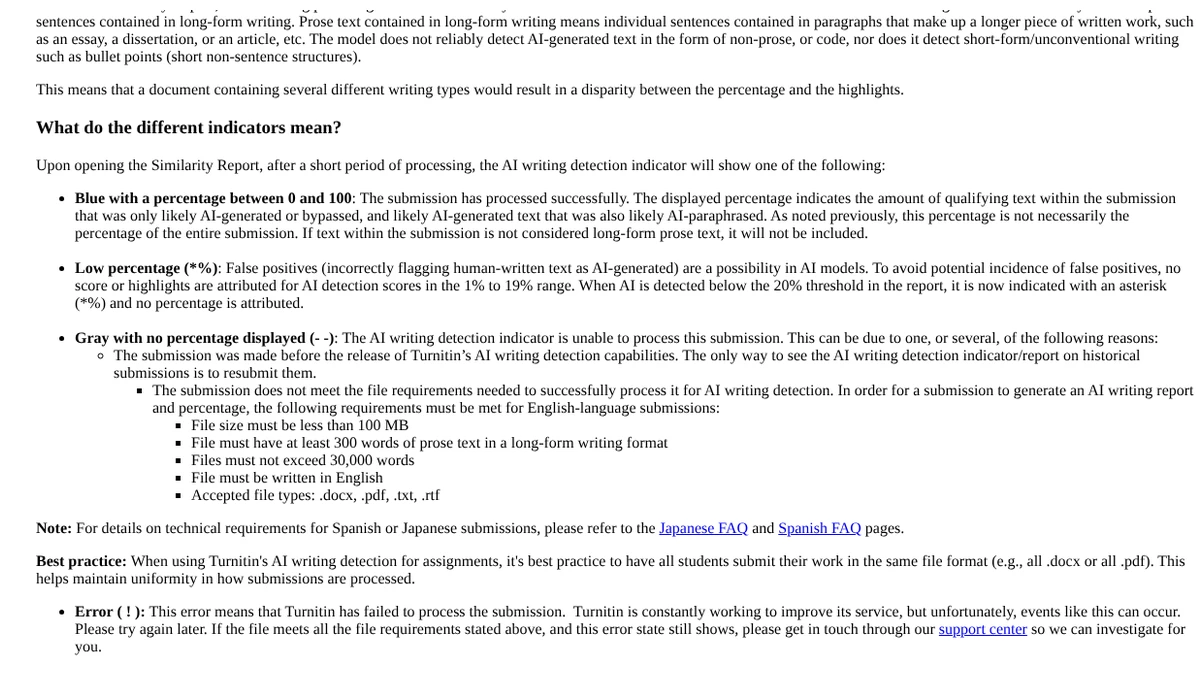
- 1Blue 0 to 100: processed. The number is the share of “qualifying text”, not of the whole submission.
- 2*%: “no score or highlights are attributed for AI detection scores in the 1% to 19% range”.
- 3Gray “- -”: not processed, for example under 300 words of prose, over 30,000 words or a file type other than .docx, .pdf, .txt or .rtf.
- 4Error ( ! ): Turnitin failed to process the file; it suggests trying again later.
Screenshot of guides.turnitin.com, Nov 3, 2026, 19:09 UTC, taken by StudyTexter. Cropped only; the numbered marks are ours. The page loaded without its styles in our browser; scaled down slightly and padded at the left for the marks, text unchanged[1].
Turnitin’s instructor guide is not fully consistent: it says the asterisk covers scores “between 0 and 20”, and a few lines later “above 0% and below the 20% threshold”[2]. The FAQ says 1 to 19%[1]. The meaning is the same: under 20%, no number.
Is Turnitin’s AI detector accurate?
Two kinds of numbers exist: Turnitin’s own, and those of researchers who tested it. Turnitin sells the product, so read its numbers as claims.
What Turnitin says
| What Turnitin says | What it means for you |
|---|---|
| False positives per document[1] under 1% | Target for documents with over 20% AI writing: “one out of every 100 fully-human written documents” could be flagged. |
| False positives per sentence[5] ~4% (2023) | A highlighted sentence may be human-written about 4 times in 100, most often next to real AI text. Published in May 2023; no newer figure found. |
| Missed AI text[1] 50% shown, up to 65% real | Turnitin accepts missing some AI text to keep false positives low. |
| Test set before each update[1] 700,000 papers | Academic papers written before ChatGPT. Turnitin’s own test, not an independent one. |
| Non-native writers[6] 0.014 vs 0.013 | False positive rate for English learners vs native writers in Turnitin’s own test, papers of 300+ words. |
Turnitin also names what can cause a false positive: text “without a lot of structural variation”, text “that literally repeats itself”, and text “paraphrased without developing new ideas”[1]. On short papers of a few hundred words, the result is mostly “all or nothing”, so a mixed text can be flagged as fully AI[1]. Grammar fixes by Grammarly were in most cases not flagged in Turnitin’s tests; text from generative features such as drafting or paraphrasing will likely be flagged[1].
What independent studies found
| Independent study and sample | Turnitin result |
|---|---|
| Peer-reviewed, Dec 2023; Turnitin tested Apr 2023[9] 18 (9 English, 9 machine-translated) | 0 wrongly flagged. Two authors help run a conference that Turnitin sponsors (disclosed). |
| Peer-reviewed, Oct 2023[10] 42 first-year essays from 2014/15 | 0 wrongly flagged. The author notes Turnitin may have seen such papers before. |
| Preprint Mar 2024, journal Sep 2024; tests Sep/Oct 2023[11] 10 control texts | 0 wrongly flagged. |
| Peer-reviewed, Jun 2026[12] 40 papers of 4,000+ words by non-native graduate students | 0 flagged at 20% or more; 3 showed *%. But all 40 fully AI-written papers (made with deep-research tools, tested before Turnitin’s October 2026 update) also scored under 20%. |
How Turnitin’s AI detection changed, 2023 to 2026
Many blog posts about Turnitin’s AI score quote rules from 2023. Several have changed. Here is what Turnitin’s release notes and blog say, by date:
- LaunchApr 4, 2023Turnitin switches on AI writing detection for its existing customers[22].
- Fewer false flagsMay 2023Minimum raised from 150 to 300 words; asterisk for scores under 20%; first and last sentences handled differently[5][4].
- References outAug 2023Bibliographies excluded; prose inside tables processed[4].
- ParaphrasingDec 2023Detects AI text rewritten with a “word spinner”[4].
- *% without a numberJul 16, 20241 to 19% shows no number and no highlights; two categories in the report; up to 30,000 words[4].
- More languagesSep 2024 to 2026Spanish (Sep 2024), Japanese (Apr 2025); today also Arabic, German, Dutch and Turkish[4][3].
- HumanizersAug 27, 2025Detects AI text changed by tools that try to make it look human-written; English only[4][1].
- Recall updatesOct 2025 to May 2026Model updated “to improve recall while maintaining a low false positive rate” (Oct 2025, Feb 2026); Spanish model updated May 2026[4].
- New English modelOct 14, 2026Better detection “while minimizing false positives”; the FAQ names a new architecture for transitions between human and AI text[4][1].
Sources: Turnitin release notes, FAQ, press release and blog[4][1][22][5], as of Nov 3, 2026.
What universities may do with the Turnitin AI score
Turnitin leaves the decision to the school. Its guide for instructors says: first check your institution’s policy[8], then treat the score as “a single data point rather than a definitive response”[7]. Each university sets its own rules, and since 2023 several have switched the AI score off entirely:
| University and status | What it says |
|---|---|
| Vanderbilt University, US[13] Switched off Aug 2023 Source dated Aug 16, 2023 | “for the foreseeable future”; Vanderbilt submitted 75,000 papers in 2022, so at Turnitin’s claimed 1% about 750 could have been wrongly flagged. |
| Aberystwyth University, UK[14] Switched off Sep 30, 2023 Source dated Sep 27, 2023 | Cites “a high incidence of false positives” and student anxiety. |
| University of Waterloo, Canada[15] Off since Sep 2025 Page dated May 2025 (metadata) | Internal tests: “in more than one instance” human text was flagged as 100% AI. |
| University of Cape Town, South Africa[16] Off since Oct 1, 2025 News report of Jul 28, 2025 | Detection tools “can produce both false positives and false negatives” (as quoted in a news report). |
| University of Queensland, Australia[17] Off from Semester 2, 2025 Page updated Nov 21, 2025 | AI Writing Indicator made unavailable; text matching continues. |
| Curtin University, Australia[18] Off since Jan 1, 2026 Source dated Sep 4, 2025 | Text matching stays; AI rules of each assessment still apply. |
| Washington State University, US[19] Cancelled Feb 2026 Source dated Feb 11, 2026 | A third of all AI-related hearing board cases from 2023 to 2025 ended “not responsible” because only a detector result was submitted. No AI detector may be the sole support for a case. |
| University of the Free State, South Africa[20] Off since Jul 1, 2026 Source dated May 21, 2026 | Similarity checking stays; AI detection no longer part of integrity processes. |
| University of Melbourne, Australia[21] Available to staff Page undated, accessed Nov 3, 2026 | A report alone “is not sufficient evidence for an allegation”; you may be asked to explain your work and show drafts or notes. |
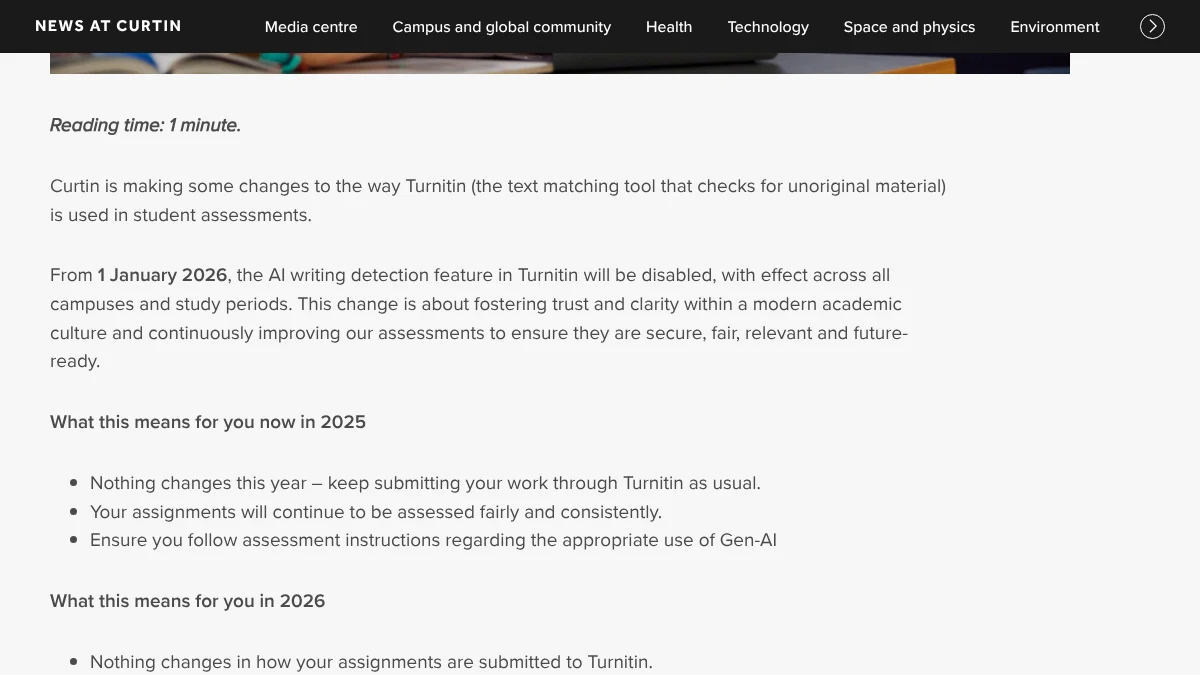
- 1Text matching stays: Curtin keeps Turnitin as “the text matching tool that checks for unoriginal material”.
- 2From Jan 1, 2026: the AI writing detection feature is disabled “across all campuses and study periods”.
- 3Rules still apply: students must follow each assessment’s instructions on the use of generative AI.
Screenshot of curtin.edu.au, Nov 3, 2026, 19:09 UTC, taken by StudyTexter. Cropped only; the numbered marks are ours. Page published Sep 4, 2025[18].
If your paper is flagged: what to bring
- Ask for the report. Instructors can download Turnitin’s AI report as a PDF[1]. Ask which sentences are highlighted and what score was shown.
- Check the state. A *% is not a number. A score on a short paper may be “all or nothing”[1].
- Show your process. Drafts, notes, version history and your sources. The University of Melbourne says you may be asked for drafts or notes, and that a talk about your work is not an allegation[21].
- Read your school’s rule. Several schools, such as Washington State University and the University of Melbourne, say a detector result alone is not enough[19][21]. Follow the procedure your school sets.
This is not legal advice. For a step-by-step plan around a flag, see our AI detector guide.
Where Turnitin’s AI detection does well, and where it falls short
Turnitin does well
- It publishes its rules: 300-word minimum, the 20% line, which text it removes[1]
- It keeps dated release notes, so you can see when the model changed[4]
- It hides scores from 1 to 19% to avoid false flags[1]
- In four independent studies, it wrongly flagged none of the human texts[9][10][11][12]
- It says itself that the score is no proof of misconduct[1]
Where it falls short for you
- You can’t see it by default, so you can’t react before your instructor does[1][19]
- Its threshold value is not stated, and single predictions may not be explainable[1]
- It misses AI text by design; in a 2026 study on an older model it missed all 40 fully AI-written papers[12]
- Short papers get “all or nothing” results[1]
- Several universities have switched it off, citing false positives or reliability[13][14][15][16]
Our own test (pending)
We have not tested Turnitin ourselves. Turnitin is sold to schools only, and we will not paste anyone’s text into a detector without consent. This is the test we would run with a partner school:
- Sample. 10 papers of 1,500 to 5,000 words, written before 2022, by students who agree to the test; 5 by native and 5 by non-native English writers.pending
- Run. A partner instructor submits them to a Turnitin assignment with AI detection on, on one day.pending
- Record. The indicator state for each paper (- -, 0%, *% or a number) and the highlighted sentences, as PDF.pending
- Publish. All states with date and model version, without names.pending
Results will be added with a date. Until then, this page makes no accuracy claim of its own.
Writing your paper with StudyTexter
StudyTexter is made by acadeo GmbH. It is not a detector and can’t show you a Turnitin score. It helps you build the paper in 12 steps, from a one-sentence topic to a draft you can export to Word, PDF, LaTeX or Google Docs. You choose your sources: in the literature search you accept or reject each one, and every citation in the draft shows its source and page number in the Evidence View. A plagiarism and AI check is included with each package. You stay the author: you edit, rewrite and check the draft before you submit.
Steps 1 to 5 are free and end with your proposal draft. The literature search starts at step 6 with a one-time package from $79. Check your university’s rules on AI tools before you use any of them.
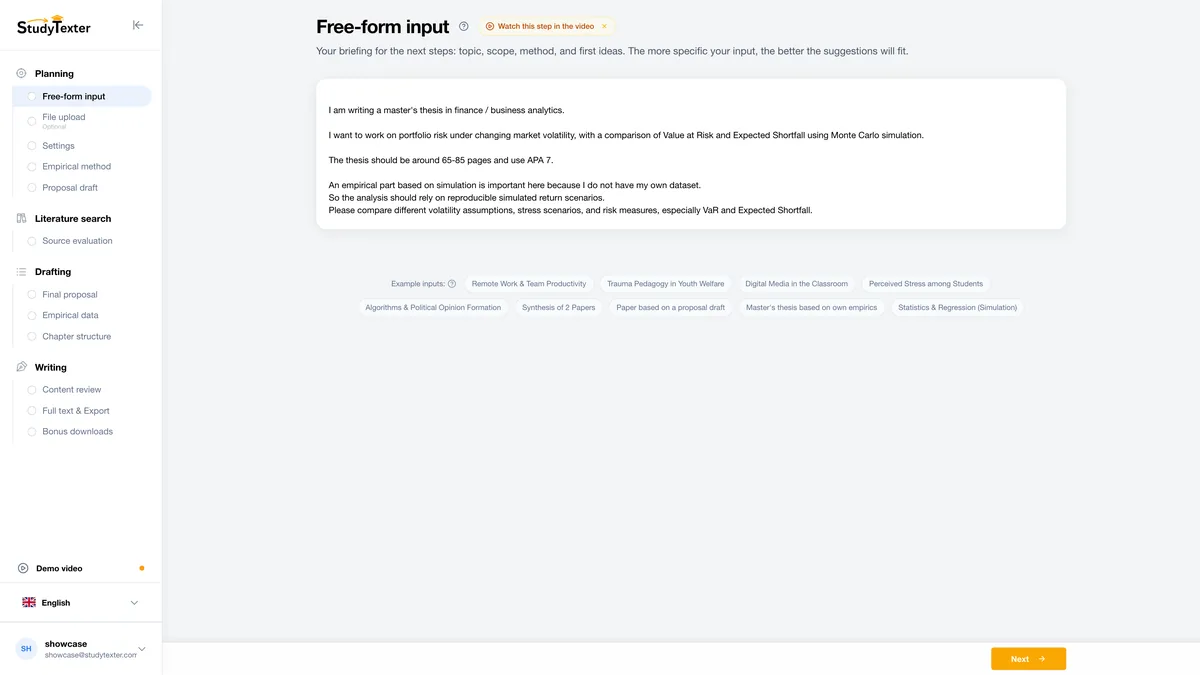
Topic in your words
Describe your topic in your own words. One sentence is enough to start.
Turnitin AI detection: frequently asked questions
Does Turnitin detect AI?
Yes, if your school licenses Turnitin’s AI writing detection and has it switched on. It scores each sentence and shows your instructor the share of prose sentences it labels as likely AI. Scores from 1 to 19% show only as *%, and files under 300 words of prose get no score.
Can Turnitin detect ChatGPT, Claude or Gemini?
Turnitin says its English model can detect text from a long list of models, including GPT-4o, GPT-5 and newer GPT versions, Claude Sonnet 4.5 and 4.6, and Gemini 2.5 Pro. It does not claim to catch every AI sentence: if it shows 50%, the paper could contain up to 65% AI writing.
How accurate is Turnitin’s AI detector?
Turnitin’s own target is a false positive rate under 1% for documents with over 20% AI writing, about one human-written paper in 100. In four independent studies, Turnitin wrongly flagged none of the human texts (in one study, 3 of 40 showed *%). In a 2026 study on an older model, it also missed all 40 fully AI-written papers. A low score does not make AI use allowed; your school’s rules decide.
What does *% mean on Turnitin?
The model labeled some sentences as AI, but less than 20% of the prose. Turnitin hides the number and the highlights in this range because false positives are more common there.
Can students see their Turnitin AI score?
Not by default. Turnitin says the indicator and report are not visible to students, but instructors can download the report as a PDF and share it. Ask your instructor if you want to see it.
Does Turnitin flag Grammarly?
Turnitin says spelling and grammar fixes by Grammarly were in most cases not flagged in its tests. Text from Grammarly’s generative features, such as drafting or paraphrasing, will likely be flagged.
Can my university punish me only because of the AI score?
Turnitin says the score should not be the sole basis for action. Several universities say the same in their rules, for example Washington State University and the University of Melbourne. Your school’s procedure decides; ask for the evidence and bring your drafts.
Method and disclosure
We read websites, terms and reviews ourselves, back every number with a source and access date, and only add test results once we have them. Found a mistake? We correct it with a date.
On Nov 3, 2026 we read Turnitin’s AI writing FAQ, its instructor guides on the AI Writing Report and file requirements, its release notes from 2023 to 2026, two Turnitin blog posts and its press release from April 2023. We read the public pages of nine universities and one news report on their decisions, and took dated screenshots. The four studies were read in full on Oct 12, 2026 for our AI detector guide. We did not create an account, did not log in and did not paste any text into Turnitin or any other detector.
StudyTexter sells a guided draft with a plagiarism and AI check included, so we have an interest in this topic. That is why every statement has a source and date, and why we say where Turnitin does well. We do not link to sites that offer “Turnitin checks” without being Turnitin. Turnitin is a trademark of Turnitin, LLC; we use the name only to describe the product. If you find a mistake, tell us and we’ll correct it and date the change.
Changes: Nov 3, 2026 first version; the same day, revised after an independent fact check (Washington State and Vanderbilt figures as in the sources, report check worded as what your instructor sees, source dates in the university table, context for the 2026 study).
Sources
- Turnitin Guides: Turnitin’s AI writing detection capabilities FAQs (updated Nov 3, 2026)how the score is calculated, *% below 20%, under 1% false positive target, not visible to students · accessed Nov 3, 2026
- Turnitin Guides: Using the AI Writing Report (for instructors)indicator states, qualifying text, “not … the sole basis for adverse actions” · accessed Nov 3, 2026
- Turnitin Guides: File requirements for an AI Writing Report300 to 30,000 words, seven languages, four file types · accessed Nov 3, 2026
- Turnitin Guides: AI writing detection model (release notes 2023 to 2026)dated model changes, latest Oct 14, 2026 · accessed Nov 3, 2026
- Turnitin blog: AI writing detection update from Turnitin’s Chief Product Officer (May 23, 2023)sentence-level false positive rate ~4%, 300-word minimum, asterisk below 20% · accessed Nov 3, 2026
- Turnitin: AI writing solutions page (vendor)English language learners: 0.014 vs 0.013 false positive rate in Turnitin’s own test · accessed Nov 3, 2026
- Turnitin Guides: How should I review the AI Writing report?score as “a single data point” · accessed Nov 3, 2026
- Turnitin Guides: What should I do if the AI writing percentage is high?check the school’s policy first; decision rests with the instructor · accessed Nov 3, 2026
- Testing of detection tools for AI-generated text, International Journal for Educational Integrity 19, article 26 (Dec 25, 2023; peer-reviewed)14 tools, 18 human texts; Turnitin tested in April 2023 · accessed Nov 3, 2026
- The Effectiveness of Software Designed to Detect AI-Generated Writing, Open Information Science 7(1) (Oct 6, 2023; peer-reviewed)16 tools, 42 first-year student essays · accessed Nov 3, 2026
- GenAI Detection Tools, Adversarial Techniques and Implications for Inclusivity in Higher Education (arXiv preprint, Mar 2024; journal version Sep 9, 2024, peer-reviewed)7 tools, 10 human control texts, tests Sep/Oct 2023 · accessed Nov 3, 2026
- Who wrote this? Evaluating the reliability of AI detection tools in higher education, International Journal for Educational Integrity 22, article 16 (online Jun 29, 2026; correction Oct 6, 2026; peer-reviewed)40 human papers by non-native graduate students, 40 fully AI-written papers; read in full Oct 12, 2026 · accessed Nov 3, 2026
- Vanderbilt University: Guidance on AI Detection and Why We’re Disabling Turnitin’s AI Detector (Aug 16, 2023)disabled “for the foreseeable future” · accessed Nov 3, 2026
- Aberystwyth University: Important Update on Generative Artificial Intelligence for Staff (Sep 2023)AI detection off from Sep 30, 2023 · accessed Nov 3, 2026
- University of Waterloo: Discontinuing use of AI detection functionality in Turnitin (announced 2025; effective Sep 2025)no longer available from September 2025 · accessed Nov 3, 2026
- IOL: UCT drops use of AI detection software (Jul 28, 2025; news report)Turnitin AI Score unavailable at the University of Cape Town from Oct 1, 2025 · accessed Nov 3, 2026
- University of Queensland, eLearning: Turnitin Similarity Report and AI Writing Indicator updateAI Writing Indicator unavailable in Semester 2, 2025 · accessed Nov 3, 2026
- Curtin University: Update on Turnitin AI-Detection Tool (Sep 4, 2025)AI detection off from Jan 1, 2026; text matching stays · accessed Nov 3, 2026
- Washington State University, Office of the Provost: Cancellation of Turnitin AI Detection software (memo, Feb 11, 2026)contract cancelled; 33% of AI hearing cases “not responsible”; no detector as sole support · accessed Nov 3, 2026
- University of the Free State: UFS shifts academic integrity approach in AI era (May 2026)AI detection discontinued from Jul 1, 2026 · accessed Nov 3, 2026
- University of Melbourne, Academic Integrity: Advice for students regarding Turnitin and AI writing detectionreport alone “not sufficient evidence for an allegation” · accessed Nov 3, 2026
- Turnitin press release: Turnitin turns on AI writing detection capabilities (Apr 4, 2023)launch date · accessed Nov 3, 2026
Read next
Brands and logos mentioned belong to their owners and are used for identification only. They are not affiliated with StudyTexter.