ChatGPT for thesis writing · Honest guide
ChatGPT is the most popular tool for thesis writing in 2026. It's also the most rejected. This guide covers what ChatGPT does well (brainstorming, outline drafting, paraphrasing), where it fails (hallucinated citations, AI-detection flags, no declared-AI-use audit-trail), and a specialised academic alternative that solves the three failure modes — without losing the speed.
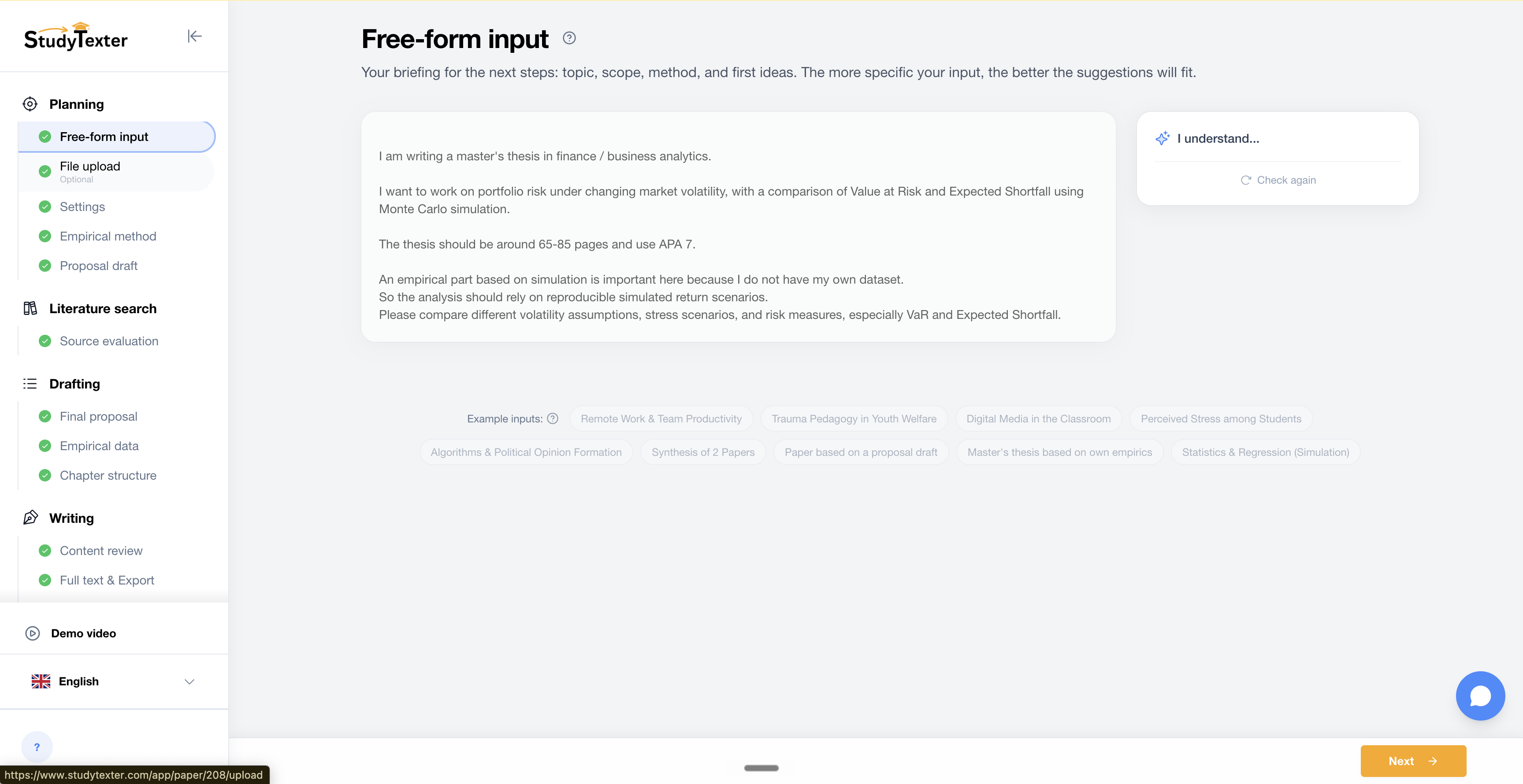 Honest guideBrand-neutral
ChatGPT is excellent at general writing; it falls short for thesis writing on three specific axes:
ChatGPT shines at brainstorming, outline drafting, and paraphrasing. Here are five prompts that work consistently:
Prompt: “I'm writing a Master's thesis in [discipline]. The broad topic is [topic]. Give me 10 research questions with explicit scope (population, time period, mechanism). Mark which are testable and which are descriptive.”
Prompt: “For research question ‘[your question]’, draft a 5-chapter thesis outline (intro / lit review / methodology / findings / discussion) with 3-5 sub-sections per chapter and 1-paragraph rationale for each section.”
Prompt: “Paraphrase the following academic passage in clear PhD-level English while preserving every claim and citation: [paste text]. Output a single paragraph; do not add or remove any cited facts.”
Prompt: “I have 30 sources listed below with their DOIs. Draft a 1,500-word thematic literature review organised by theme (not chronologically), ending with the research gap. Use APA 7 in-text citations: [paste source list].” Always verify the citations afterwards (this is where hallucination hits).
Prompt: “My thesis investigates [research question] using [method: e.g. semi-structured interviews with 12 participants in healthcare settings]. Draft the methodology section: research design, sampling, data collection, analysis approach, ethics. 1,000 words.”
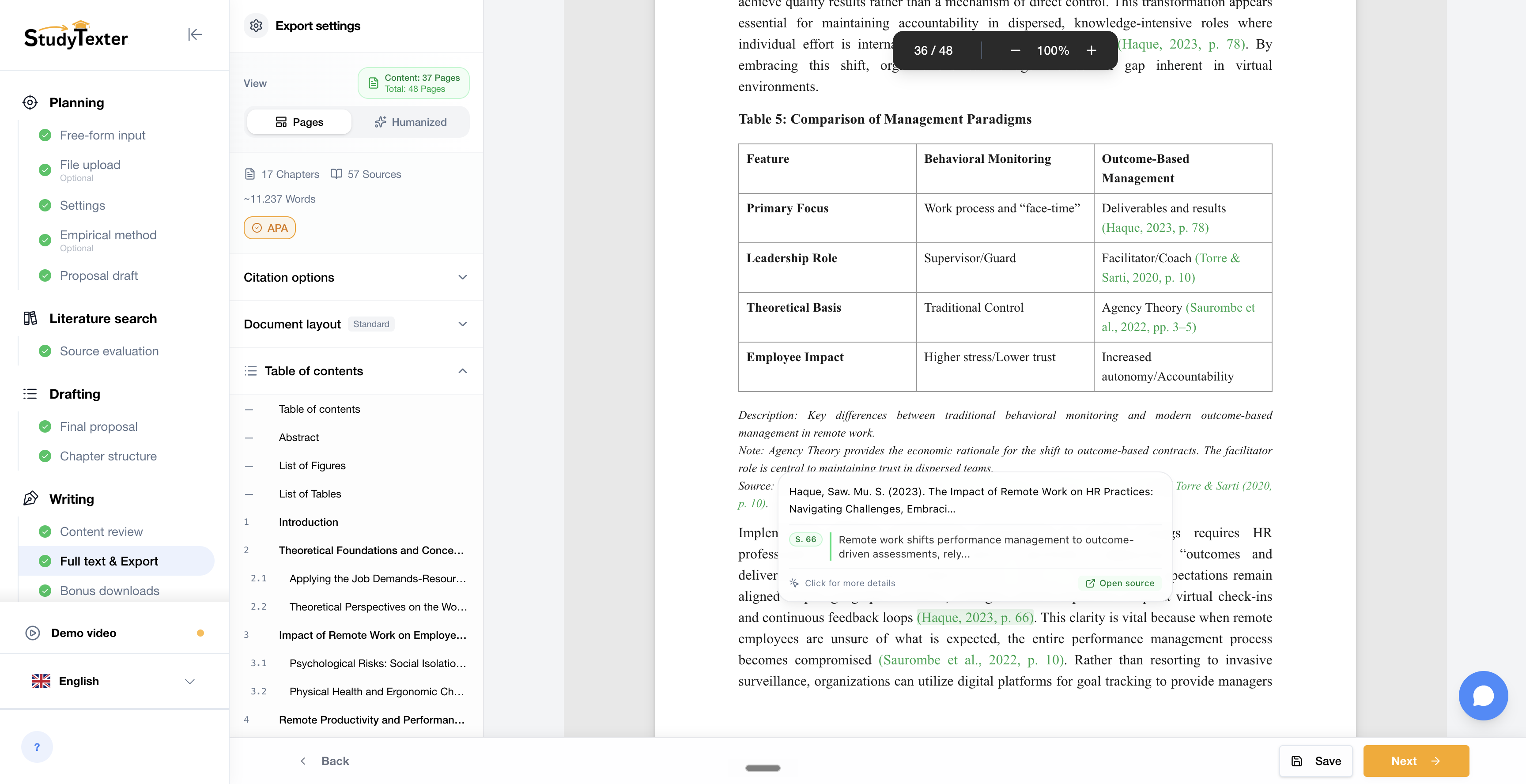
An objective breakdown of where each tool fits in a thesis-writing workflow.
| Capability | ChatGPT (free or Plus) | StudyTexter (academic-specialised) |
|---|---|---|
| Brainstorming research questions | Excellent | Equivalent |
| Outline drafting | Excellent | Equivalent |
| Paraphrasing existing text | Excellent | Equivalent |
| Real DOI citations (Crossref / PubMed) | Hallucinated | Live lookup |
| Full thesis drafting (40–200 pages) | Context-window limits | Chapter-by-chapter |
| Originality report (Turnitin-style) | No | At export |
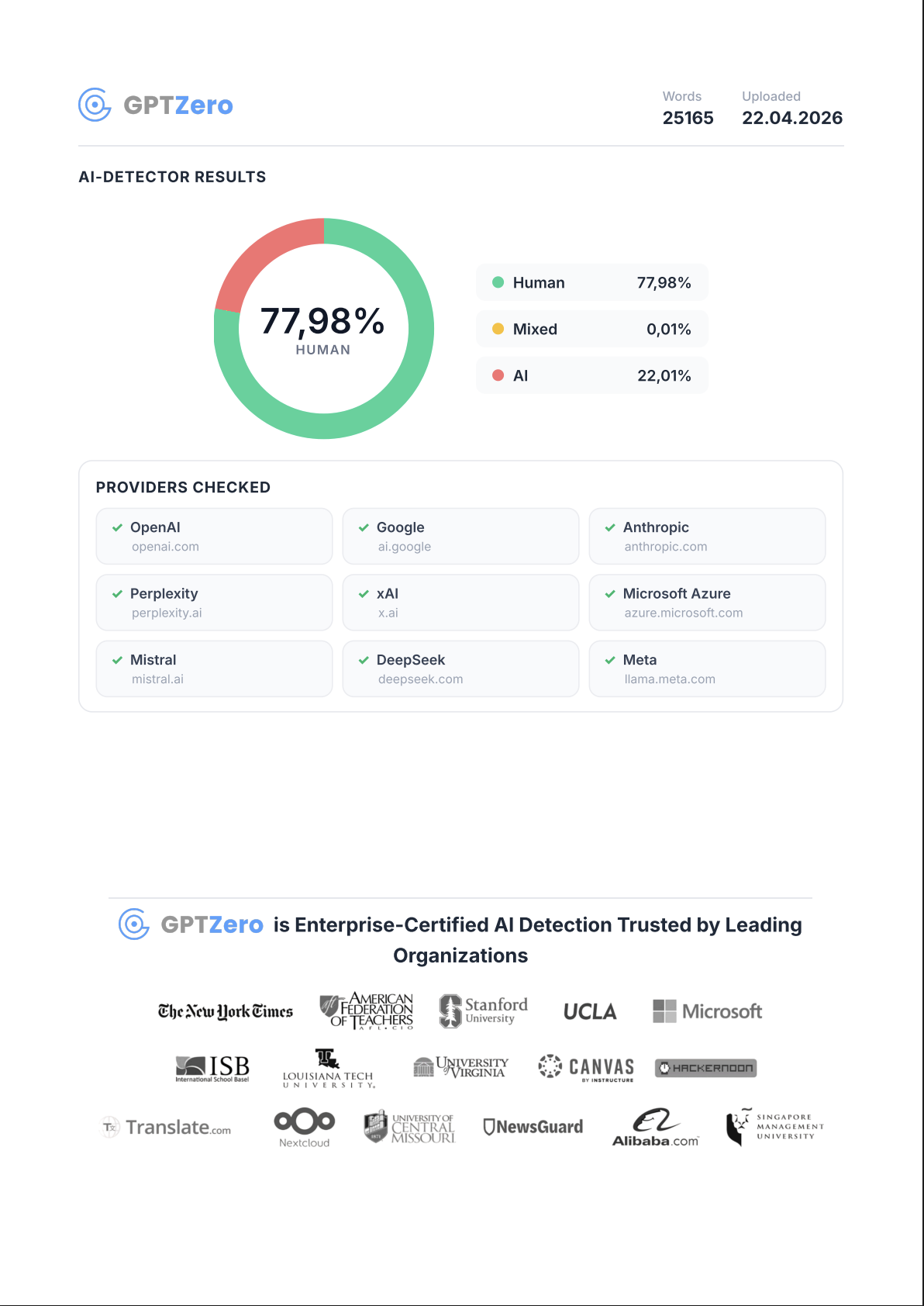
| AI-detection report | No | At export |
| Declared-AI-use audit-trail | Chat log only | Structured (brief, outline, sources, drafts) |
| Reference style (APA 7, Harvard, Vancouver, IEEE) | Inconsistent | First-class |
| Cost | Free → $20/mo | Free preview; $129–$249 per thesis |
Brainstorming research questions, drafting chapter outlines, paraphrasing existing text, generating analogies, sketching methodology sections. ChatGPT is fast, conversational, and excellent at general-language tasks. Use it freely for these.
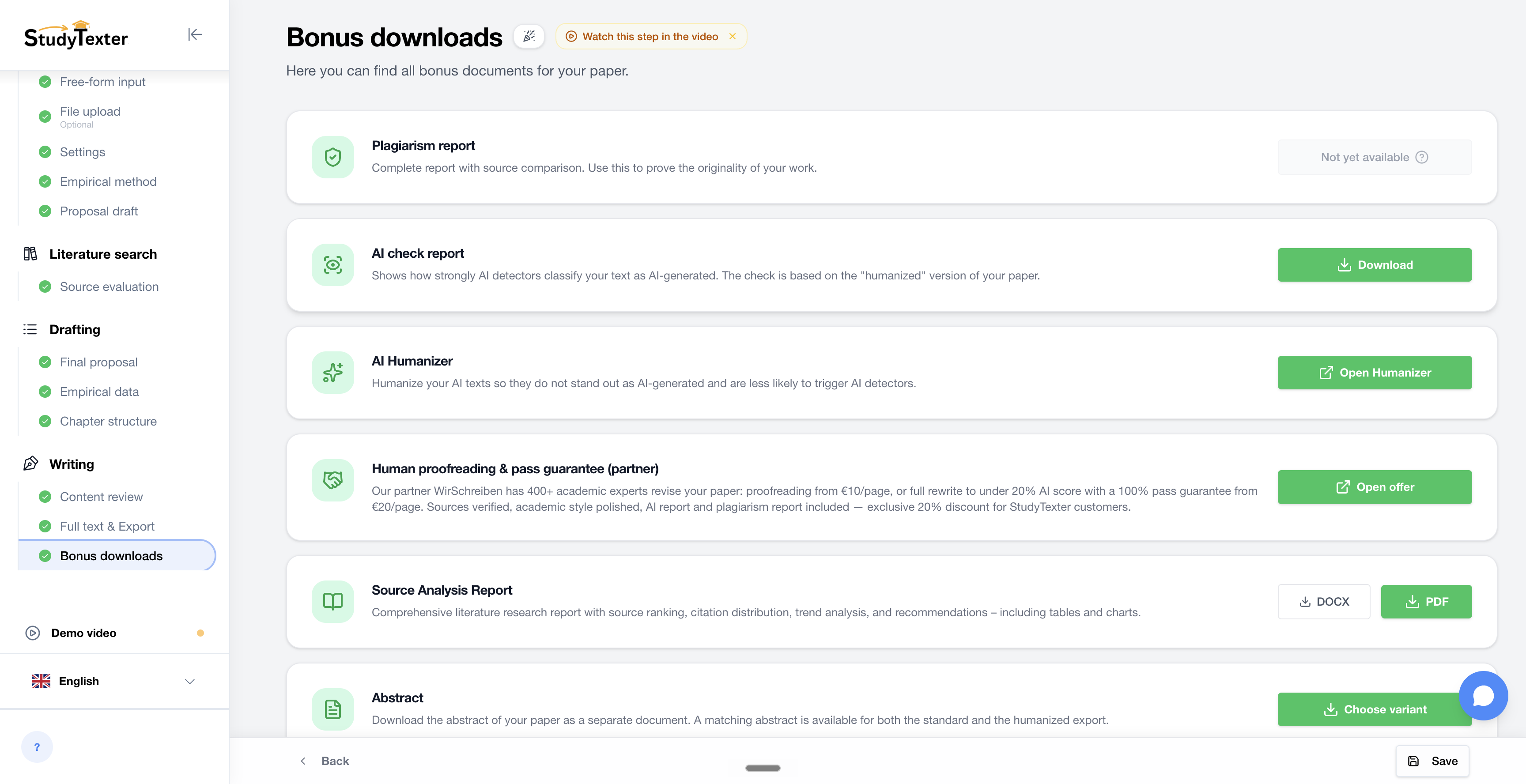
Real-citation lookup against Crossref / PubMed / IEEE Xplore, drafting the full thesis chapter-by-chapter, originality + AI-detection report at export, and declared-AI-use audit-trail. These are the three things ChatGPT structurally cannot do.
Many users brainstorm with ChatGPT and draft with StudyTexter. The audit-trail captures the StudyTexter side; for the ChatGPT side, save your chat exports as supporting documentation. Universities accept this combination.
Try the academic-grade alternative — free brief, outline, first chapter. Pay $129–$249 only when you export the finished thesis with real DOI citations, originality + AI-detection report, and declared-AI-use audit-trail.
AI-use policies vary by country and institution. Here are the major regulatory regimes you should know.
ChatGPT is cheap to subscribe to ($20/month for Plus). The hidden costs are in the failure-mode mitigation:
ChatGPT is cheap up-front and expensive on the back-end. Specialised academic AI tools are cheaper end-to-end if the thesis is your primary use-case.
ChatGPT can draft sections of a thesis (introduction, outline, paraphrased lit review) but is structurally weak on three things: real-citation generation (it hallucinates DOIs), AI-detection avoidance (modern tools flag GPT-generated text at high rates), and declared-AI-use audit-trail. For a full thesis, a specialised academic tool fills those gaps.
See the workflow section above for the five most effective prompts: brainstorm research questions, draft chapter outline, paraphrase existing text, draft a lit review from a source list (verify citations afterwards), sketch the methodology section. These cover ~70% of where ChatGPT excels for thesis work.
Modern AI-detection tools (GPTZero, Originality.ai, Turnitin AI-writing detection) flag ChatGPT-generated text at 70–95% accuracy depending on the model and prompt engineering. Hiding ChatGPT use is risky; declaring it is the safer path. Most major universities (UCL, Stanford, Oxford, Bocconi, Bologna) now have explicit declared-AI-use policies that permit ChatGPT with disclosure.
ChatGPT is trained on text patterns; it doesn't have live access to academic databases. When asked for a citation, it generates one that pattern-matches the format (author + year + journal + DOI) without verifying the DOI actually resolves to a paper. This is structural — it cannot be fully prompt-engineered away. Always verify every citation manually after ChatGPT generates it.
Same answer as thesis: brainstorm and outline yes; full chapter-drafting with hallucinated citations is risky. PhD dissertations have higher citation density (60–120 sources) and stricter committee review, so the citation-verification burden after ChatGPT is heavier. See AI dissertation writer for the PhD-specialised tool.
Depends on your university's policy. Most major universities (US Ivy League, UK Russell Group, EU Bologna / Bocconi, AU Group of Eight) now permit declared AI-use with disclosure. Using ChatGPT without disclosure when your university requires it is cheating; using it with disclosure typically is not.
ChatGPT: general-purpose conversational AI, free or $20/mo, hallucinates citations, no originality / AI-detection report. StudyTexter: academic-specialised AI thesis writer, $129–$249 per thesis, real DOI citations via Crossref / PubMed / IEEE Xplore lookup, originality + AI-detection report at export, declared-AI-use audit-trail. Different tools for different stages; many users use both.
ChatGPT can draft prose around a source list you provide. It cannot reliably find sources (returns hallucinated DOIs). For a literature review with verifiable sources, use a discovery tool (Litmaps, ResearchRabbit, SciSpace) to find sources, then a synthesis tool (literature review AI) to draft the prose around them.
See ChatGPT alternative for academic writing for an honest comparison of the six leading alternatives (StudyTexter, Paperpal, Jenni, Scite, Scribbr, Thesify), each with strengths and limitations.
The ChatGPT Thesis Writer GPT (custom GPT, no extra subscription beyond Plus) is a competent prompt-pack for thesis writing. It inherits ChatGPT's core limitations: hallucinated citations, AI-detection flags, no audit-trail. Useful for brainstorming and outline drafting; verify everything afterwards.
Heavy paraphrasing reduces detection rates but doesn't eliminate them. The honest path is declared-AI-use disclosure rather than trying to hide ChatGPT use. If your university accepts declared AI-use (most do now), you don't need to evade detection.
Bachelor's theses are shorter (30–60 pages) so the context-window limits matter less. The other limitations (hallucinated citations, AI-detection, audit-trail) still apply. See AI thesis writer for the specialised alternative.
