
Does Grammarly Count as AI? A Traffic Light for Every Feature
“Is Grammarly AI?” has two answers, because Grammarly has two kinds of AI. On Nov 3, 2026 we read Grammarly’s own pages, Turnitin’s FAQ and the public rules of 9 universities and colleges in the US, UK, Australia and Canada. Then we rated each Grammarly feature: green, amber or red. No tests, no accounts: only quoted, dated sources.

 Janosch & Dr. Jonathan SchulteStudyTexter editorial team
Updated
15 min read
Disclosure: This comparison is published by StudyTexter, a company in the same market. We only state verifiable facts with source and date. Method
Contents
Yes, Grammarly is AI, but most of the school rules we read treat only part of it as AI use. Spelling and grammar corrections use what Grammarly calls “foundational AI”; Turnitin says that in its tests these changes were not flagged in most cases. Rewrites, the Paraphraser and text from AI prompts are generative AI. They are in Grammarly Free too (100 prompts a month), Turnitin says they “will likely be flagged”, and most of the 9 rules we read ban them or require disclosure. Some schools, such as Notre Dame, also restrict basic editing tools when a course bans generative AI. Your course rule decides (as of Nov 3, 2026).
Does Grammarly count as AI? The short answer
Grammarly is an AI tool. The real question for your paper is which part of it you use. Grammarly itself splits its features into two groups[1]:
- Foundational AI: the suggestions for spelling, grammar, clarity, conciseness and tone. Grammarly says this “does not change the substance of the writing”.
- Generative AI: features that “produce new content based on their inputs or prompts”, such as rewrites, the Paraphraser and AI prompts.
Most of the school rules we read, and Turnitin’s FAQ, draw the line in the same place[7]. Some schools go further.
Grammarly’s two kinds of AI, in its own words
Grammarly has a support page that asks “Does the use of Grammarly trigger AI detectors?”. It says Grammarly has used “foundational AI technology” since 2009[1].
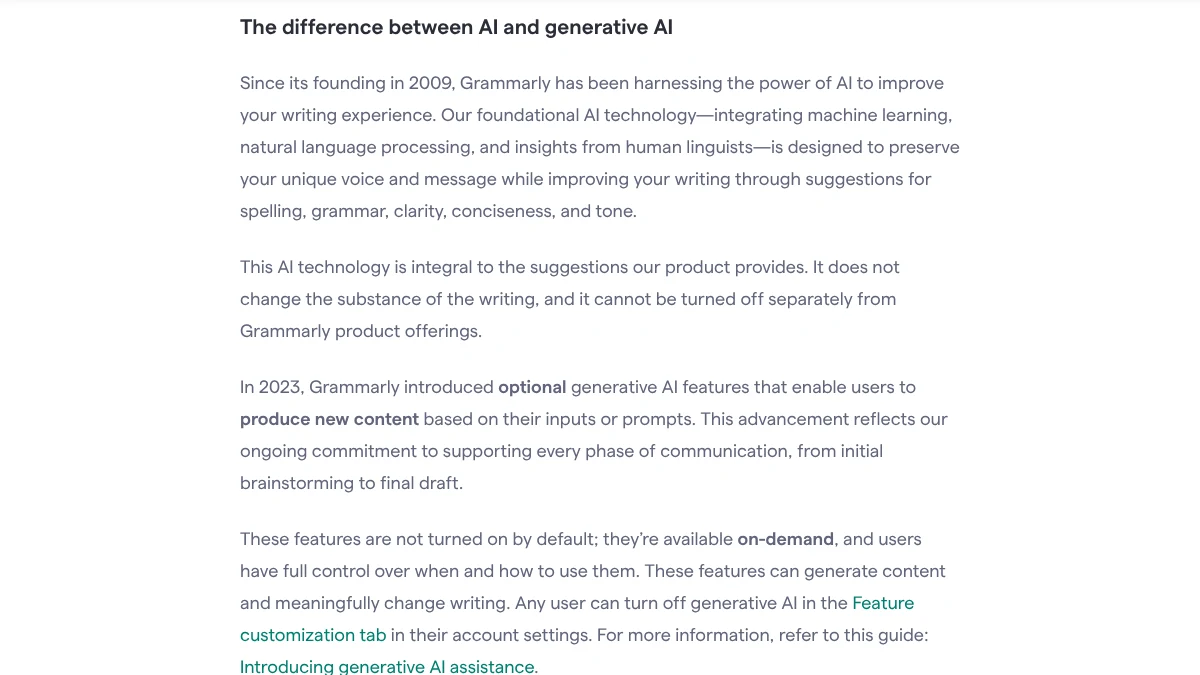
- 1Foundational AI: suggestions for “spelling, grammar, clarity, conciseness, and tone”.
- 2This part “does not change the substance of the writing” and “cannot be turned off separately”.
- 3Since 2023: “optional generative AI features” that “produce new content”.
- 4“Not turned on by default”, they “can generate content and meaningfully change writing”, and you can turn them off in Feature customization.
Screenshot of support.grammarly.com, Nov 3, 2026, 19:30 UTC, taken by StudyTexter.
Two details matter for students:
- You cannot switch off the basic AI. It “cannot be turned off separately from Grammarly product offerings”[1]. So a school that calls all of Grammarly “AI” also covers the plain spell check.
- The free plan has generative AI too. The plans page lists “Generate text with 100 AI prompts” in Grammarly Free. Pro adds “Rewrite full sentences with a click” and 2,000 prompts[2]. Grammarly says the generative features are “not turned on by default”[1]. Arden University puts it this way: “all versions of Grammarly now also offer generative AI features”[14].
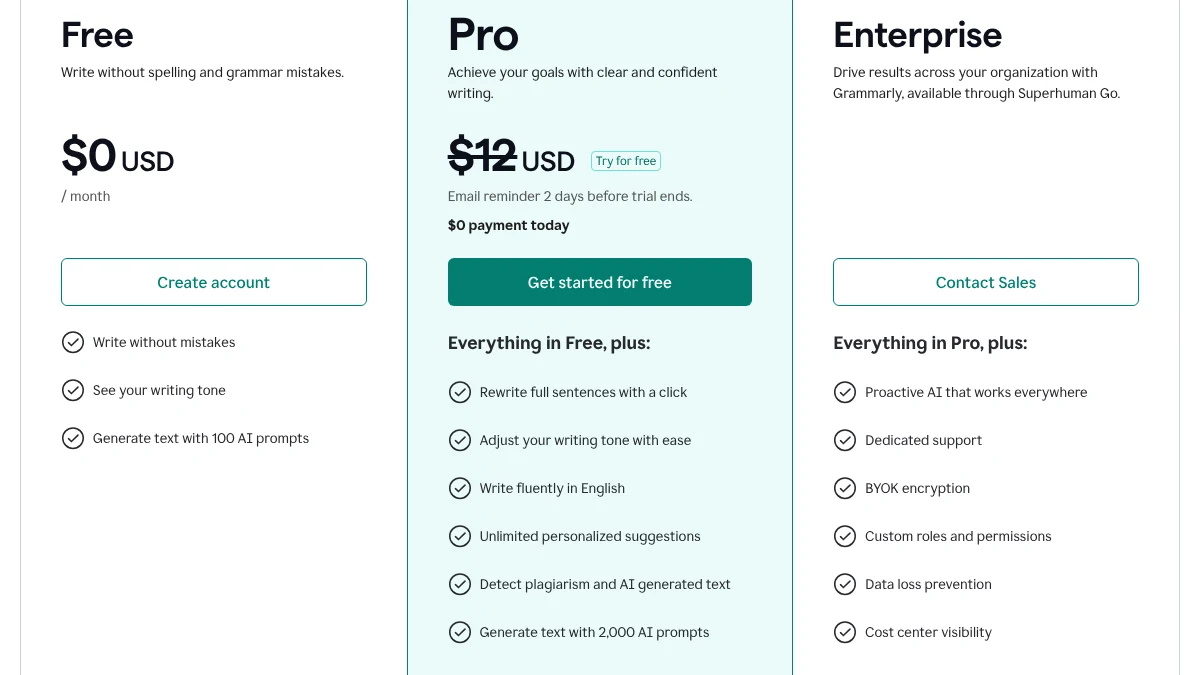
- 1Free: “$0 USD / month”.
- 2Free includes “Generate text with 100 AI prompts”.
- 3Pro: “$12 USD” shown crossed out next to “Try for free”, no billing period shown.
- 4Pro adds “Rewrite full sentences with a click” and “Generate text with 2,000 AI prompts”.
Screenshot of grammarly.com/plans, Nov 3, 2026, 19:31 UTC, taken by StudyTexter.
So the answer to “does Grammarly use AI?” is always yes. Whether your use of Grammarly counts as AI use depends on the feature.
The traffic light: does each Grammarly feature count as AI?
This is our editorial rating of each feature, based on what the sources say. Where no school rule names a feature, the table says so and marks the rating as ours.
| Grammarly feature and our rating | Why (what the sources say) |
|---|---|
| Spelling, grammar and punctuation suggestions (Free) Usually OK | Grammarly calls this “foundational AI” that does not change the substance[1]. Allowed at Arden, Stanford PWR and Westcliff[14][10][12]; UniSC lets course coordinators allow it[16]. Exception: at Notre Dame it falls under a course ban on generative AI unless allowed[9]. |
| Clarity, conciseness and tone suggestions (tone hints Free, tone adjustment Pro) Rules differ | Part of the basic suggestions[1]. Westcliff allows clarity edits “selectively applied” and does not allow accepting all suggestions without review[12]. Stanford PWR prohibits changes to “tone, structure, content, concision”[10]. |
| Proofreader agent (Free and Pro) Rules differ | Runs in Grammarly’s docs writing surface[3]. Carleton calls it “a souped-up version of Grammarly’s ordinary suggestions”[19]. Under rules like Stanford PWR, structure changes are out[10]. |
| Rewrite full sentences, adjust tone (Pro), “Improve it” Generative AI | “Rewrite full sentences” is a Pro feature[2]. Westcliff does not allow Paraphrase or “Improve It” tools “that replace large chunks of text”[12]; Leeds Beckett names “rewrite with Grammarly” and “Improve it” as AI features[15]. |
| Paraphraser (agent) Generative AI | One of Grammarly’s AI agents[3][5]. Arden: generative features that rewrite your work are “not allowed”[14]. UniSC: “the unauthorised use of … paraphrasing tools can be a form of plagiarism”[16]. |
| Generate text with AI prompts, AI chat (Free: 100 prompts, Pro: 2,000) Generative AI | Grammarly: these features “produce new content”[1]. Turnitin: draft generation “will likely be flagged”[7]. Only with your instructor’s permission, and disclosed[15][18]. |
| Citation Finder (agent) Generative AI | Finds evidence and “automatically generates correctly formatted citations”[3]. Our rating: it is an AI agent that creates text for you, so we treat it as generative AI. None of the rules we read names it. Open every source yourself before you cite it. |
| Reader Reactions, AI Grader (agents) Not covered: ask first | Feedback and “estimated grades before submission”[3]. None of the rules we read names them. Our rating: Grammarly calls them AI agents, so a course ban on generative AI may cover them. |
| Humanizer Do not use for graded work | Carleton describes it as a tool “to make AI-generated text sound more natural”[19]. Our rating: where generative AI is not allowed, rewriting your work with it is not allowed either[14][16]. More in our Grammarly Humanizer review. |
| AI Detector, Plagiarism Checker (Pro at launch) Changes no text | Our rating: they check text and change nothing[3]. Not named in the rules we read. Grammarly says no detector can “reliably and conclusively” tell if AI was used[1]. |
| Authorship (Free and Pro) Changes no text | Our rating: it records how your text was made (typed, pasted, AI-assisted) and changes nothing. “You decide when to share your Authorship Report.”[4] |
Looking for a checker without generative features, or one built for academic English? See our Grammarly alternatives for students, with dated prices.
What universities say about Grammarly: 9 rules side by side
We read 9 public pages that name Grammarly, editing tools or grammar checkers. Each row shows the school’s view on basic spelling and grammar checks, and on rewriting or generating text.
| School (country, date) | Basic checks · rewrite or generate |
|---|---|
| Arden University (UK, updated Oct 8, 2026)[14] | Basic spelling and grammar “fine” Rewrite or generatenot allowed, free or paid |
| University of the Sunshine Coast (Australia, amended Oct 23, 2024)[16] | Basic spelling and grammar can be allowed by the course Rewrite or generategenAI functions prohibited |
| Stanford, Program in Writing and Rhetoric (US, no date)[10] | Basic spelling and grammar basic (free) autocorrect acceptable Rewrite or generatetone, structure, word choice prohibited |
| Westcliff University Writing Center (US, undated PDF, uploaded 2025/11)[12] | Basic spelling and grammar proofreading allowed Rewrite or generateRewrite/Generate not allowed |
| University of Notre Dame (US, Fall 2024)[9] | Basic spelling and grammar covered by a course ban on generative AI, unless allowed Rewrite or generatecovered by the same ban |
| Southern New Hampshire University Library (US, Jun 25, 2026)[11] | Basic spelling and grammar cite Grammarly as an AI tool (page covers citing, not permission) Rewrite or generatenot covered on that page |
| Leeds Beckett University Library (UK, no date)[15] | Basic spelling and grammar not covered on that page Rewrite or generatemust be acknowledged, also for disability or language support |
| Royal Roads University (Canada, Jan 23, 2026)[17] | Basic spelling and grammar no APA citation expected Rewrite or generatesubstantial AI revision: a transparency statement may be expected |
| West Coast University Libraries (US, no date)[13] | Basic spelling and grammar “Yes”, Grammarly is AI (no rule given) Rewrite or generatenot covered on that page |
One example, as it appears on the page. Arden University in the UK updated its answer on Oct 8, 2026:
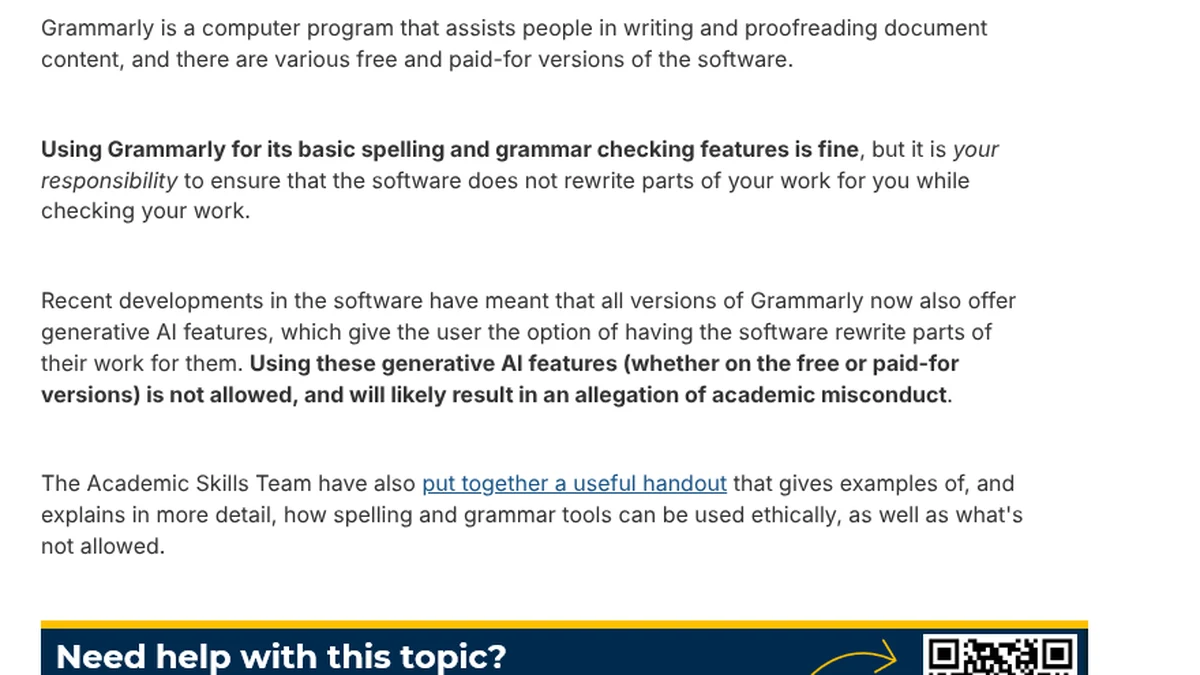
- 1“Using Grammarly for its basic spelling and grammar checking features is fine”.
- 2“All versions of Grammarly now also offer generative AI features”.
- 3Using them “(whether on the free or paid-for versions) is not allowed”.
Screenshot of answers.arden.ac.uk, Nov 3, 2026, 19:31 UTC, taken by StudyTexter. The page says “Last Updated 08 Oct 2026”.
Rewrite and generate are red at Arden, UniSC, Stanford PWR and Westcliff; Leeds Beckett requires you to acknowledge them, “even if you are using the software to support a disability or language need”[15]. Basic checks are mostly green, except under a course ban at Notre Dame[9].
Grammarly for Education offers “optional generative AI for brainstorming and outlining”[6]. In the UK, Jisc notes that school licenses can turn the generative features off for a whole school, but that most students use their own individual accounts[20]. On your own account, you have to turn them off yourself. If you use Grammarly because of a disability, ask your disability service which features are allowed.
Does Turnitin detect Grammarly?
Turnitin answers this in its FAQ. Basic Grammarly corrections: in most cases, no. Generative features: likely yes[7].
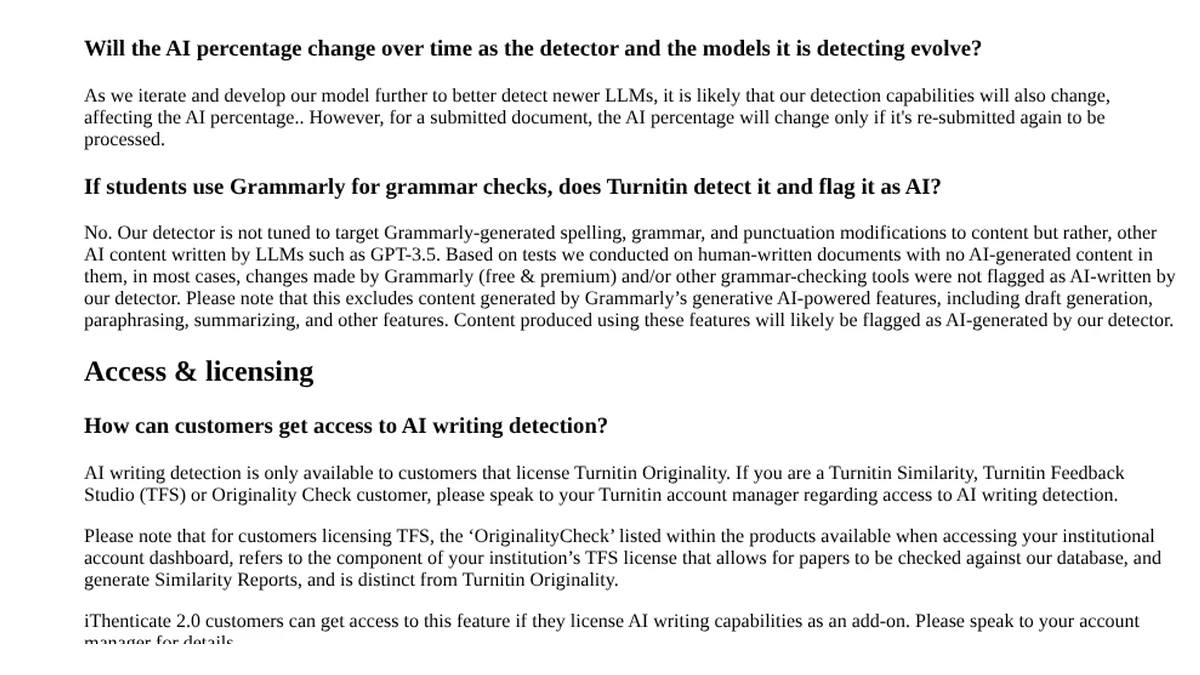
- 1Turnitin’s own question: “If students use Grammarly for grammar checks, does Turnitin detect it and flag it as AI?”
- 2The answer starts with “No.” The detector is “not tuned to target” spelling, grammar and punctuation changes.
- 3In its tests with human-written documents, Grammarly changes (free and premium) were “in most cases” not flagged.
- 4Exception: text from Grammarly’s generative features (drafts, paraphrasing, summaries) “will likely be flagged”.
Screenshot of guides.turnitin.com, Nov 3, 2026, 19:35 UTC, taken by StudyTexter. In our browser the page loaded without its style sheet; the text is unchanged. The page was marked as updated earlier that day.
Two limits: Turnitin bases this on its tests with human-written documents. And the same FAQ says Turnitin updated its model for English submissions in October 2026; the Grammarly answer does not say whether it was re-tested with that model[7]. Turnitin also does not display AI scores below 20%[7].
| Date and source | What it says, and what it means for you |
|---|---|
| 2023, Turnitin staff in its educator forum[8] | Testing was “largely based on the free version of Grammarly”; flagged text “may have been written using GrammarlyGo”. For you: Turnitin staff suggested such cases may come from Grammarly’s generative feature, not from basic checks. |
| As of Nov 3, 2026, Turnitin FAQ[7] | Grammar checks: “No”, in most cases not flagged in its tests. Generative features: “will likely be flagged”. For you: The current official answer. Scores below 20% are not shown in the report. |
Not every school follows Turnitin’s view. Notre Dame writes that “even a small number of suggestions from an AI editing tool in your writing can cause it to be flagged”, and adds: “This is not a false positive”[9]. Westcliff says “any and all changes made with Grammarly … can raise the AI percentage in Turnitin”[12].
If you get flagged anyway: show your drafts, your version history and, if you used it, your Authorship report. Turnitin says its AI percentage “should not be used as the sole basis for action”[7].
Which detectors exist and how independent studies rate them: best AI detector 2026.
Do you have to cite or disclose Grammarly?
For basic spelling and grammar checks, the answers differ:
- Royal Roads University (Canada): “APA Style doesn’t expect you to provide a citation for commonly-used software, such as word processing programs, or spelling- or grammar-checking functions within that software.”[17]
- SNHU (US): “If you use Grammarly to check your spelling and grammar, you will need to include a general citation on your References page”[11].
For generative features, APA Style says that if you use AI “to edit, analyze, organize, or refine your own writing”, you disclose it, for example in the method section or author note, and cite the tool[18].
A disclosure can be one sentence, for example: “I used Grammarly’s spelling and grammar suggestions on my final draft. I did not use its generative AI features.” Adapt it to what you used and to your school’s format.
Where StudyTexter fits, and where it counts as AI too
StudyTexter is our own product, so first the honest part: StudyTexter is generative AI. If your course bans generative AI, that includes StudyTexter. Use it only where your course allows AI tools, and disclose it the way your course asks.
Grammarly is the better tool if …
StudyTexter fits if …
- your course allows AI tools, and you need a sourced draft for a paper
- you want a literature search across 479M+ sources and pick yes or no for each one (from step 6, with a package)
- you want every citation to show its source and page number in the Evidence View
- you want one payment per paper: free up to your proposal draft (steps 1 to 5), then from $79 one-time; plagiarism check and AI check included
A safe plan from first idea to submission
- Read the rule and askweek 1Look for “editing tools”, “Grammarly” or “generative AI” in your syllabus. Notre Dame’s advice: if you aren’t sure, check the syllabus or ask your instructor[9]. If it is silent, ask in writing.
- Set up Grammarlyweek 1If generative AI is not allowed, turn it off under Feature customization in your account settings[1]. Turn on Authorship if you want a record of your process; you decide when to share it[4].
- Plan and researchweeks 1 to 3Collect and read your sources. Where AI tools are allowed, StudyTexter is free up to your proposal draft (steps 1 to 5).
- Write your draftweeks 3 to 5Write in Word or Google Docs. Save a copy before every Grammarly pass.
- Correctlast weekRun the basic checks and review each suggestion. Skip rewrites and generated text unless your course allows them.
- Disclose and submitdeadlineAPA: if AI helped you “edit, analyze, organize, or refine your own writing”, say so and cite the tool[18]. Keep your drafts until the grade is final.
Does Grammarly count as AI: FAQ
Does Grammarly count as AI?
Yes, Grammarly is an AI tool, but not every feature is generative AI. Its spelling, grammar, clarity and tone suggestions use what Grammarly calls “foundational AI”. Its optional generative features (prompts, rewrites, Paraphraser) produce new content. Most of the 9 school rules we read allow the first and restrict the second (as of Nov 3, 2026).
Is using Grammarly cheating?
The basic spelling and grammar check is allowed on most of the 9 school pages we read. Letting Grammarly rewrite or generate your text can be academic misconduct where generative AI is not allowed. Your course rule decides.
Does Turnitin detect Grammarly?
Turnitin’s FAQ says that in its tests with human-written documents, Grammarly’s spelling, grammar and punctuation changes were not flagged in most cases, for the free and the premium version. Text from Grammarly’s generative features “will likely be flagged as AI-generated”.
Does Grammarly get flagged as AI?
Basic corrections usually not, according to Turnitin. Rewrites and generated text can be. Some schools are stricter: Notre Dame says even a small number of AI editing suggestions can be flagged.
Is Grammarly Free generative AI?
Partly. The plans page lists “Generate text with 100 AI prompts” in Grammarly Free. Grammarly says these features are not turned on by default and can be turned off.
Do I have to cite Grammarly?
It depends on your school. Royal Roads University says APA does not expect a citation for spelling and grammar functions. SNHU’s library asks for a general citation even for spelling and grammar checks. For generative features, APA asks you to disclose the use and cite the tool.
How do I turn off Grammarly’s generative AI?
Grammarly says any user can turn it off in the Feature customization tab in the account settings. On school licenses, the school can turn it off for all students (Jisc, 2024).
Method and disclosure

We read websites, terms and reviews ourselves, back every number with a source and access date, and only add test results once we have them. Found a mistake? We correct it with a date.
On Nov 3, 2026 we read 6 Grammarly pages, Turnitin’s FAQ and educator forum, 9 university pages that name Grammarly, editing tools or grammar-checking software, APA Style and Jisc. We saved each page as text and took UTC-stamped screenshots from a US-English browser.
We did not create accounts, did not sign in and did not put any text into Grammarly, Turnitin or an AI detector, so this page has no detection scores of its own. The traffic light is our editorial rating of the quoted sources, not a legal opinion. School rules change; we show the date of each page where it has one.
We name no private persons. StudyTexter is our own product. All other names are trademarks of their owners. If you find a mistake, tell us and we will correct it with a date.
Changes: Nov 3, 2026 first version; same day corrected after our independent fact check (rating legend, sources for each rating, Royal Roads, SNHU, Notre Dame and Jisc wording, Turnitin limits and date, plans screenshot, shorter text).
Sources
- Grammarly Support: How can I turn off AI in the Grammarly product offerings? Does the use of Grammarly trigger AI detectors?accessed Nov 3, 2026
- Grammarly: Prices and PlansPro “$12 USD” shown crossed out next to “Try for free”, no billing period shown · accessed Nov 3, 2026
- Grammarly Blog: Grammarly Launches Specialized AI Agents (Aug 18, 2025)accessed Nov 3, 2026
- Grammarly Authorshipaccessed Nov 3, 2026
- Grammarly: AI at Grammarlyaccessed Nov 3, 2026
- Grammarly for Educationaccessed Nov 3, 2026
- Turnitin Guides: Turnitin’s AI writing detection capabilities FAQspage marked as updated on Nov 3, 2026 (it showed “Updated 5 hours ago” at 19:35 UTC; the changed part is not shown) · accessed Nov 3, 2026
- Turnitin Educator Network: “AI Detection and Grammarly” (2023)accessed Nov 3, 2026
- University of Notre Dame, Honor Code: Policy Update: AI Editing Tools (Fall 2024)accessed Nov 3, 2026
- Stanford University, Program in Writing and Rhetoric: PWR GenAI Policy FAQsaccessed Nov 3, 2026
- Southern New Hampshire University Library: How do I cite Grammarly in APA style? (updated Jun 25, 2026)accessed Nov 3, 2026
- Westcliff University Writing Center: Guidelines for Grammarly (undated PDF, uploaded Nov 2025)undated PDF, uploaded Nov 2025 · accessed Nov 3, 2026
- West Coast University Libraries: Is Grammarly considered artificial intelligence (AI)?accessed Nov 3, 2026
- Arden University (UK): Can I use tools like Grammarly when writing my assignment? (updated Oct 8, 2026)accessed Nov 3, 2026
- Leeds Beckett University Library (UK): Does Grammarly use generative AI?accessed Nov 3, 2026
- University of the Sunshine Coast (Australia): Responsible and ethical use of AI technologies guidelines (amended Oct 23, 2024)accessed Nov 3, 2026
- Royal Roads University (Canada), WriteAnswers: citing generative AI used to edit your writing (updated Jan 23, 2026)accessed Nov 3, 2026
- APA Style Blog: Citing generative AI in APA Style, Part 1 (Sep 9, 2025)accessed Nov 3, 2026
- Carleton College, AI at Carleton: Grammarly Revisited (Oct 29, 2025, note added Feb 17, 2026)accessed Nov 3, 2026
- Jisc National Centre for AI (UK): AI and assistive technology: Grammarly (Aug 8, 2024)accessed Nov 3, 2026
Read next
Brands and logos mentioned belong to their owners and are used for identification only. They are not affiliated with StudyTexter.