
Is Grammarly AI Detector Accurate? What Its Own Fine Print Says
Grammarly’s free AI detector promises “99% detection accuracy” and calls itself “Ranked #1 in Quality”. Further down, the same page says “No AI detector is 100% accurate” and that its model was trained on texts from “before 2021”. On Nov 3, 2026, we took dated screenshots of both, checked the public RAID leaderboard and read every published test of the detector we found. Here is what is true, and what it means before you submit a paper.

 Janosch & Dr. Jonathan SchulteStudyTexter editorial team
Updated
17 min read
Disclosure: This comparison is published by StudyTexter, a company in the same market. We only state verifiable facts with source and date. Method
Contents
Partly. On the RAID benchmark, Grammarly scores 0.999 in the default view, close to the top: on Nov 3, 2026 it was listed 6th of 60, with the top four at 1.000. RAID uses news, reviews and other non-student texts from older AI models. The small outside tests are much weaker: ZDNET gave it 40% on 5 texts (Oct 2025), and a rival vendor’s test found 0 of 9 newer AI texts (Jan 2026). Grammarly’s help center says its model is “directionally accurate” and that the score “should not be used as an objective source of truth”; its detector page says never to rely on a detector alone. Treat the score as a rough hint and look for other evidence. If you still have to write the paper, StudyTexter gives you a guided draft on real sources, with the page number for every citation and a plagiarism and AI check included, one-time from $79.
Short verdict: strong on a benchmark, weak in small tests, and Grammarly says so itself
Grammarly’s AI detector is free and sits inside a tool that, by Grammarly’s count, 40 million people use[1]. On RAID, an open benchmark, it scores near the top[4]. In the few outside tests we found, it did much worse, especially on texts from newer AI models[8][7].
The most useful sentence about its accuracy comes from Grammarly’s own help center: the model is “directionally accurate”, and the score “should not be used as an objective source of truth”[2]. Read every result with this in mind.
 Grammarly AI Detector at a glanceAs of Nov 3, 2026
- Made by
- Superhuman Platform (formerly Grammarly, Inc.); Grammarly’s footer also lists GPTZero under “Company”[1][15]
- Free check
- on grammarly.com/ai-detector; word limit not stated on the page[1]
- Result
- one percentage, split into “Resembles AI text” and “No AI text patterns found”[1]
- Pro
- AI Detector agent shows which parts may sound AI-generated; $12 a month billed annually, $30 monthly[1][11]
- Accuracy claim
- “99% detection accuracy”, “#1 on RAID’s independent benchmark”[1]
- Grammarly’s caveat
- “never rely on the results of an AI detector alone”[1]
Six promises next to Grammarly’s own fine print
The detector page makes six promises. Five come from its “Why choose” box, shown here as of Nov 3, 2026; one comes from the top of the page:
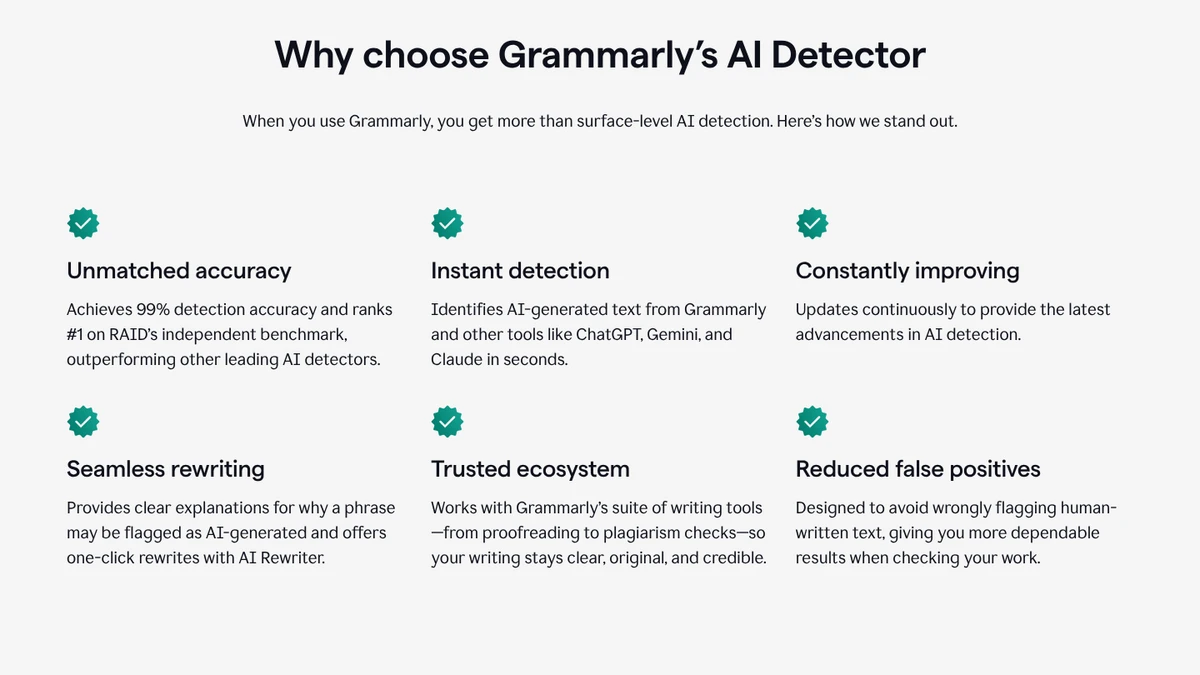
- 1The headline claim: “99% detection accuracy” and “#1 on RAID’s independent benchmark”.
- 2Newer models: the page says it identifies text from ChatGPT, Gemini and Claude.
- 3“Updates continuously”: we found no change log or model date.
- 4False flags: “designed to avoid” them, but no rate is given.
Screenshot of grammarly.com/ai-detector, Nov 3, 2026, 19:27 UTC, taken by StudyTexter. Section cropped from the full page.
The same page, its FAQ, Grammarly’s help center and its blog qualify almost every one of them. We put each promise next to the matching fine print and what we could check ourselves:
Most surprising is the training note in the FAQ. It says the model was trained on human and AI-generated texts “created before 2021”[1], before ChatGPT was released (Nov 2022). The help center and an updated blog post speak of “hundreds of thousands” of texts, without a year[2][3]. Grammarly does not say which note is current:
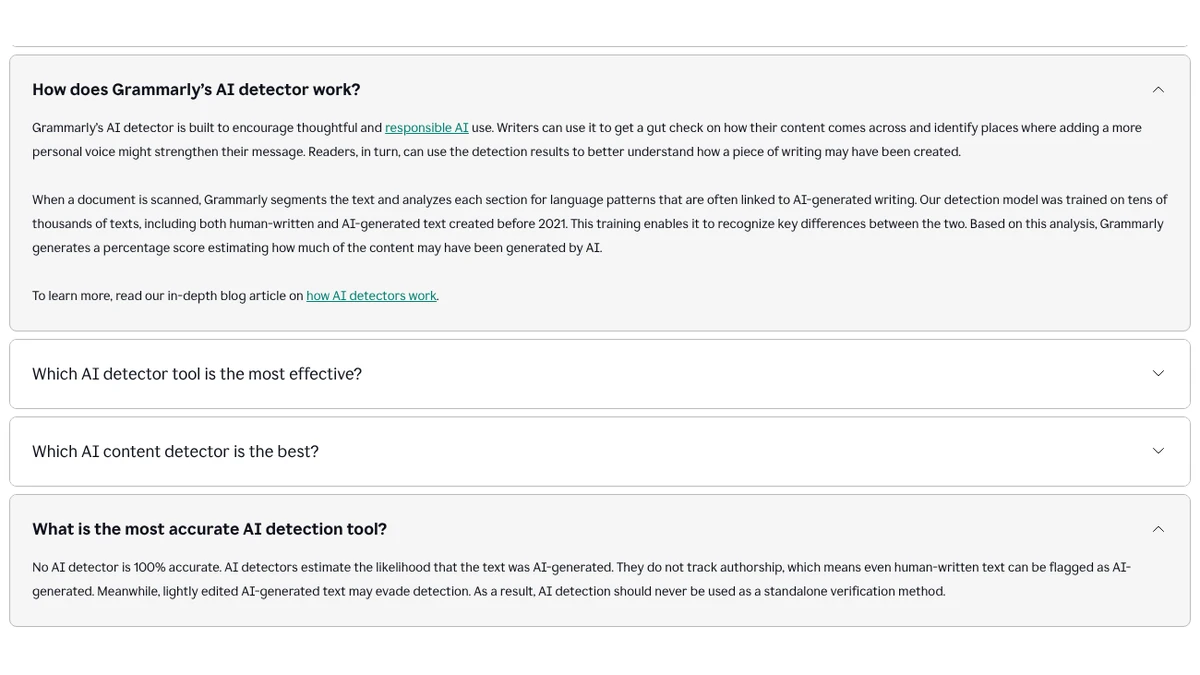
- 1Training data: human and AI-generated texts “created before 2021”, before ChatGPT was released (Nov 2022).
- 2“Tens of thousands of texts”: the help center says “hundreds of thousands”.
- 3Grammarly’s own warning: no detector is 100% accurate, and human writing can be flagged.
- 4Missed AI text: lightly edited AI text can be missed, so a detector should never be the only check.
Screenshot of grammarly.com/ai-detector, FAQ answers opened, Nov 3, 2026, 19:29 UTC, taken by StudyTexter. Cropped; white space added above and below.
Is Grammarly really #1 on RAID?
RAID is a public benchmark from researchers at the University of Pennsylvania. Developers run their detector on RAID’s test set, whose answers are not public, and submit the predictions. RAID then scores them: it counts how many AI texts a detector catches when the cut-off is set so that a fixed share of human texts, 5 or 1 in 100, is flagged[6]. Grammarly’s results were released on February 9, 2026[5].
On Nov 3, 2026, the leaderboard did not show Grammarly first. In the default view it was listed 6th of 60, with 0.999; four detectors scored 1.000, with Winston AI listed first[4]. The gap to the top is 0.001 in rounded scores. Grammarly’s blog says it “ranked #1”; we could not see how the list looked when Grammarly submitted in February 2026[3][5]. We checked 9 filter settings. Grammarly was listed first in none of them. Only with AUROC, a broader measure that is not RAID’s default, did its rounded score tie the top score:
| RAID setting (all genres) | Grammarly’s score and place |
|---|---|
| Unedited AI texts, 5 in 100 human texts flagged (default view) | 0.999 listed 6th; 4 score higher |
| Unedited AI texts, 1 in 100 human texts flagged | 0.997 listed 4th; 3 score higher |
| All attack types combined, 1 in 100 human texts flagged | 0.982 listed 14th; 13 score higher |
| AI texts rewritten by a paraphrasing model, 1 in 100 flagged | 0.957 listed 6th; 5 score higher |
| Unedited AI texts, AUROC (a broader measure) | 1.000 listed 2nd; ties the top score |
These are still strong results, and Grammarly deserves credit for submitting to an open benchmark. But they come with RAID’s limits: texts from models available in 2023, such as ChatGPT, GPT-4 and Llama 2, and genres like news, Reddit posts, recipes and poems. There are no student papers in RAID[6]. For how other detectors compare in independent studies, see our best AI detector guide.
What Grammarly said, and what testers found, 2024 to 2026
We found no peer-reviewed study that tests Grammarly’s detector. What exists is small: one media test, one vendor test, two blog posts from a college and a writing centers association. Here they are in order, next to Grammarly’s own statements:
- Grammarly launches its AI detectorAug 14, 2024Grammarly’s launch post calls AI detectors an “emerging” and “inexact” technology and warns that they are biased against non-native English writers[12].
- A writing centers association tests itNov 15, 2024The Canadian Writing Centres Association checks one paragraph: the human original scores 0%, a ChatGPT rewrite also 0% in five checks, a second rewrite 50%[10]. One text, so only an example.
- ZDNET: 40%Oct 28, 2025In ZDNET’s regular test with 5 texts (2 human, 3 ChatGPT), Grammarly gets 40%. The tester sees “no improvement since the last time I checked”[8].
- Carleton College blog: “somewhat reliably”Oct 29, 2025A student writer at Carleton College finds that the detector caught AI text “somewhat reliably”, but “struggled” with bulleted lists and brief notes. No count of texts is given[9].
- Pangram: 0 of 9 AI textsJan 7, 2026Pangram, which sells a rival detector, runs 30 free detectors on 12 texts of about 1,000 words. Grammarly labels all 3 human texts correctly, but catches none of the 9 texts from ChatGPT-4o, Gemini 2.0 and Claude 3.7 Sonnet[7].
- Grammarly submits to RAIDFeb 9, 2026Grammarly’s results appear in the RAID repository, with no paper or code linked[5]. RAID scores the submitted predictions against its hidden labels.
- Grammarly’s blog: “#1 for quality”Mar 25, 2026An updated Grammarly article says it “ranked #1 for quality, earning a 99% accuracy score”, and in the same text that English-as-an-additional-language writers are “particularly vulnerable” to false flags[3].
- Superhuman agrees to buy GPTZeroJun 24, 2026Grammarly’s parent company agreed to acquire GPTZero, another AI detector[15]. Grammarly’s footer now lists GPTZero under “Company”[1]. Grammarly’s help center names GPTZero among “other solutions” whose scores may differ[2].
- Our checkNov 3, 2026The page says “Ranked #1 in Quality”; see the RAID check above[1][4].
None of these tests is large enough to give a reliable rate. Together, they point the same way: the detector tends to call human writing human, and it often misses AI text, especially from newer models[7][8]. Pangram sells a rival detector and ranks itself first, so read its test as a vendor test[7].
How to read your Grammarly score
The free check returns one percentage, split into “Resembles AI text” and “No AI text patterns found”[1]. Grammarly’s help center explains what that number is, and what it is not:
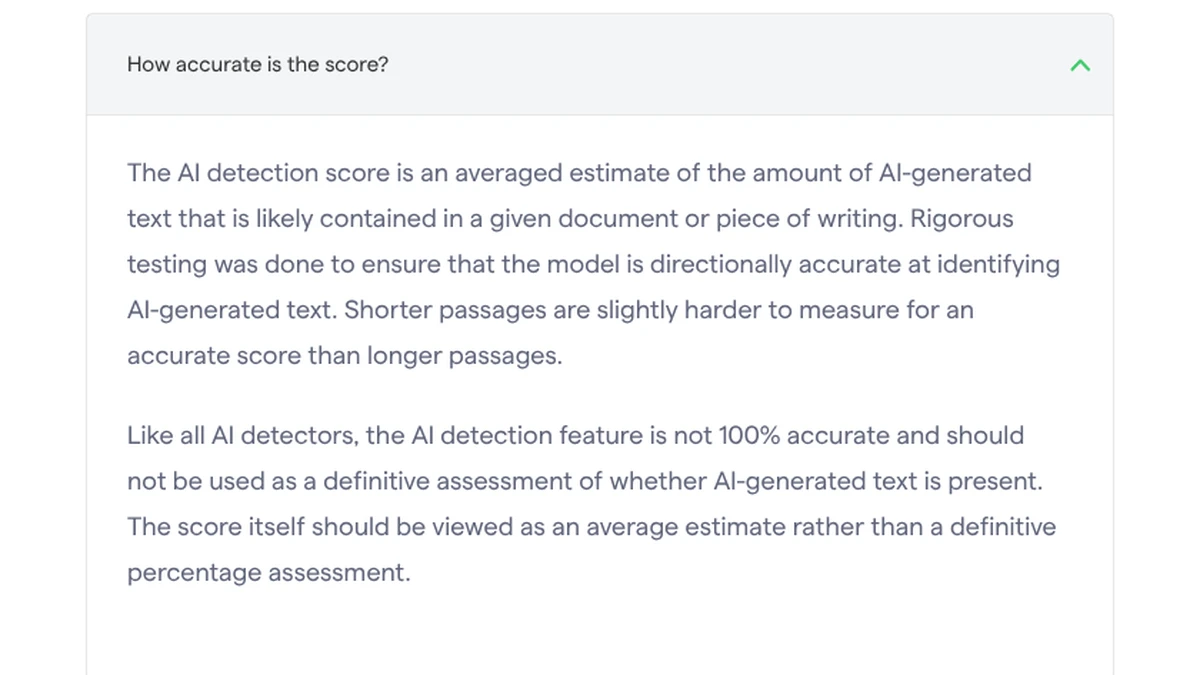
- 1“Directionally accurate”: Grammarly’s own word for how accurate its model is.
- 2Short texts: “slightly harder to measure” than long ones.
- 3Not 100% accurate and not “a definitive assessment”.
- 4An average estimate: the score is not an exact share of your text.
Screenshot of support.grammarly.com, AI Detector user guide, answer opened, Nov 3, 2026, 19:27 UTC, taken by StudyTexter. Cropped from the full page.
- It is an estimate. Grammarly splits your text into sections and checks each one for patterns typical of AI text. The result is “an average estimate rather than a definitive percentage assessment”[2].
- Short texts are less reliable. “Shorter passages are slightly harder to measure”[2]. The Carleton College writer saw the same with lists and brief notes[9].
- Your own writing can be flagged. Grammarly expects this to be “very rare”[2], but its blog says people who write in English as an additional language are “particularly vulnerable”, and so is very formal, structured writing[3].
- Grammarly’s own rewrites count as AI. If you let its Grammarly, Paraphraser or Humanizer agents rewrite your text, “it is likely” the detector flags it[2]. We looked at Grammarly’s humanizer in our Grammarly humanizer review.
What your school sees instead
You may run Grammarly to guess what your instructor will see. But if your school uses Turnitin, that is a different tool, and Grammarly says plainly that its scores may differ[2]:
| Your Grammarly check vs your school’s check | |
|---|---|
| Who runs it | Grammarly: you, before you submit[1] Turnitin: your school; the AI report is “not visible to students” by default[13] |
| Same number? | Grammarly: “scores may differ” from Turnitin, GPTZero and Copyleaks, but “should be directionally aligned”[2] Turnitin: needs 300 words; 1 to 19% show only as “*%”[13] |
| Grammar fixes | Grammarly: normal red and blue underlines “should typically not impact” the score[2] Turnitin: Grammarly corrections “in most cases” not flagged[13] |
| Rewrites by AI | Grammarly: its own rewrite agents will “likely” be flagged[2] Turnitin: generative drafting, paraphrasing and summarizing “will likely be flagged”[13] |
| What counts as proof | Grammarly: Authorship, “when enabled”, reports what was typed, generated with AI, or pasted[3] WSU, for example: a detector should not be the “sole source of support”[14] |
So a low Grammarly score does not tell you what Turnitin will show, and a high one does not mean Turnitin will agree. If you want to check sources and wording before you submit, see our Turnitin alternative guide.
- Texts: three human texts written before 2022 and three AI texts from current models, each over 300 words, plus one AI text with a short list.pending
- Run: one text at a time in the free Grammarly check, by hand, with a dated screenshot of each result.pending
- Record: the percentage, the split “Resembles AI text” / “No AI text patterns found”, and whether a second run gives the same number.pending
- Compare: with the outside tests in the timeline above.pending
Not run. Our rules for this page do not allow entering texts into other companies’ tools; if that changes, we will add a dated, manual run here.
Where Grammarly’s detector is the better choice
Use Grammarly’s AI detector if …
- you want a free check right now, on a page you can open without signing in
- you already use Grammarly in its browser extension, desktop app, Google Docs or Microsoft Office
- you want a detector that submitted its results to an open benchmark
- you want a vendor that tells you openly not to rely on its score alone
- you want Authorship to record how your text was written
Use StudyTexter if …
- you still have to write the paper and want a guided draft
- you want to accept or reject each source yourself
- you want every citation shown with its source and page number
- you want a plagiarism and AI check included with your draft
- you would rather pay once than subscribe
Grammarly also has a strong tool for a different job. If you want writing help rather than detection, see our Grammarly alternatives for students.
Grammarly AI detector vs StudyTexter
The two start at different points. Grammarly’s detector checks a text you already have. StudyTexter takes you from your topic to a full draft built on real sources, in up to 2 hours, which you then revise as the author. Every citation shows its source and page number in the Evidence View, so you can show where each claim comes from.
| Feature | |  |
|---|---|---|
| What it does | estimates how much of a text looks AI-generated | 12 guided steps from topic to full draft |
| Free | basic AI check on the web page | steps 1 to 5, up to your proposal draft |
| AI and plagiarism check | AI check free; more in Pro | plagiarism and AI check included |
| Sources | not part of the detector | 479M+ sources, you accept or reject each |
| Citations | Citation Generator and Citation Finder, separate tools | source and page number per citation in the Evidence View |
| Payment | Pro subscription, $12 a month billed annually or $30 monthly | one-time from $79, no subscription |
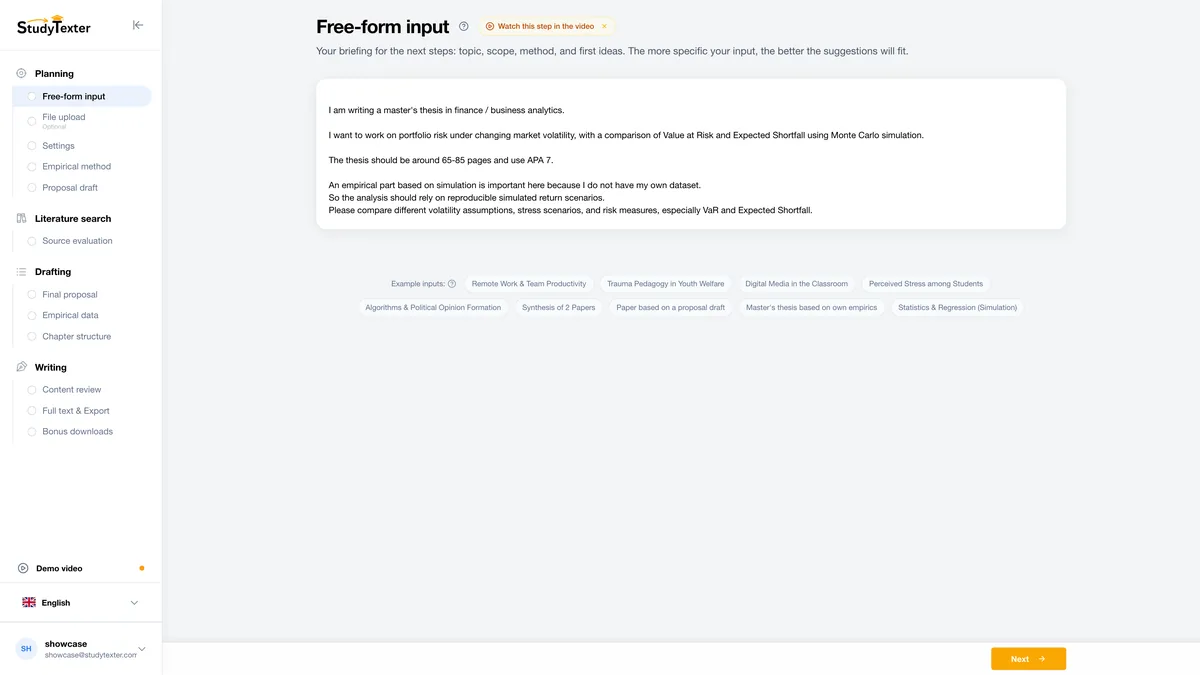
Topic in your words
Describe your topic in your own words. One sentence is enough to start.
Grammarly AI detector FAQ
Is Grammarly’s AI detector accurate?
Grammarly scores very high on the RAID benchmark (0.999 in the default view), but RAID does not use student papers or the newest AI models. In small outside tests it did much worse: 40% in ZDNET’s 5-text test and 0 of 9 newer AI texts in a vendor test. Grammarly itself says the model is “directionally accurate” and that you should never rely on a detector result alone.
Is Grammarly really #1 on RAID?
Not on the day we checked: on Nov 3, 2026, RAID’s leaderboard listed it 6th of 60 in the default view (0.999, the top four at 1.000), and first in none of the 9 settings we checked. It may have ranked higher when it submitted its results in February 2026.
Can Grammarly’s AI detector flag my own writing?
Yes. Grammarly says “even human-written text can be flagged as AI-generated”. It expects this to be “very rare”, but its own blog says writers of English as an additional language are “particularly vulnerable”. Keep your drafts and notes, so you can show how you wrote the paper.
Will Grammarly’s score match what Turnitin shows my professor?
Not necessarily. Grammarly’s help center says its scores may differ from Turnitin, GPTZero and Copyleaks, though they “should be directionally aligned”. Turnitin needs at least 300 words, shows no number from 1 to 19%, and students usually do not see its AI report.
Is the Grammarly AI detector free?
Yes, the basic check on grammarly.com/ai-detector is free. The page does not state a word limit. Grammarly Pro, at $12 a month billed annually or $30 monthly, adds the AI Detector agent, which shows which parts may sound AI-generated.
Do Grammarly’s own rewrite tools raise the AI score?
Grammarly says so: if you let its Grammarly, Paraphraser or Humanizer agents rewrite your text, “it is likely” its detector flags it as AI. Turnitin says normal grammar corrections by Grammarly were “in most cases” not flagged.
I haven’t written the paper yet. Where do I start?
StudyTexter guides you from topic to full draft in 12 steps: you accept or reject sources from 479M+, every citation shows its source and page number in the Evidence View, and a plagiarism and AI check is included. Steps 1 to 5 are free; packages start at $79, one-time. You stay the author.
Method and disclosure
We read websites, terms and reviews ourselves, back every number with a source and access date, and only add test results once we have them. Found a mistake? We correct it with a date.
On Nov 3, 2026 we read grammarly.com/ai-detector (page source and the rendered page, FAQ answers opened), Grammarly’s AI Detector user guide, two Grammarly blog posts and the Pro pricing page, and took dated screenshots. We read the public RAID leaderboard in 9 filter settings and Grammarly’s submission metadata, and the published tests by ZDNET, Pangram, Carleton College and the Canadian Writing Centres Association. Turnitin’s FAQ and Washington State University’s memo were read the same day for our pages on Turnitin and QuillBot.
We did not create an account, did not paste any text into Grammarly or any other company’s tool and did not click “Try sample text”. Our own short test is shown as a plan, not run.
The tests use different texts, versions and scoring, so their numbers are not directly comparable. RAID places follow the order the leaderboard shows; scores are rounded, so tied entries may swap. Grammarly’s headline is part of an A/B test and may look different for you.
StudyTexter sells a guided draft with a plagiarism and AI check included, so we have an interest in this topic. That is why every statement has a source and date, and we say openly where Grammarly is the better choice. Grammarly is a trademark of its owner; we use the name only to describe the product. If you find a mistake, we’ll correct it and date the change.
Changes: Nov 3, 2026 first version.
Sources
- Grammarly: Free AI Detector page, incl. FAQ“Ranked #1 in Quality”, “99% detection accuracy”, FAQ “No AI detector is 100% accurate”, training data “created before 2021” · accessed Nov 3, 2026
- Grammarly Support: AI Detector user guide“directionally accurate”, “not 100% accurate”, “very rare” false flags, scores may differ from Turnitin · accessed Nov 3, 2026
- Grammarly blog: Are AI Detection Tools Accurate or Reliable? (updated Mar 25, 2026)“hundreds of thousands” of training texts; writers of English as an additional language “particularly vulnerable” · accessed Nov 3, 2026
- RAID Benchmark Leaderboard (University of Pennsylvania)60 entries; default view: Grammarly listed 6th with 0.999; 9 settings read 19:31 and 20:59 UTC · accessed Nov 3, 2026
- RAID GitHub: Grammarly’s submission metadatareleased Feb 9, 2026; no paper or code linked · accessed Nov 3, 2026
- RAID: A Shared Benchmark for Robust Evaluation of Machine-Generated Text Detectors (ACL 2024), GitHub READMEAI models, genres, metric TPR@FPR · accessed Nov 3, 2026
- Pangram: Which AI Detector Is Most Accurate? 30 Tools Tested (Jan 7, 2026; Pangram sells an AI detector)Grammarly 0 of 9 AI texts, 3 of 3 human texts · accessed Nov 3, 2026
- ZDNET via Yahoo Tech: AI content detector test (Oct 28, 2025)5 texts, Grammarly 40% · accessed Nov 3, 2026
- Carleton College AI blog: Grammarly Revisited (Oct 29, 2025, updated Sep 11, 2026)“somewhat reliably”; weaker on lists and brief notes · accessed Nov 3, 2026
- Canadian Writing Centres Association (CWCA/ACCR) blog post on Grammarly’s AI Detector (Nov 15, 2024)own paragraph 0%, ChatGPT rewrite 0% five times, second rewrite 50% · accessed Nov 3, 2026
- Grammarly Pro$12 per member per month billed annually, $30 billed monthly · accessed Nov 3, 2026
- Grammarly blog: From AI Detection to Authorship (Aug 14, 2024)“an emerging” and “inexact” technology · accessed Nov 3, 2026
- Turnitin Guides: AI writing detection capabilities FAQsGrammarly corrections “in most cases” not flagged; 300 words minimum; report “not visible to students” · read for our Turnitin AI detection page · accessed Nov 3, 2026
- Washington State University, Office of the Provost: Cancellation of Turnitin AI detection software (memo, Feb 11, 2026)33% of AI cases before the Academic Integrity Hearing Board “not responsible”, detector not the “sole source of support” · accessed Nov 3, 2026
- SiliconANGLE: Grammarly parent Superhuman buys AI detector GPTZero (Jun 24, 2026)Superhuman “has agreed to acquire GPTZero” · accessed Oct 11, 2026
- Trustpilot: Grammarly3.1 out of 5 from 10,473 reviews, whole company · accessed Oct 11, 2026
Read next
Brands and logos mentioned belong to their owners and are used for identification only. They are not affiliated with StudyTexter.